
Living with a Dog and Cats: How Hodu and Four Cats Share a Home
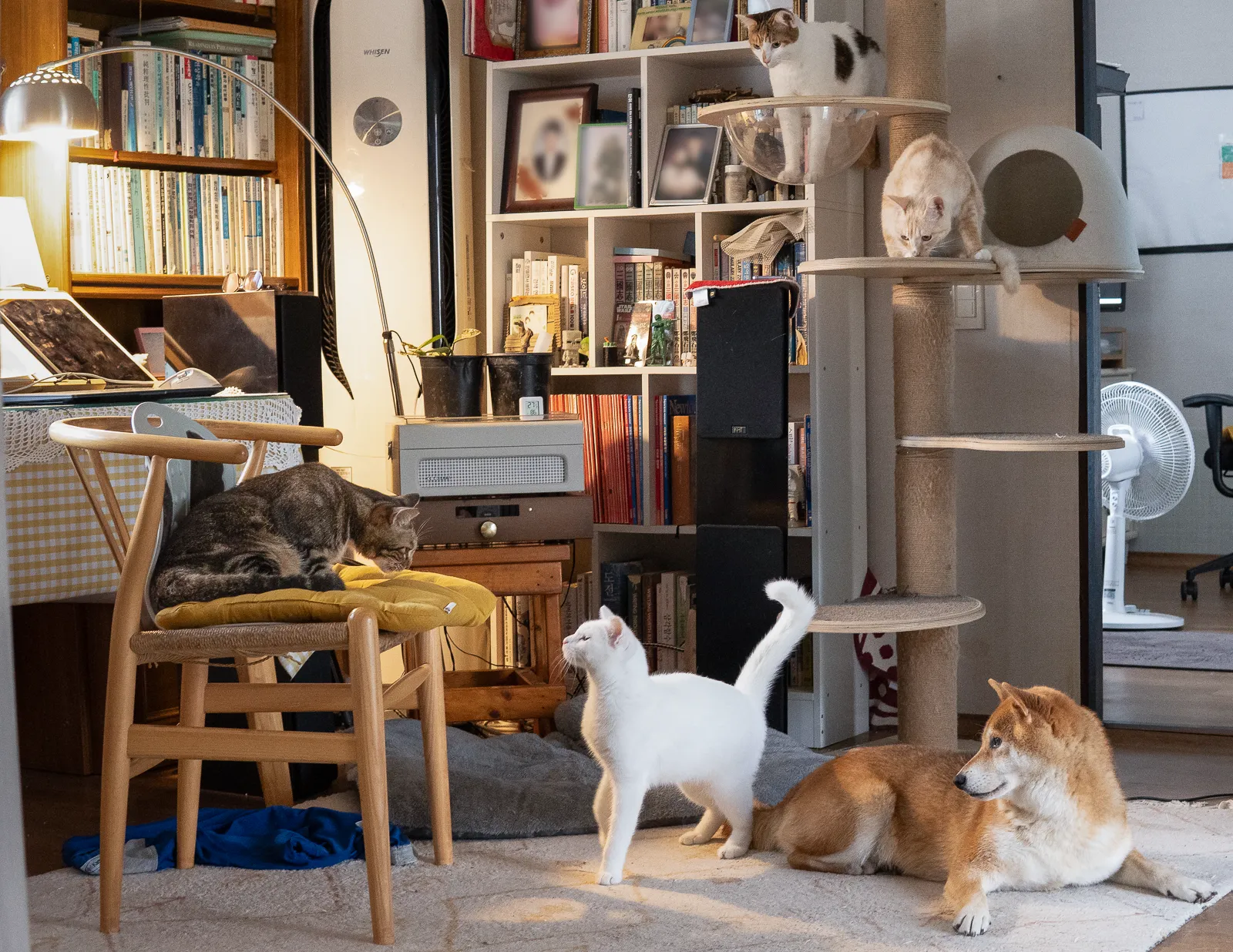
When the house is quiet, Hodu and the cats each find a place to rest.
Hodu may lie on the floor or watch the world outside the front door. The cats might be on a cat tree or a bookshelf, sitting in the sun by a window, or looking outside through the screen door. Even when they sleep in the same room, they usually leave some space between one another. Sometimes they lie close enough for their bodies to touch.
Most of the time, they do not seem especially interested in one another.
There was a time when I would not have thought of this as coexistence. I used to assume that dogs and cats naturally had difficulty living together.
A tiny kitten Hodu found one morning began to change that assumption.
The Day Hodu Found Kant Before His Eyes Had Even Opened
On the morning of July 26, 2024, I was walking Hodu when we found a very young kitten in a parking area.
His eyes were still closed, and there was a wound on his side. He was tiny, but his cries were surprisingly strong. I placed him carefully in the small bag I normally used to carry Hodu’s ball, a towel, and waste bags, and brought him home.
That kitten was Kant.
My younger daughter was on school break at the time, so I asked her to take Kant to the veterinary clinic and care for him until I came home from work.
I had not planned to keep him. At first, I thought that once his wound healed and he was healthy, perhaps he could be taken to an animal shelter. Looking back, that was an idea formed when I knew almost nothing about what such a young kitten actually needed.
Eventually, with my wife’s agreement, Kant stayed.
No one in my family had experience raising a cat. I also vaguely assumed that dogs and cats were natural adversaries and were likely to fight.
Against that background, Hodu showed an extraordinary amount of interest in Kant.
I Could Not Tell Whether Hodu’s Interest Was Curiosity or Aggression
Hodu followed Kant constantly. She tried to get close enough to sniff him, pushed her nose toward him, and attempted to make physical contact.
The problem was that I had no idea how to interpret what I was seeing.
I could not tell whether Hodu was simply curious about a small unfamiliar animal or whether her behavior could become aggressive toward a cat.
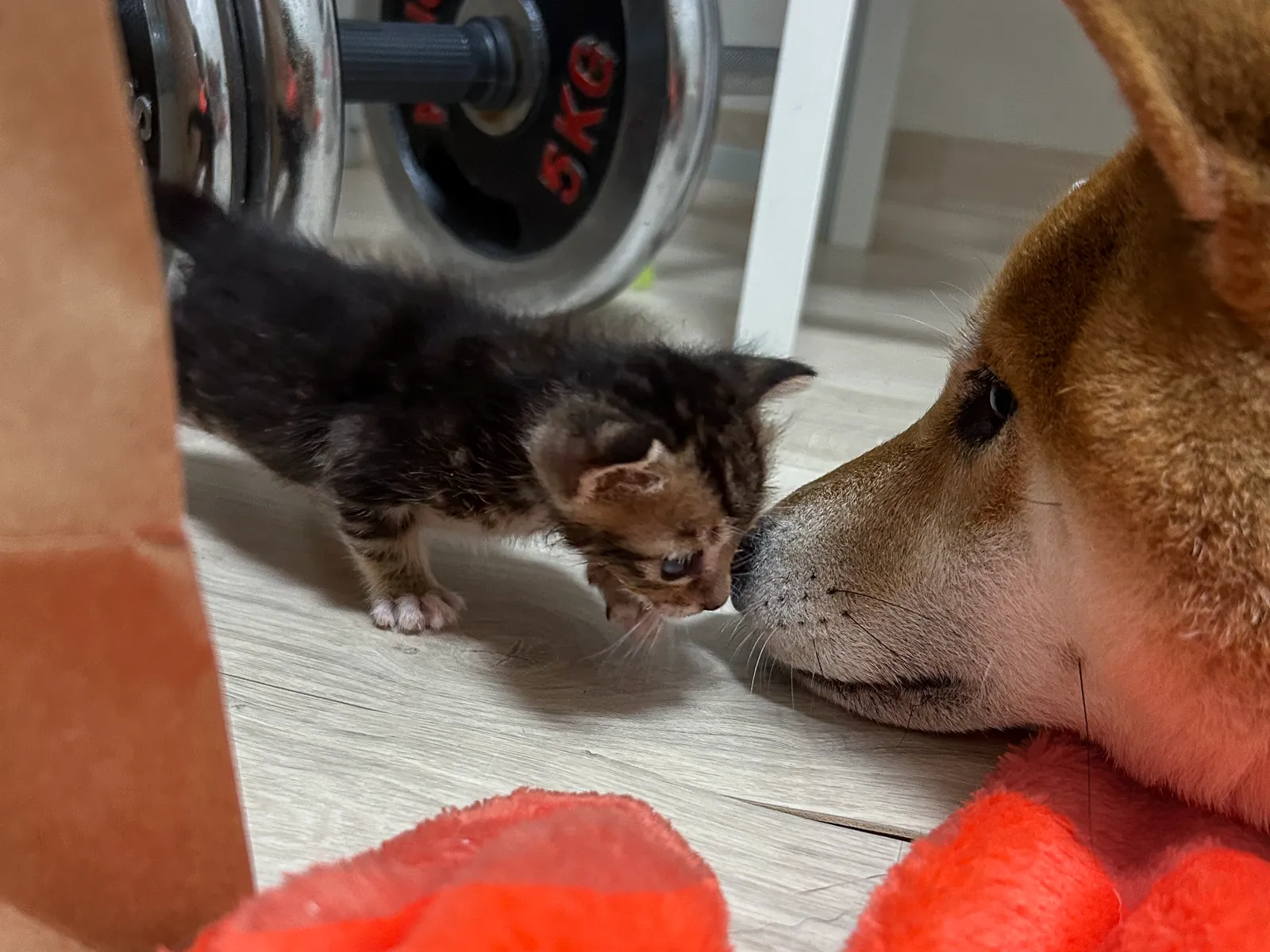
So I chose to protect Kant first.
I bought a sufficiently large two-level cage and kept Kant there. When nobody was home, I moved the cage into a separate room so Hodu could not reach him. When someone was home, Kant spent increasing amounts of time outside the cage, allowing his contact with Hodu to increase gradually.
At the time, I did not even think of this as a structured introduction process.
When a problem appeared, I searched for information and responded with whatever I had managed to learn.
There were other moments that showed how little I knew about cats. I bought what I thought was milk for a newborn kitten, only to discover later that it was a supplemental milk product intended as a treat for adult cats. At first, I even held Kant on his back with his belly and head facing upward while feeding him, much as someone might feed a human baby.
That was how unprepared I was while trying to bring a dog and a kitten into the same home.
As Hodu’s Interest Faded, They Spent More Time Together
Fortunately, Hodu’s intense interest in Kant did not last very long.
As Kant spent more time outside the cage and the two encountered each other repeatedly, Hodu gradually stopped following him so closely.
I have a video recorded on August 29, 2024.
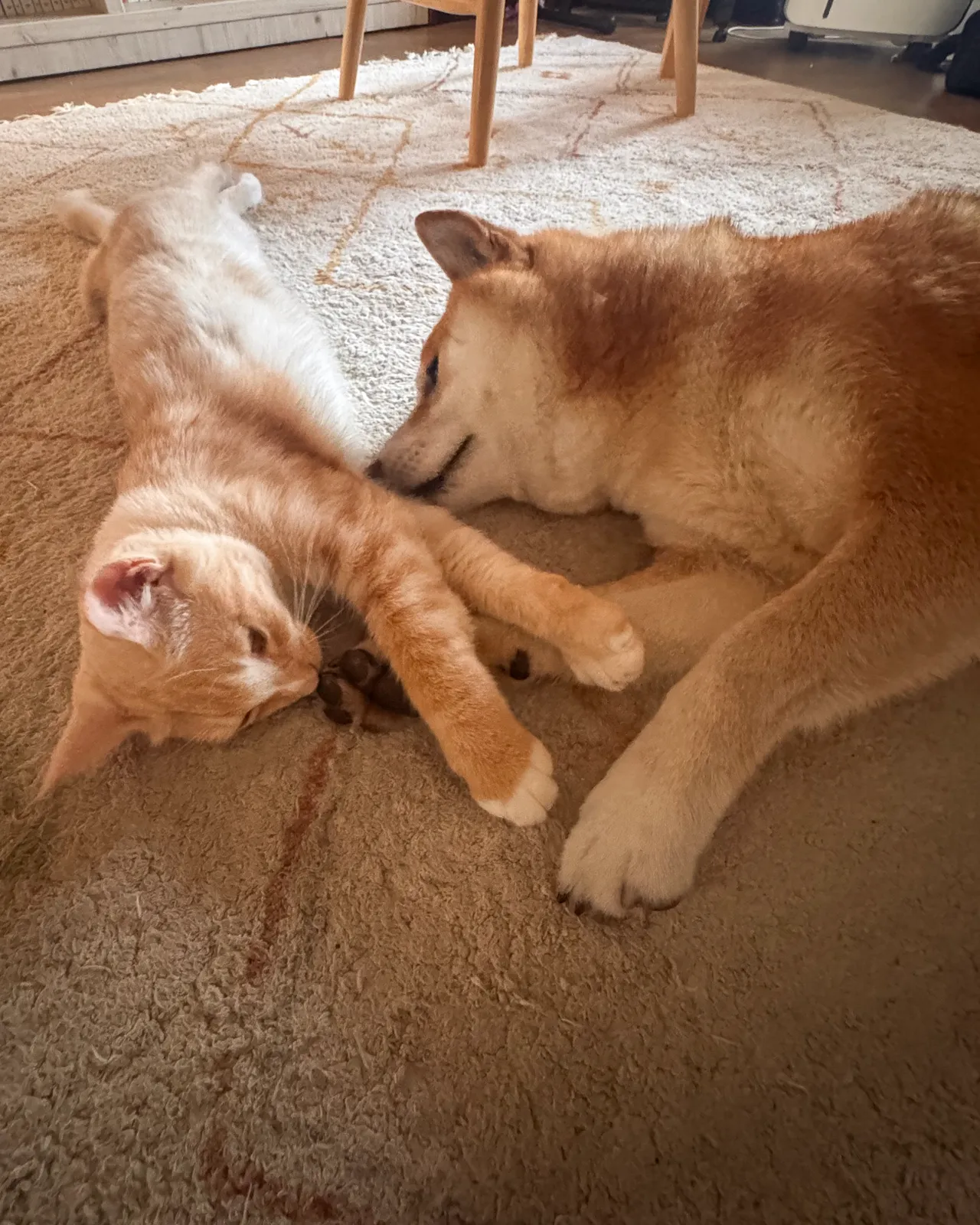
Hodu is lying quietly on the floor. Young Kant approaches her and taps at her with his forepaws, trying to play. Hodu barely reacts.
That scene stayed with me.
At first, I had been tense whenever Hodu approached Kant because I did not know what might happen. With time, it became ordinary for Kant to be the one approaching Hodu.
Another video, recorded about two months later on October 21, 2024, shows something similar. Kant is beside Hodu as she lies on the floor, using his forepaws to play with her tail.
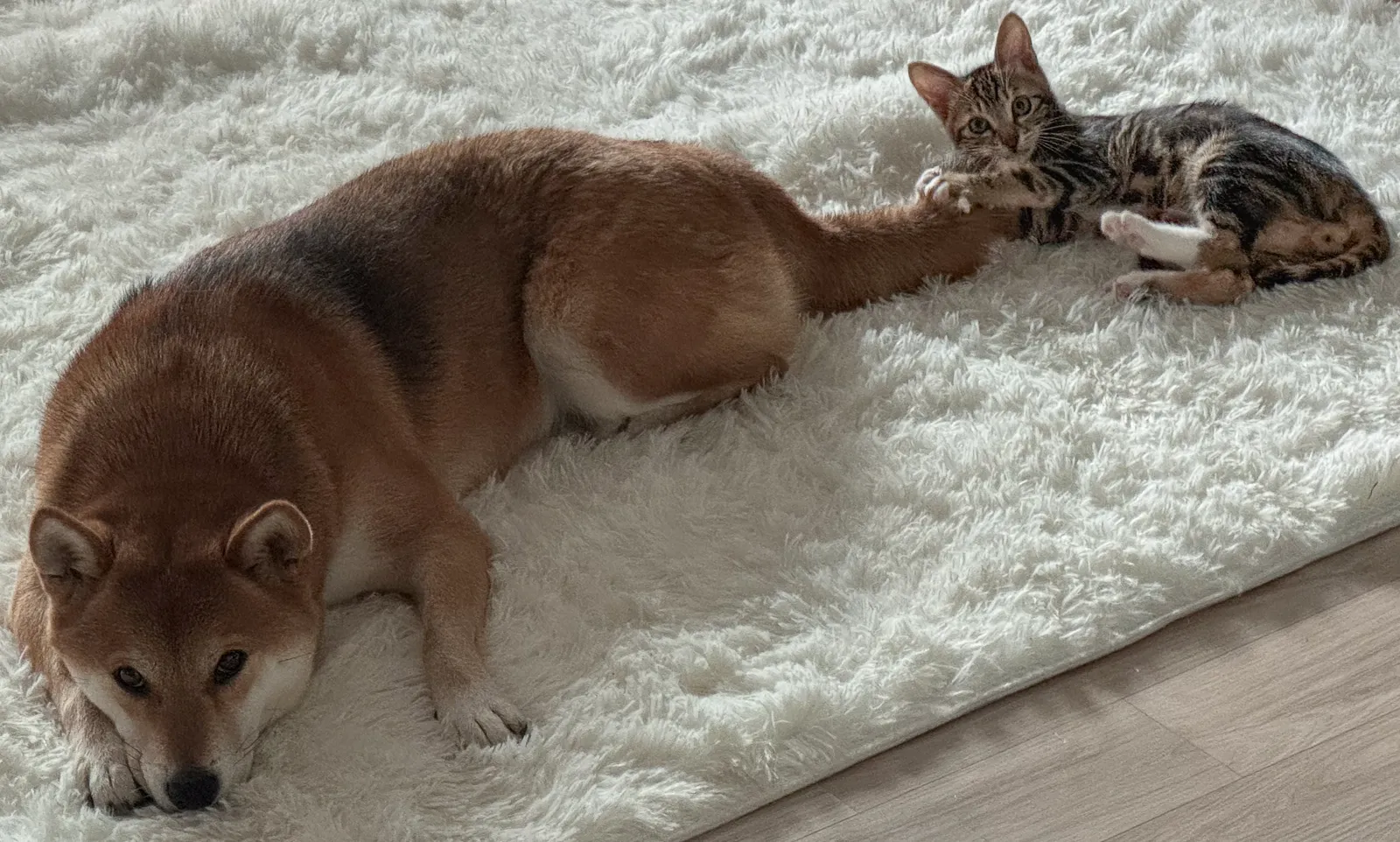
Later, Kant sometimes slept close to Hodu or rested with his body touching hers.
I do not remember a period when Kant showed any clear, continuing wariness of Hodu. Kant did not open his eyes until several days after coming to my home. By the time he began seeing the world, Hodu was already part of his surroundings.
At the time, my family said that Hodu seemed to have “accepted Kant as family.”
Now, I think there is no way to know exactly what that meant to Hodu.
What I could observe was simpler: Hodu did not continually threaten the young kitten, and the intense interest she showed at first diminished considerably with time.
I later saw a similar pattern when Hodu encountered other animals.
On a few occasions, Hodu and I found young crows or magpies that could not fly during our walks, and I temporarily cared for them before transferring them to wildlife rescue care. Hodu initially wanted to approach, sniff, and continue watching those birds as well.
I have seen something similar with young cats living outside more recently.
Hodu often becomes highly interested in a small unfamiliar animal for a while. As the animal becomes familiar, that interest tends to fade.
When Fooku, Nori, and Witty Came Into the House
When Fooku arrived, Hodu’s reaction was very similar to what I had seen with Kant.
At first, Hodu kept watching Fooku and tried to approach her. With time, that interest also diminished.
I did not observe Fooku continuing to avoid or remain wary of Hodu.
Today, Fooku often approaches Hodu when Hodu returns from a walk or while they are waiting for food and rubs her face or body against her. Hodu occasionally growls during these encounters, but they do not develop into serious conflict.
Nori and Witty were slightly different.
Neither cat was completely unfamiliar to Hodu before moving indoors.
When Nori lived outside, she approached Hodu with very little hesitation. The two sometimes even napped with their bodies touching.
Witty behaved differently. She stayed in Hodu’s vicinity but generally did not allow Hodu to approach too closely.
Before they became indoor cats, both Nori and Witty also spent time in the space between the entrance and the interior of the house, where they could avoid the cold and eat. Hodu therefore had opportunities to see and smell them before they were fully introduced indoors.
After their tests were completed and their isolation period ended, I opened the door and Hodu again showed interest in the two cats.
But it did not last as long as it had with Kant or Fooku.
After briefly investigating them, Hodu returned to her usual routine.
By then, I was different from the person who had first brought Kant home. The fact that Hodu was meeting another cat no longer worried me by itself.
I had already watched Hodu and Kant learn to share a home.
There Is No Place in My Home That Belongs Only to Hodu
Today, Hodu and the four cats share almost every floor-level space that Hodu can access.
One thing I find interesting is that I have yet to identify a place that Hodu insists on treating as exclusively hers.
Even the bed she has used for a long time is no exception.
Witty and Nori often use it. Witty sometimes sleeps there at night.
Fooku uses the bed as well.
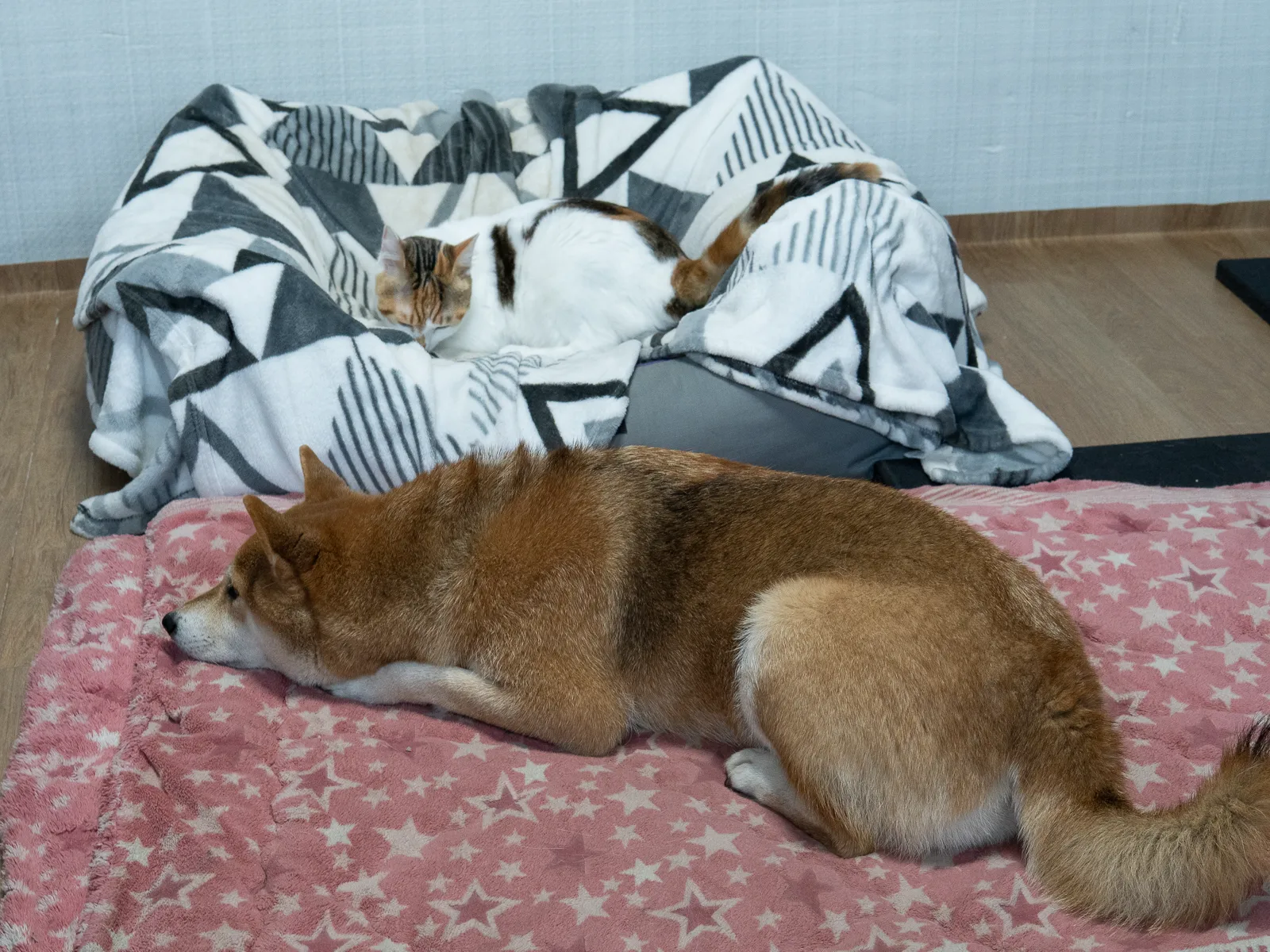
I have never seen Hodu approach a cat already lying there and force the cat out to reclaim the bed.
She simply finds somewhere else.
I see something similar among the cats. When one animal has already occupied a resting place, I rarely see another try to take it by force.
Fooku or Nori may also approach Hodu while she is sitting or lying down and settle close enough for their bodies to touch.
Most of the time, Hodu barely reacts.
There are also many vertical spaces available to the cats: cat trees, bookshelves, desks, and other surfaces Hodu cannot reach.
If a cat wants to increase the distance from Hodu, doing so is easy.
Yet I rarely see the cats use those places specifically to escape from her.
There are exceptions. Hodu occasionally becomes excited and chases one of the cats. A cat may roll onto its back and use its forepaws to stop her, and Witty sometimes moves up to a higher place to avoid Hodu.
But these situations are occasional exceptions rather than the pattern of everyday life.
A Guide to Multi-Cat Households: Creating a Home Where Cats Can Live Together Comfortably discusses in more detail why I consider access to resting places, resources, and the ability to move away important in a home shared by several cats.
Sharing Resources Does Not Mean Everyone Has to Use Them in the Same Way
There are three water stations in the house.
Hodu and all four cats use the same ones.
Hodu usually finishes her food before the cats, but she does not go over and take their food.
If anything, the reverse has happened. When Nori was younger, she sometimes tried to eat Hodu’s food.
Even now, when a meal begins, Nori often puts her nose toward Hodu’s bowl almost as if it were part of a routine. Hodu rarely makes much effort to stop her.
That does not mean I leave every resource completely unmanaged.
Kant and Fooku naturally chose the cat tree as their eating place and continue to eat there. Nori eats in a separate space because she tends to finish quickly and then try to eat the other cats’ food.
Mealtimes with the animals are among the parts of the day I enjoy, but they also require close attention. I need to make sure that each animal actually eats the amount intended for them.
By the time everyone has finished and I have cleaned up, I sometimes feel tired.
Living together does not mean that every resource has to be shared without limits.
Things that can be shared safely can remain shared. When separation is needed to protect an individual animal’s needs, that needs to be managed.
I see that as part of living together too.
Each Cat Keeps a Different Distance From Hodu
I do not see an obvious hierarchy or pattern of favoritism between Hodu and the four cats.
There is no cat Hodu clearly seems to favor, and none she appears to especially dislike.
Still, each cat relates to Hodu differently.
Fooku initiates physical contact with Hodu most often.
She may rub against Hodu when Hodu returns from a walk or press her face against Hodu while waiting for food.
Nori does not show the same kind of repeated interest in Hodu that Fooku does, but she appears to show very little wariness around her. She often naps close by.
Witty is different.
I have almost never seen her deliberately approach Hodu to rub against her. When the distance becomes uncomfortable for her, she may warn Hodu with a forepaw. This happens most often when everyone is waiting for food and the animals end up standing closer together than usual.
Hodu generally moves away rather than responding in kind.
I no longer see these differences as a problem.
Fooku’s way of being close to Hodu is fine. Witty’s preference for greater distance is fine too.
They do not all need to become close in the same way.
What matters more to me is whether any relationship continually interferes with an animal’s ability to go about daily life.
I Allow Freedom Until It Begins to Interfere With Someone Else’s
Today, I rarely need to intervene in Hodu’s relationships with the cats.
But that does not mean I never intervene.
Hodu occasionally mounts Kant or Nori, and sometimes she becomes excited for reasons I cannot clearly identify and chases one of the cats.
In the past, I would immediately tell Hodu to stop. If she did not respond, I would physically pick her up and end the behavior.
Now I first look at how the cats are responding.
I do not think every behavior Hodu wants to perform needs to be stopped simply because she wants to do it.
But if another animal appears to experience that behavior as threatening, or clearly shows that the interaction is unwanted, the situation changes.
At that point, I believe limiting Hodu’s behavior is part of my responsibility as the caregiver.
I think of this less as punishment and more as intervention when the freedom of one animal begins to conflict with the freedom of another.
Hodu should be able to behave in ways that are natural to her.
The cats should also be able to move away from contact they do not want.
When the freedom of one animal begins repeatedly interfering with another animal’s choices, the responsibility for restoring that balance ultimately belongs to the person caring for them.
A Good Outcome Does Not Mean I Handled the Introduction Well
Looking back at Hodu and Kant’s first introduction, there are some things I still think I did well.
Buying a sufficiently large cage immediately was one of them.
It allowed Kant to remain physically protected even when someone could not watch him every second, while still allowing Hodu and Kant to see one another.
Given how little I knew at the time, creating a physical barrier against the most obvious risk was a reasonable decision.
But if I faced the same situation today, I would do many things differently.
For example, I would begin by helping Kant become familiar with Hodu’s scent, perhaps by giving him a blanket Hodu had used.
More importantly, I would first learn and follow established introduction practices rather than improvising as I went.
In the end, Hodu and Kant did not develop serious problems.
Kant still does not appear afraid of or hostile toward Hodu, and the two can rest close together without obvious tension.
That does not mean I believe I handled their introduction well.
I think their temperaments happened not to collide strongly, and I was also fortunate.
Luck is something I cannot control.
Fooku’s arrival made me think about this again.
Kant and Fooku also began with a difficult first reaction and eventually developed a much closer relationship than I expected. But after that period, I also began to notice changes in Kant. He spent more time quietly by himself than he had before.
Kant and Fooku’s Introduction Story records their first reactions and the changes in their relationship in more detail.
I do not know what caused the changes I saw in Kant.
I cannot say that they were caused by the introduction to Fooku.
But that experience made one idea much harder for me to ignore.
Animals cannot tell me in words what stress they are experiencing or how one of my decisions has affected them.
The consequences of care also do not always become visible immediately.
So I no longer think a good outcome is enough to prove that the process leading to it was also good.
Care should not depend on luck.
Not knowing exactly what might happen is not a reason to do nothing. It is a reason to look for plausible risks and prepare for them.
I now consider that part of a caregiver’s responsibility as well.
What “Living Well Together” Means to Me Now
When Hodu and Kant first began sharing a home, I mainly worried about whether they would fight.
Now I look at different things.
Can one animal walk over to the water without hesitating because another animal is there?
Does each animal have somewhere to rest?
Can they increase the distance from one another when they want to?
Do they have to remain alert every time another animal approaches?
And when nothing is happening, can each of them simply get on with their own life?
Most of the time, Hodu and the cats are indifferent to one another.
Hodu watches the world outside the entrance. The cats look outside from windows or higher places.
One sleeps. Another walks around. Another lies in the sun.
Sometimes they sleep with their bodies touching, but most of the time they do not need to.
I no longer think this kind of indifference is a bad thing.
If each animal can reach the resources they need, has somewhere to withdraw, and does not have to keep giving up ordinary activities because of another animal, then not having to pay constant attention to one another may itself be one sign that they are living well together.
That does not mean I can simply leave everything alone.
The peaceful life I see today was never something that could be guaranteed automatically.
I still need to intervene when necessary and continue watching for signs that one animal is uncomfortable.
I no longer think successful life between a dog and cats means making them like one another.
To me, it means sharing a space where each animal can continue living in their own way, can move closer or farther away, and does not have to keep sacrificing everyday life because of someone else.
And when that balance breaks down, it means the person responsible for them steps in.
After living with Hodu and four cats, that is the form of coexistence I have come to recognize.