
Do Cats Really Have a Pecking Order?
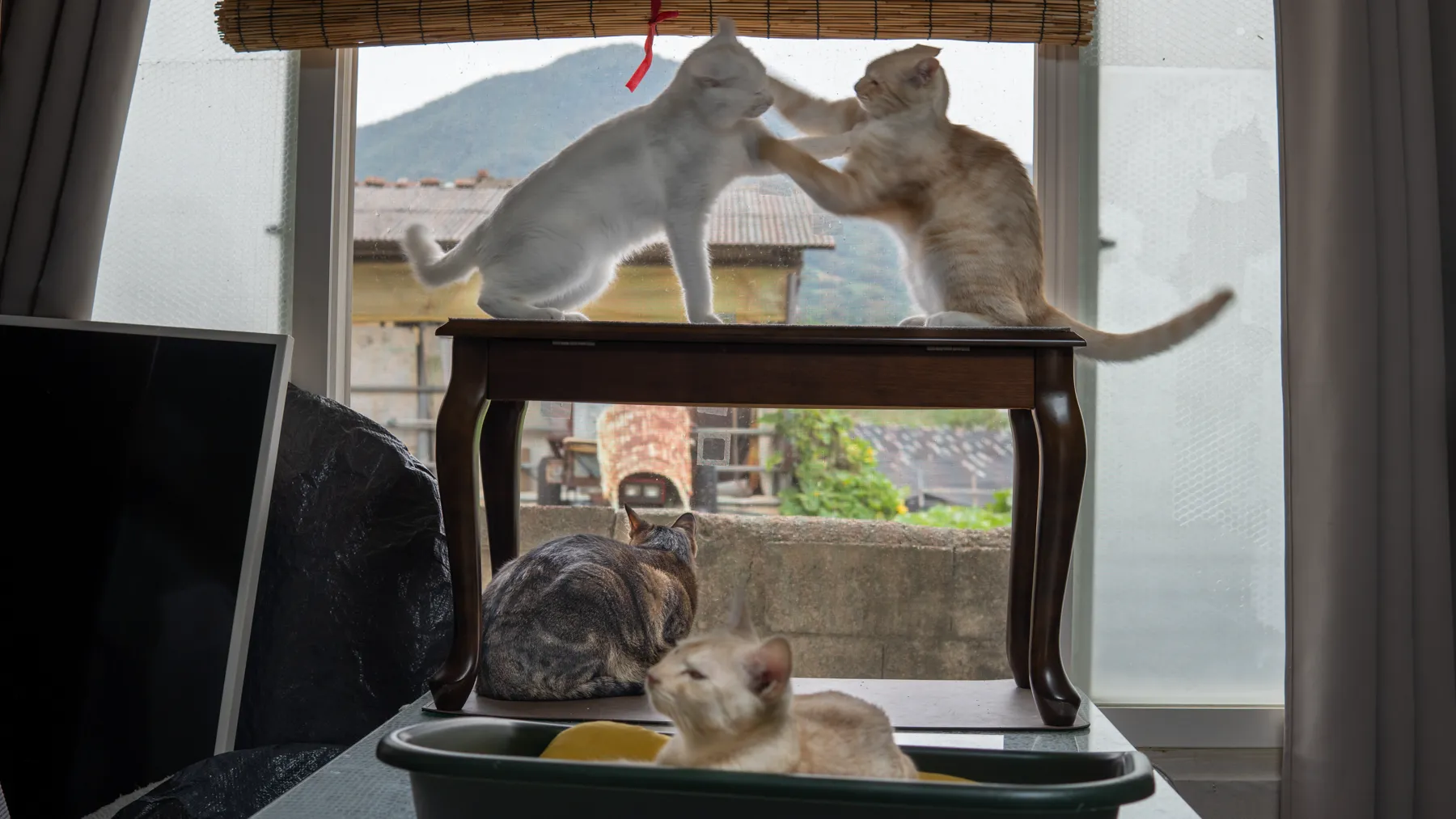
Watching my five cats, I asked the question again
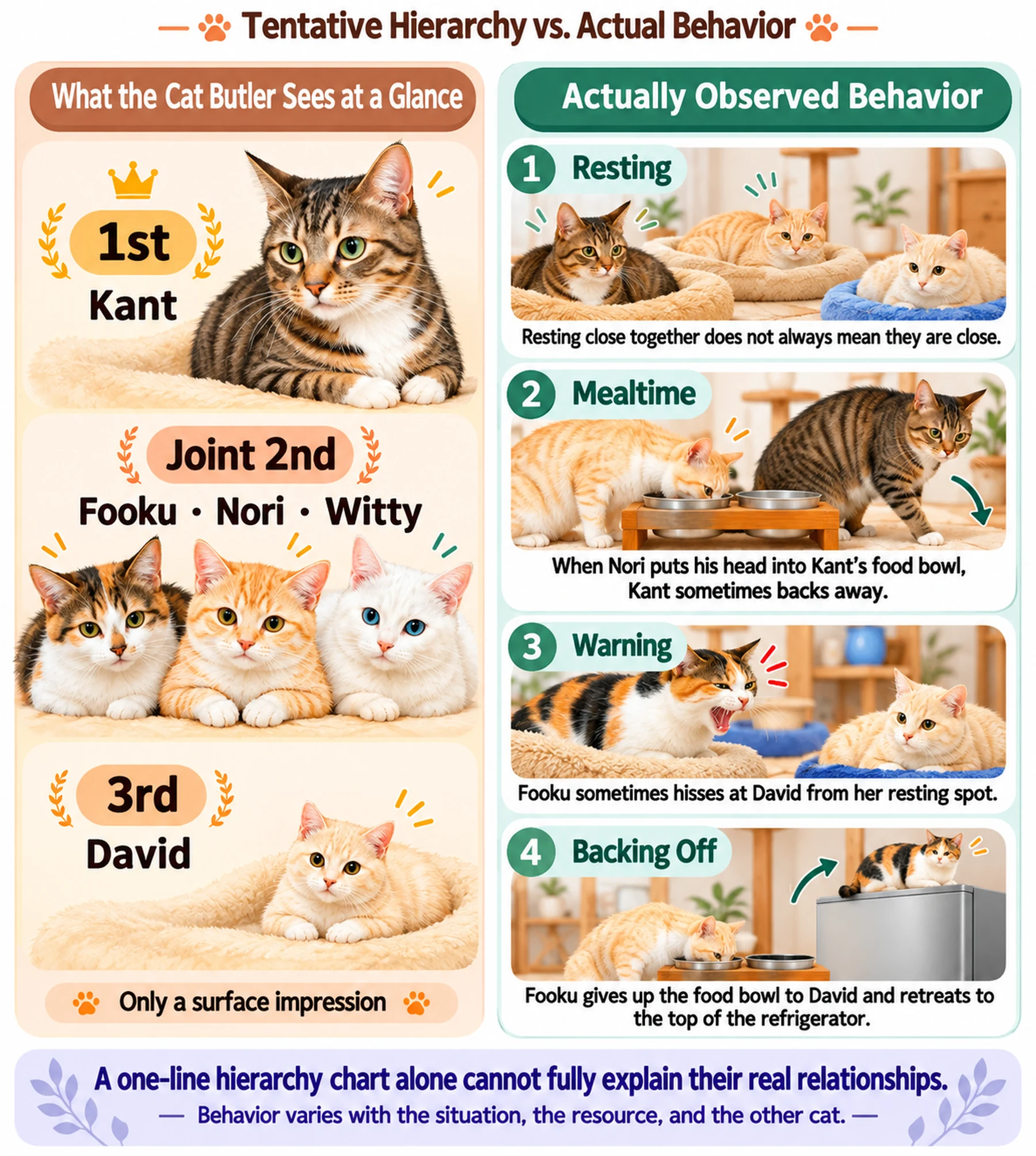
If I had to rank my five cats, I wouldn’t hesitate for long. Kant goes first. Fooku, Nori, and Witty tie for second, and David, the youngest, comes third.
I’d have my reasons. Kant hisses at Nori, Witty, and David, and sometimes takes a swipe at them. I’ve never seen it go the other way. Not one of them has ever raised a paw to Kant, or so much as hissed at him. Apart from the rare times Kant is in the mood to play, Nori, Witty, and David hardly ever go up to him and press against him anymore. I suppose they’ve understood, very clearly, that he doesn’t want them to. It’s Kant, it seems, who decides who gets how close.
But take that ranking to mealtime, and strange scenes turn up almost at once. Kant, my number one, gives up his bowl to Nori when Nori barges in, and walks away. Before we moved, when Fooku was still small, she would push her head into the bowl Kant was eating from and demand a share, and Kant would step aside without a single warning. That same Fooku now quietly steps aside when David, the youngest, sticks his head into her bowl. And yet, when she’s resting and David starts pestering her, she hisses at him.
So the ranking above is only my impression from the outside. Whether cats really have a hierarchy, and if they do, what it means to them, gets harder to settle the longer I watch. At the very least, it looks quite different from hierarchy among people.
This is a record of looking again, with that question in mind, at how my five cats and the cats of our alley behave. Nothing I’ve seen can prove that cats have a hierarchy, or that they don’t. But a few scenes set side by side may show what a one-line ranking leaves out.
If Kant is the one hissing, why is Kant the one who leaves?
Apart from Fooku, Kant has almost nothing to do with the other cats. It’s been that way since Nori and Witty first came to live indoors. To my eye, Kant treated them coldly. If they came close, he hissed. If they still didn’t leave, he raised a paw and threw a punch. Nori, good-natured as he is, kept going up to Kant, curious, time after time, and every time the answer was a hiss. Fooku was the opposite. From the first day the three of them shared a room, she was running around and playing with the two newcomers. How Nori and Witty came in from the yard is a story I’ve told in Bringing Stray Cats Indoors.
What’s interesting is what happened next. When Nori, Witty, or David came close, Kant would hiss and even raise a paw in warning, yet he rarely held his ground to the end. Usually it was Kant who got up and moved somewhere the others weren’t.
That didn’t look to me like Kant losing his spot. I thought he left to avoid a clash. It certainly wasn’t kindness. It looked closer to displeasure. If I had to put it into human words, it would be the old Korean quip: “You step around dung because it’s filthy, not because you’re afraid of it.”
Thinking back, I never saw Nori or Witty try to take Kant’s spot, either. To my eye, they went that way because they had somewhere to go, not because of Kant. Kant may have felt his place had been taken. But from the outside, it looked less like one cat taking a spot from another than this: Kant happened to be in Nori’s and Witty’s path, and, uncomfortable with them so close, he moved away on his own.
In fact, I have never seen one of our cats take another’s bed or resting spot. Each has favorite places, but none of those places belongs to any one cat, so the others use them too, and whoever gets there first is left alone. No one has ever blocked a passage or kept another from the water bowls or the litter boxes. My intuitive judgment, from living with them, is that that sort of thing just isn’t how they are with each other.
Kant has mellowed a little lately. I feel he’s somewhat less tense with Nori, Witty, and Nori’s younger brother, David, than he was at first. Quite often Kant, Nori, and David fall asleep together on a blanket I’ve spread out. Usually Kant is already lying there, Nori and David settle in nearby, and Kant stays put. They keep more than 50 centimeters (about 20 inches) apart.
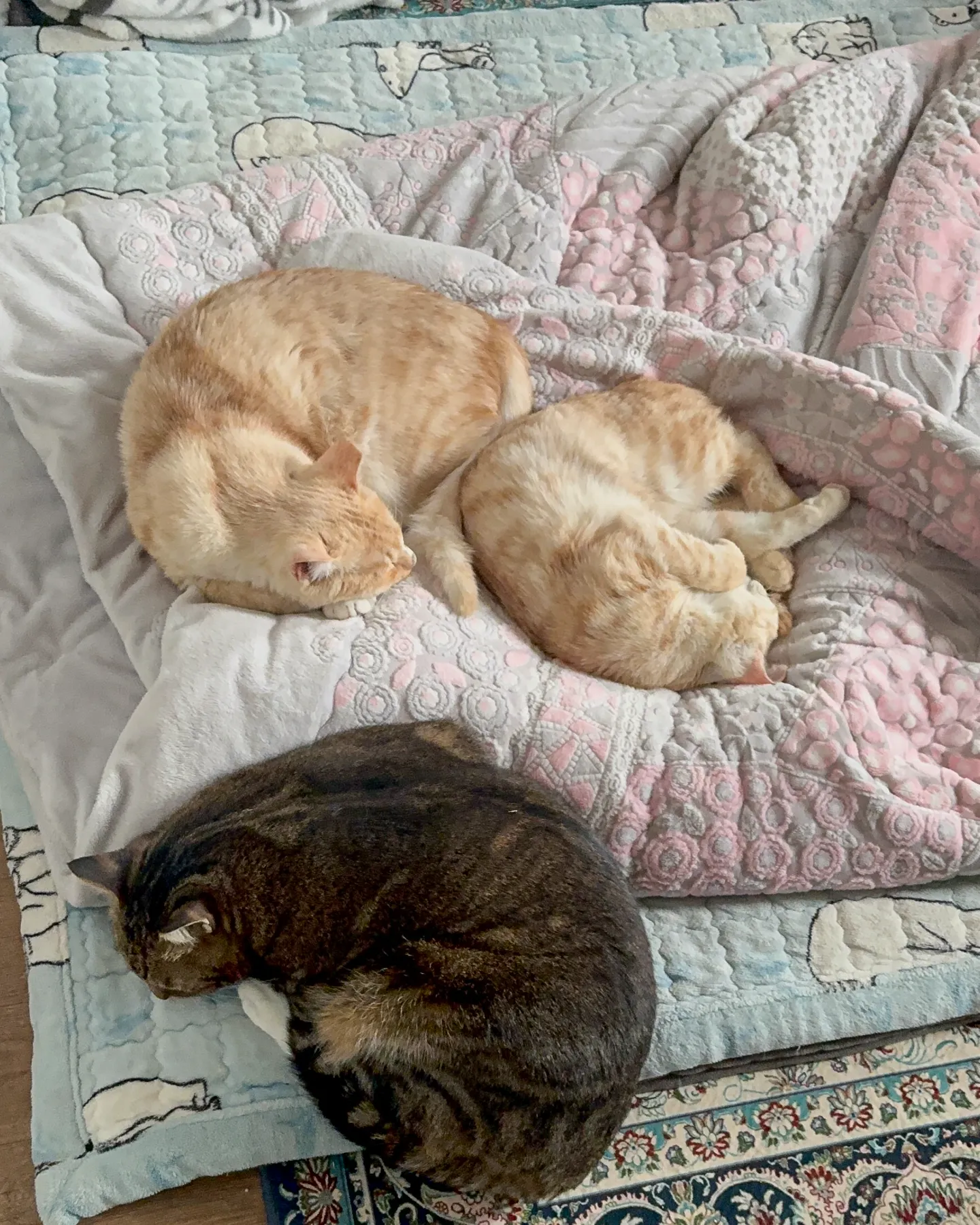
Seeing them like this, I feel that our cats respect one another’s space. Food is the one exception.
Kant hisses and still loses his dinner: the first crack in the ranking
Kant eats very slowly, about three times slower than the others, by my reckoning. Nori is the opposite. He wolfs down his share with astonishing greed, then heads for Kant’s bowl while Kant is still eating. If I don’t stop him, he buries his face in it and eats.
Kant hisses and smacks Nori on the head with a paw, and Nori pays no attention. He takes the blows and keeps eating. If I don’t step in right away, Kant gives up the bowl and walks off. It still happens regularly. Kant warning Nori off somewhere else and Nori going after Kant’s food can both happen on the same day, quite separately.
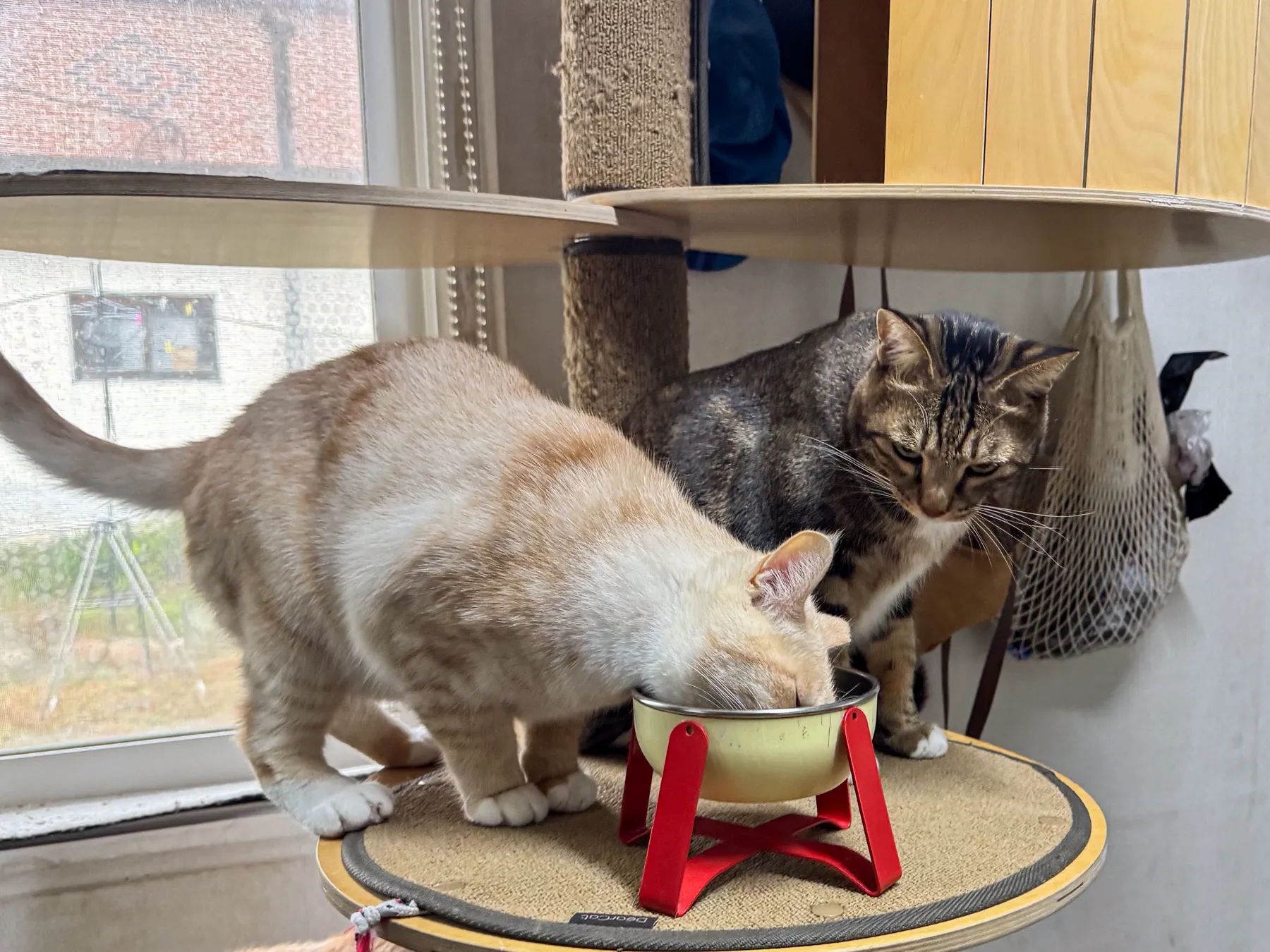
Through the lens of the ranking, it’s a strange scene. If Kant really is number one, why can’t he hold on to his own dinner? Is he giving way to Nori because he sees Nori as weaker? I’m not so sure. Even if it is giving way, I can’t know what it means to Kant.
It’s the same from Nori’s side. He puts his mouth to other cats’ bowls too, even to the bowl of Hodu, our dog. But I’ve never seen him threaten anyone to claim the right to eat first. Hissed at or swatted, he just eats. I can’t read this as a bid for rank or priority. It looks to me like nothing more than wanting more food and helping himself.
Add David, and the picture gets more complicated. He too heads for other bowls once he’s finished his own, but he isn’t bold like Nori, and he often hesitates. The bowl he actually puts his head into is usually Nori’s. I’d guess that’s because he feels at ease with Nori. When he goes near Kant’s bowl, where Kant is still eating, Kant hisses, and David usually wavers, gives up, and wanders off. At the other cats’ bowls, too, unless someone moves aside for him, he doesn’t dare push in. He just circles. How that will change as he grows, I don’t know.
Try to put these scenes in a single line, and it gets confusing. Kant hisses and David usually backs off, but Nori doesn’t. David can’t put his head in Kant’s bowl, but he does in Nori’s. And Nori eats Kant’s food. Line them up by who outranks whom, and somewhere the order gets tangled. At the food bowl, their relationships look less like a ladder than like a separate line drawn between each pair of cats.
I’ve written about these mealtimes, and how I step in, in A Guide to Multi-Cat Households. Here I only want to look at what they say about the word “hierarchy.”
Kant gave way to young Fooku. Why does Fooku give way to David?
Before we moved, when Fooku was still small, she would finish her own food and then go for whatever Kant was eating, his bowl or his treats. Every time, Kant stepped aside for her. I never once saw him hiss or get angry, the way he does with Nori. If anything, I was the one who worried. How Kant and Fooku first met and grew close is a story I’ve told in Introducing Fooku to Kant.
Today’s Fooku stands roughly where Kant stood then. When she’s eating and Nori or David puts his head in her bowl, she pulls back and, with hardly a pause, leaps onto the fridge nearby and settles about halfway along the plank that runs from the fridge to the bookcase. She isn’t leaving because she’s full. When I rescue the bowl and set it on top of the fridge, she starts on the rest of her food again. She hasn’t lost her appetite, and she hasn’t given up on the bowl. She simply lets it go, without asserting what she wants.
I never saw this side of Fooku before Nori and Witty came. Kant had never taken her food. Maybe she’s afraid of clashing with another cat. But I can’t know what’s going on inside her.
When she’s resting, though, Fooku is different. If young David, in his heedless way, squeezes into her spot or pesters her, pressing against her too much, she hisses. Before David came to live with us, I had never once heard Fooku hiss. That doesn’t mean the two don’t get along. Fooku and David sometimes fall asleep together. To my eye, she takes him a little lightly, and by now she seems quite at ease with him.
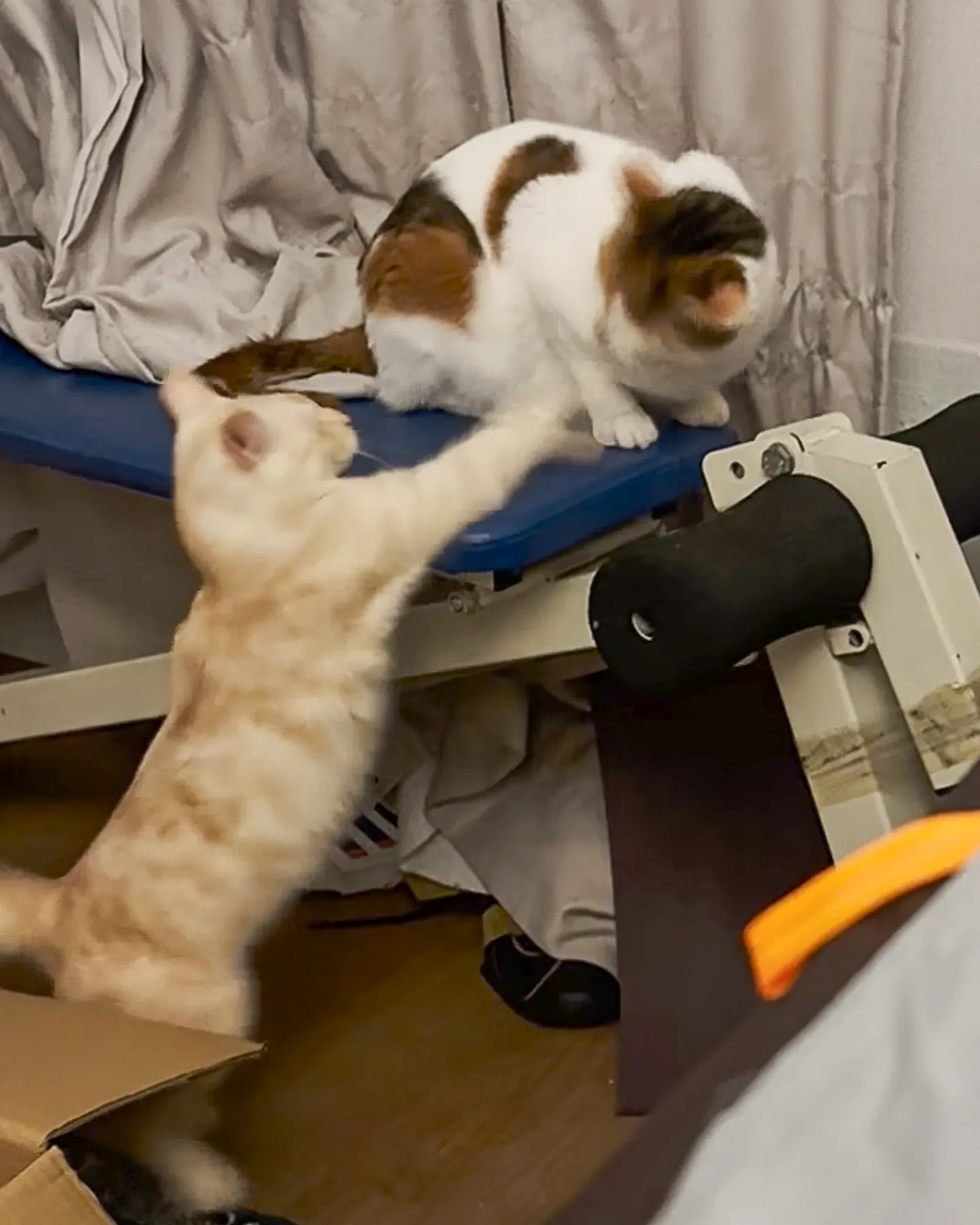
At the food bowl, Fooku backs away from David. In her resting spot, she warns him off with a hiss. Between the same two cats, Fooku’s response changes with what they’re meeting over. Kant is the same. The Kant who quietly stepped aside from his bowl for young Fooku meets Nori with hisses and swats.
After David came, how did five cats sort themselves out again?
David is Nori’s younger brother, born to the same mother from her next pregnancy, sometime between late March and early April 2026. For a while at first, he lived in a room apart from the other cats. We ended his isolation only after the vet tested him for disease and found nothing wrong.
Nori was unusually interested in David even while he was shut away in that room. Once David came out, the two hit it off at once. David followed Nori almost everywhere, and Nori groomed him. Within a few days they were wrestling. They looked exactly like a big brother and his heedless little brother. I was more than a little surprised. Whether they grew close so quickly because they’re brothers, though, I have no way of knowing.
With Witty, things started differently. At first, when David came too close, Witty often moved away or hissed, and that worried me. David didn’t seem very frightened of Witty, but when Witty hissed, he would give up the spot. Now the two nap together, and sometimes groom each other. They’re at ease with each other, and neither threatens the other.
The early hissing, in other words, was not where their relationship ended up. In the meantime, Nori and Witty spend less time together than before. They still nap together and groom each other, but Nori now spends more of his time with David. Just in the time since David arrived, their relationships have shifted this much. That’s why a ranking made at any one moment, or the relationships seen at that moment, rarely holds for long.
Was there a clear hierarchy among the cats in our alley?
Neighborhood cats come to our yard to eat. How I came to feed them, and what that daily routine looks like, I’ve written about in Eleven Bowls Under the Eaves. Among these cats, too, I couldn’t see any single order.
I’ve never seen the big, strong toms threaten the smaller females. If anything, it went the other way. Nori’s Mom, free-spirited and full of confidence, the neighborhood PTA president, so to speak, would sometimes snap at Witty’s Dad or Nori’s Dad. Perhaps because it was around the time she was in heat, the toms didn’t dare move a muscle in front of her. The difference in strength seemed plain, but I saw no particular hierarchy.
Even among the alley’s three big toms, Witty’s Dad, Nori’s Dad, and Ppeonppeoni (“the shameless one”) from the house at the top of the alley, I don’t really know the order. Witty’s Dad looks the oldest and the roughest-looking of the three, but I’ve never seen him threaten another cat. Ppeonppeoni, on the other hand, is cute and friendly with people. Yet when a truly fierce-looking cat from somewhere else came to the house at the top of the alley, Ppeonppeoni fought him hard. It made me think that the cat people see and the cat that’s really there can be two different things.
These observations have clear limits, though. I see the outdoor cats mostly around feeding times, and I’ve never seen how they behave when they’re starving. The scenes with Nori’s Mom and the toms came around the time she was in heat. My sense is that the peace on this alley is kept not by a balance of power fixed by rank, but by cats using force only when their territory or resources are threatened, and otherwise stepping back, strategically. But that’s my interpretation. I don’t really know why cats fight, or why they back down. Nor do I understand the big, strong tom who, now and then, simply puts up with the hissing and pestering of a kitten that isn’t his own flesh and blood.
So cats have no hierarchy? What the science says about their flexible social lives
I used to think of cats as animals that don’t live in groups. But the 2024 intercat tension guidelines from the American Association of Feline Practitioners (AAFP) see it a little differently. According to the guidelines, cats’ social systems are flexible and varied. Cats can form close bonds with other cats, but they don’t depend on those relationships to survive. Some cats prefer to live alone; others prefer to live in a group. So they’re less animals that don’t form groups than animals that may or may not. The guidelines also point out that, unlike outdoor cat groups, the cats in a home were chosen by their caregiver, so they may not be a group bound together by bonds at all, just cats who share a house. That’s why what I see in the alley can’t simply be carried over to the cats indoors.
On hierarchy, the guidelines explain it this way. Hierarchies have been observed in outdoor cat groups, defined by who predictably takes precedence over whom. But such hierarchies aren’t fixed, and they aren’t the basis on which cat society is organized; they’re a result of the relationships. Cats labeled “dominant” are often simply more active or curious than others. And there’s no evidence that tension among cats in a home comes from a struggle to establish a hierarchy. It usually comes from competition over resources, or from things that shake up relationships: a new cat joining, pain, illness.
This gives me a few ways to read the scenes in my own house. The guidelines don’t rank my cats for me, though.
First, don’t read one hiss as the whole relationship. The guidelines explain that cats often end a tense moment with a clear signal like a hiss, and that occasional brief falling-outs are normal social behavior. At the same time, they treat quiet behavior, such as walking away, as a possible sign of tension too. That’s not far from how I read Kant leaving: as an expression of displeasure.
Second, tell closeness apart from tolerance. Sleeping pressed together or grooming each other are signs of a close relationship, while cats that sleep on the same piece of furniture without touching may or may not be close. Kant and Nori, and Kant and David, sleeping more than 50 centimeters apart on the blanket, may be less friends than cats who put up with each other to share a spot. The guidelines consider that an acceptable outcome too. Though Nori and David, for their part, don’t seem to mind Kant’s unfriendly signals much.
Third, the scenes at the food bowl are about resources first. The guidelines recommend feeding even closely bonded cats separately, out of each other’s sight.
So the guidelines aren’t saying cats have no hierarchy. Who gets to a resource first in a given situation can be predictable. But that isn’t a fixed rank, and it isn’t the key to explaining tension at home.
Instead of ranking our cats, what should we watch for?
The guidelines say not to leave cats to work it out among themselves, and not to force them to get along. Instead, look at how resources are arranged right now, and whether that arrangement is creating tension.
At home, I step in almost only in two situations. One is when a cat takes another’s food. The other is when I judge that Hodu is playing too rough with Nori or Kant. Beyond those, I can hardly think of a reason to step in.
Food is different. Hiss or no hiss, Kant and Fooku end up giving up their bowls and leaving. Left alone, they might not get their full share. So when Nori or David puts his head in someone else’s bowl, I stop him, and a bowl that’s already been taken goes back to its owner.
Putting the guidelines together with what I’ve seen at home, these are the questions that turn out to be more useful than “Who’s the boss?”:
Who approaches whom, and who backs off, and in what situations? The same two cats may behave differently at the food bowl and in a resting spot.
Does any cat keep breaking off or avoiding something: food, water, the litter box, a resting spot? What matters is less whether there was a hiss than what a cat has actually been kept from doing.
In chase games, do they take turns, or is one cat always the one being chased, and hiding?
How do the relationships change over time? Weeks and months tell you more than one or two scenes.
Practical ways to feed cats separately, and the signs of tension between cats, are gathered in A Guide to Multi-Cat Households.
I still don’t really know whether my cats have a hierarchy. The fact remains that Kant hisses at the others and they don’t hiss back. But that fact alone explains neither Kant giving up his bowl to Nori and walking away, nor Fooku, who leaves her bowl for the top of the fridge yet hisses at David from her resting spot.
That’s about all I know. The cats in my house and the cats in my alley live together more peacefully than I had imagined. ■