
Six Months With a Cat Water Fountain: Why I Stopped Using It—and Why I Started Again
Last updated: October 13, 2026
I purchased this product myself and received no sponsorship.
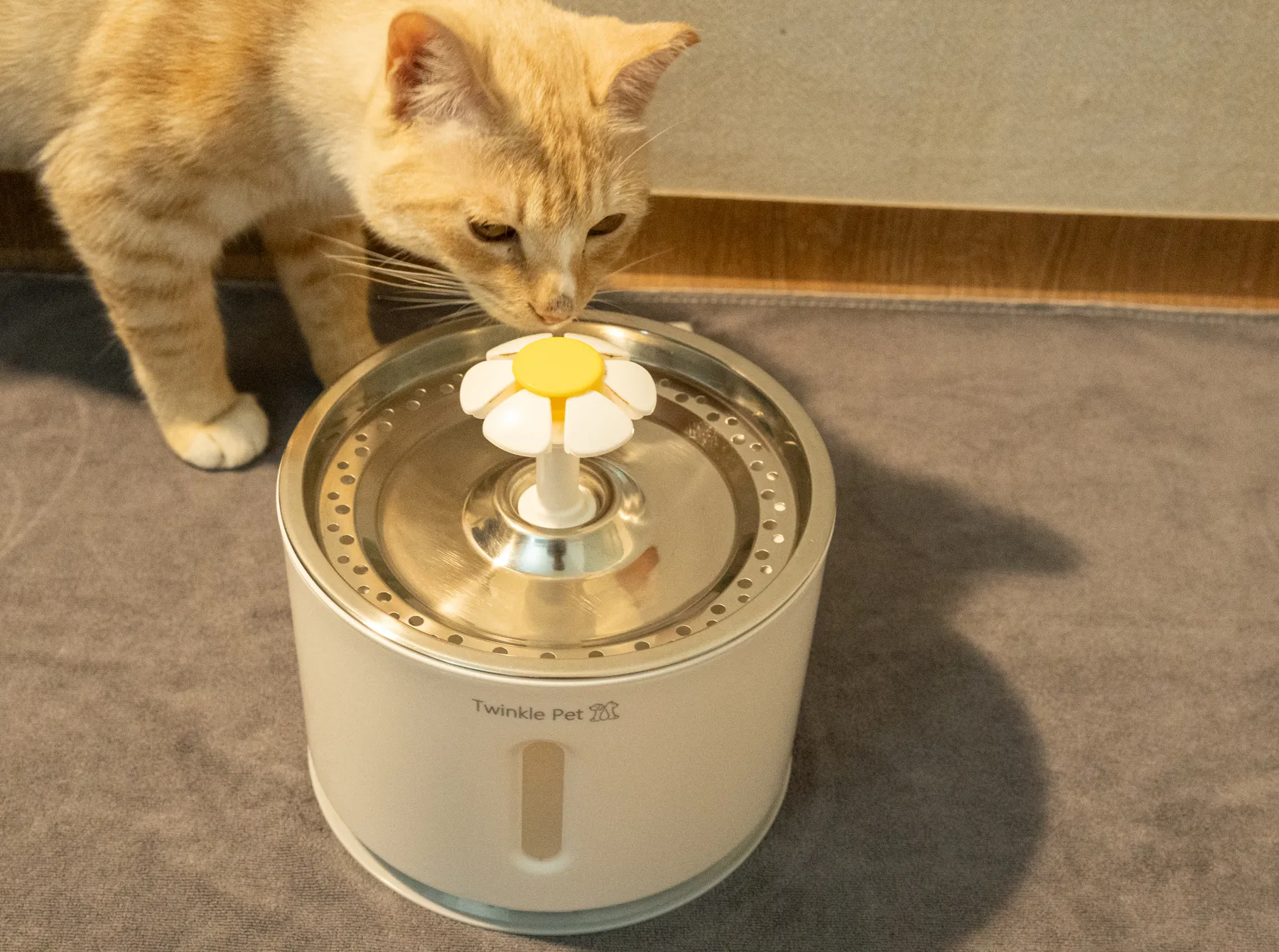
On December 18, 2025, I bought a Twinkle Pet 2.4L stainless-steel cat water fountain.
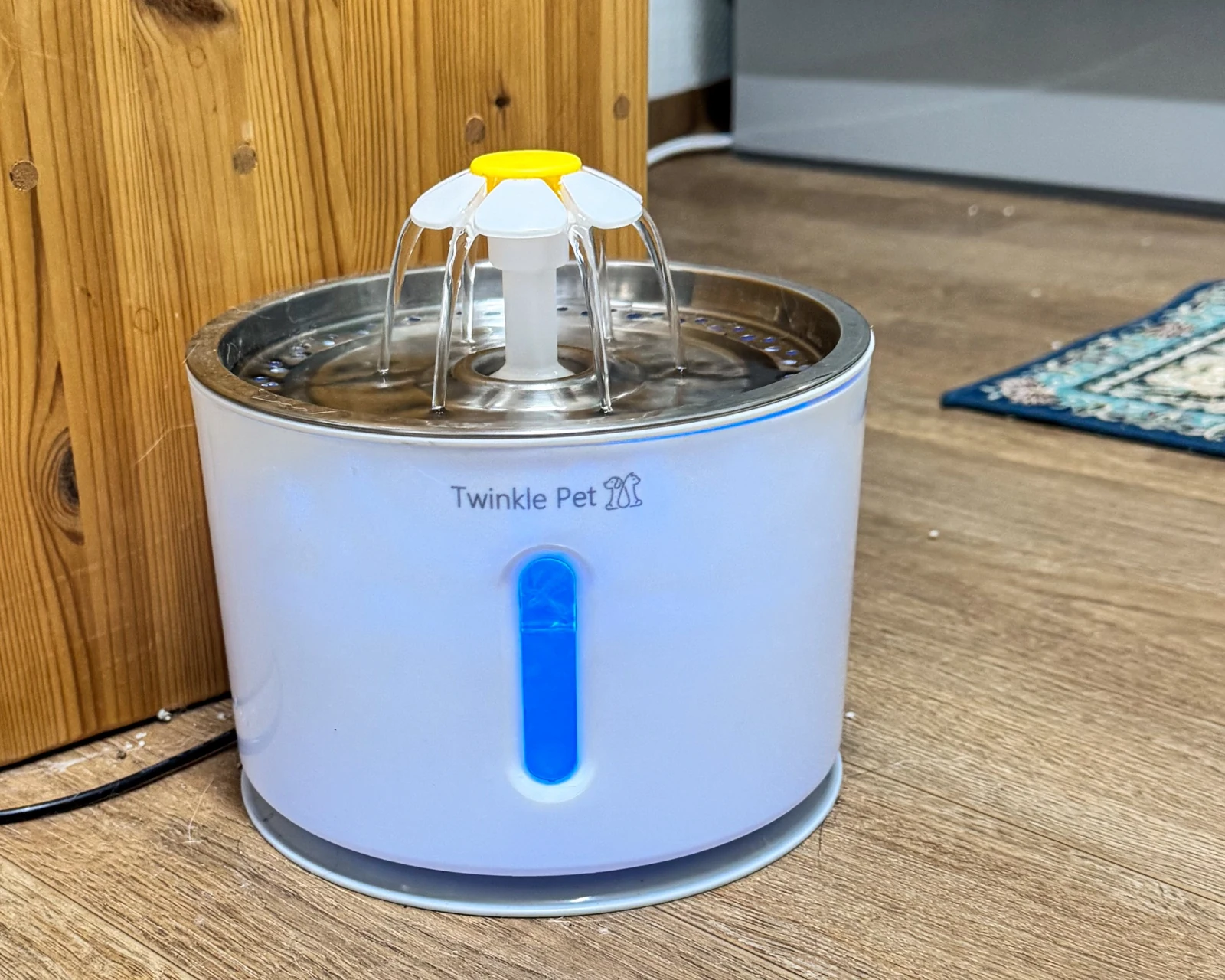
When plugged in, a pump draws water upward. The water falls from the top in several streams and then circulates back into the reservoir. The product came with two replacement filters, and I started using it the following day, December 19.
At first, I expected my cats to prefer moving water to still water, and I thought that might lead them to drink more.
But after about six months of use, I could not confirm that difference in my household. Then, on June 27, 2026, I found an insect-like object, something that looked like a small larva, and more debris than usual inside the reservoir. I stopped using the fountain.
Today, however, I am using the same fountain again.
The short version
I have not been able to confirm that my cats prefer the fountain to regular water bowls or that they drink more because of it. If anything, I have come to feel that where the water is placed, how easy it is to reach, and how clean it remains matter more than whether the water is moving.
Even so, I had practical reasons to bring the fountain back. It gives the animals a third water station, and while I currently replace the water in our regular bowls three or four times a day, the fountain requires one light daily maintenance routine.
I also changed the way I maintain it after the June incident. Every day, I empty the water, lightly rinse the easily accessible parts, and refill it. Every five days, I take the fountain apart completely and clean it more thoroughly.
| Date | Use record |
|---|---|
| December 18, 2025 | Bought the Twinkle Pet 2.4L stainless-steel cat water fountain |
| December 19, 2025 | Started using it |
| March 22, 2026 | Bought a six-pack of Comet Pet replacement filters |
| June 27, 2026 | Found an insect-like object, something resembling a small larva, and more debris than usual inside the fountain; stopped using it |
| Around late September 2026 | Started using the fountain again |
| Now | Light daily maintenance + full disassembly and cleaning every five days |
Do Cats Really Prefer Moving Water?
At first, I too thought about it in fairly simple terms. Cats’ ancestors lived in natural environments, and moving water may have been fresher than still water. If so, perhaps offering moving water would be a more natural option.
The sales page for the product I bought also included a description suggesting that cats prefer moving water to water left sitting in a bowl. I came across similar statements online and in videos as well. Watching the water continuously fall from the top of the fountain, I expected that if my cats preferred it, it might help them drink a little more.
My cats did use the fountain. But after watching them for several months, I began to question whether they actually preferred moving water.
Based on what I observed, I could not confidently say that they did.
A 2019 study by Robbins and colleagues in the Journal of Feline Medicine and Surgery compared still water, circulating water, and free-falling water. Among the 14 cats that completed the study, there was no significant difference in average water intake among the three methods. Some individual cats did, however, show preferences for particular water sources.
In other words, some cats may prefer moving water, but that does not mean every cat does, or that a fountain will necessarily increase water intake.
My own experience was consistent with that uncertainty.
What I Observed With the Fountain and Regular Bowls in a Multi-Cat Home
I did not measure how many milliliters my cats drank from the fountain compared with the regular bowls, so I cannot prove quantitatively that they drank more from the bowls.
Still, from watching them drink during ordinary daily life, a few things stood out. The cats did not make a point of going to the fountain simply because it was there, and I rarely saw them pass a nearby regular bowl to seek out the fountain farther away. Within the limits of my own observation, I saw them drinking from the regular bowls more often.
That was especially true of Hodu. Hodu is our Shiba Inu. She will drink from the fountain, but I see her using the regular water bowls far more often.
Location and accessibility began to matter more to me
Over time, I started paying more attention to location and accessibility than to the form of the water itself.
I look at where the cats tend to rest, which routes they use around the house, and whether water is available near those places. International Cat Care also emphasizes that the location of water matters, not just the type of bowl. Its guidance recommends providing water in several easily accessible locations so cats do not have to go far to find it, while also keeping the water fresh and the containers clean.
That matched what I was seeing in everyday life.
So now, instead of first thinking, “If I provide moving water, they will drink more,” I ask different questions: Is there water close to where the cats spend time and along the routes they use? Can they reach it easily when they need it? Are there enough places where they can choose clean water?
Related reading: A Guide to Multi-Cat Households
David Gave Me a Reason to Add a Third Water Station
The direct reason I started using the fountain again was David.
David is Norang-i’s younger sibling, born in a later litter to the same mother. After David became ill, I brought the kitten indoors for care, and David eventually became part of our family.
That brought the number of cats living in the house to five. With Hodu, six animals were now sharing the home.
While I was not using the fountain, the existing cats and Hodu shared two regular water bowls. I did not see any obvious competition over them. I did not see any animal being kept from drinking by another, nor did I see conflicts at the bowls.
But once David had joined us, I thought it would be better to add another place to drink than to continue with only two. I tried adding another regular bowl, a smaller bowl, and a plate.
Eventually, I brought out the fountain I had stopped using.
June 27, 2026: What I Found Inside the Fountain
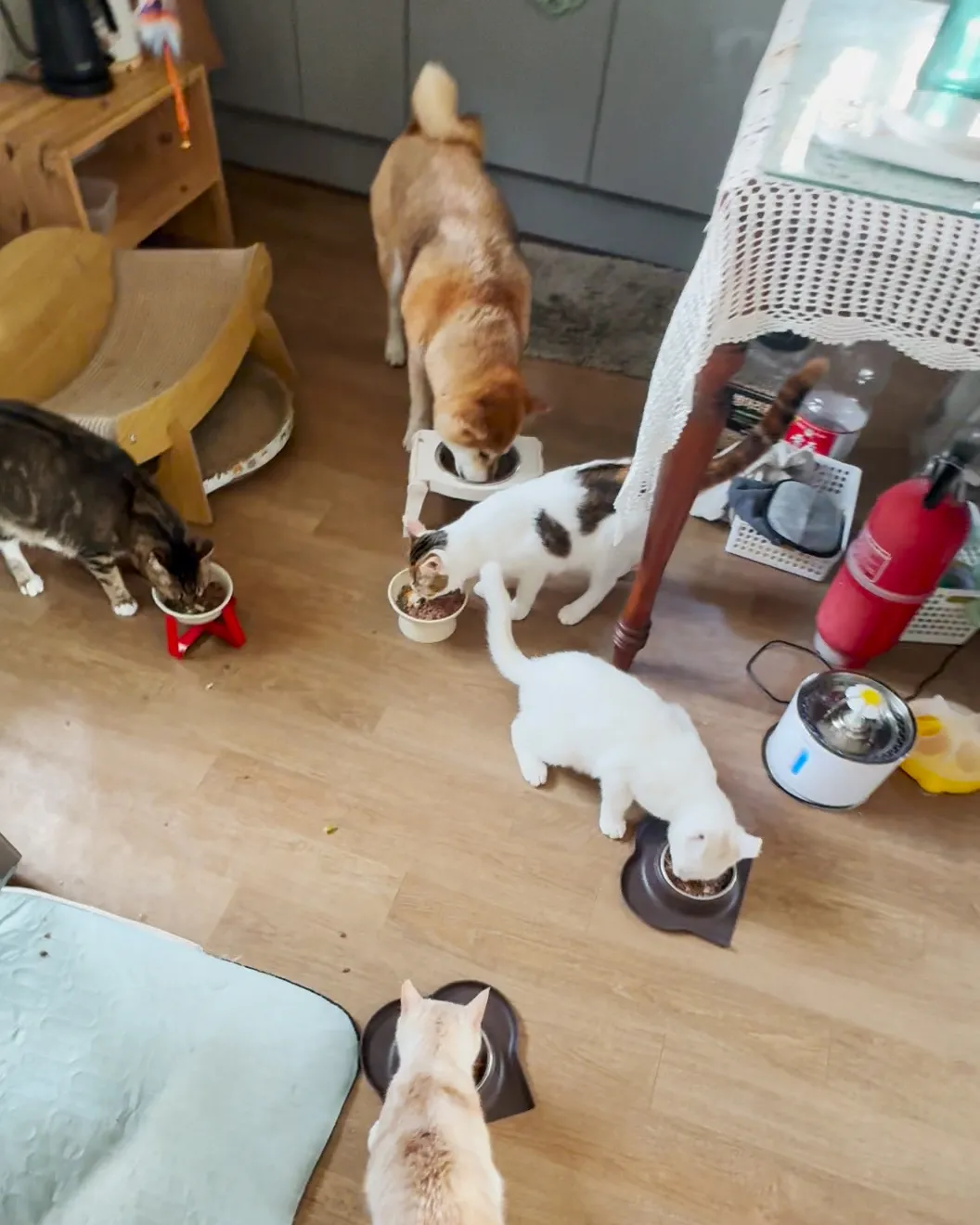
I first started using the fountain in December 2025. A video recorded on June 23, 2026 still shows the fountain in use in our living space at the time.
Four days later, on June 27, I noticed something unusual while cleaning it.
Inside the reservoir was an object that looked like a winged insect. There was also something that looked like a small larva. On the bottom, I could see more dust and debris than usual.
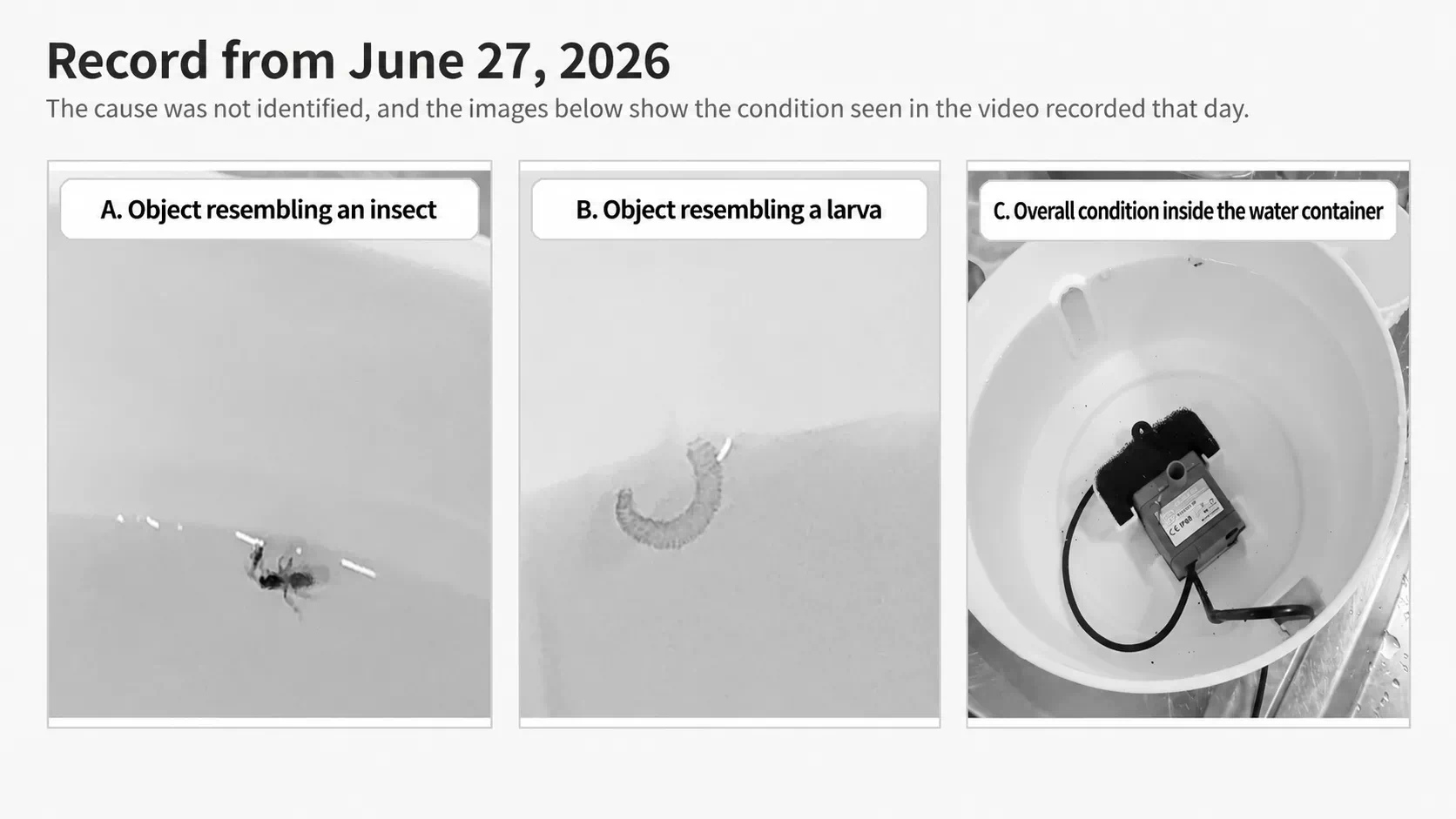
I recorded the condition on video and stopped using the fountain.
At the time, I thought that cleaning the fountain was already more work than washing a simple bowl, and that if I also had to worry about a hygiene problem like this, there was little reason to keep using it.
I do not know what caused it
Looking back at the incident now, there is one point I want to make clearly.
I do not know what caused it.
I have no evidence that it happened because of a defect in the fountain itself. At the time, I was not using the filters that originally came with the product.
On March 22, 2026, I bought a six-pack of Comet Pet replacement filters. Their diameter was almost the same as that of the original Twinkle Pet filters, and I judged that I could use them in the fountain. I was using one of those filters when I found the unusual material on June 27.
I mention this to record exactly how I was using the fountain at the time.
I have no basis for concluding that the Comet filter caused what I found.
There were other possibilities as well. Around that time, I had used a blower to blow dust away while cleaning the house. Because there was more dust than usual inside the reservoir, I considered the possibility that dust or a small creature might have gotten in during that process.
The rural house where we now live also gets more small insects indoors than our previous home in the city, so I have considered whether the environment may have played a role.
But these are only possibilities.
I do not know whether the blower was involved, whether the rural environment mattered, or whether the cause was something else.
So this is as far as I can go based on what I actually know:
On June 27, 2026, I found an insect-like object, something that looked like a small larva, and more debris than usual inside the reservoir of the fountain I was using.
I could not determine the cause.
Why I Started Using the Fountain Again Anyway
When I considered bringing the fountain back, I hesitated. After an experience like that, did I really need to use it again?
But while looking after the regular bowls, I kept noticing a different kind of problem.
Cat hair and Hodu’s hair fall directly into the open bowls. As the animals move around the house, small amounts of dust also get into the water. When sunlight hits the bowls, the hair and dust on the surface and bottom become especially easy to see.
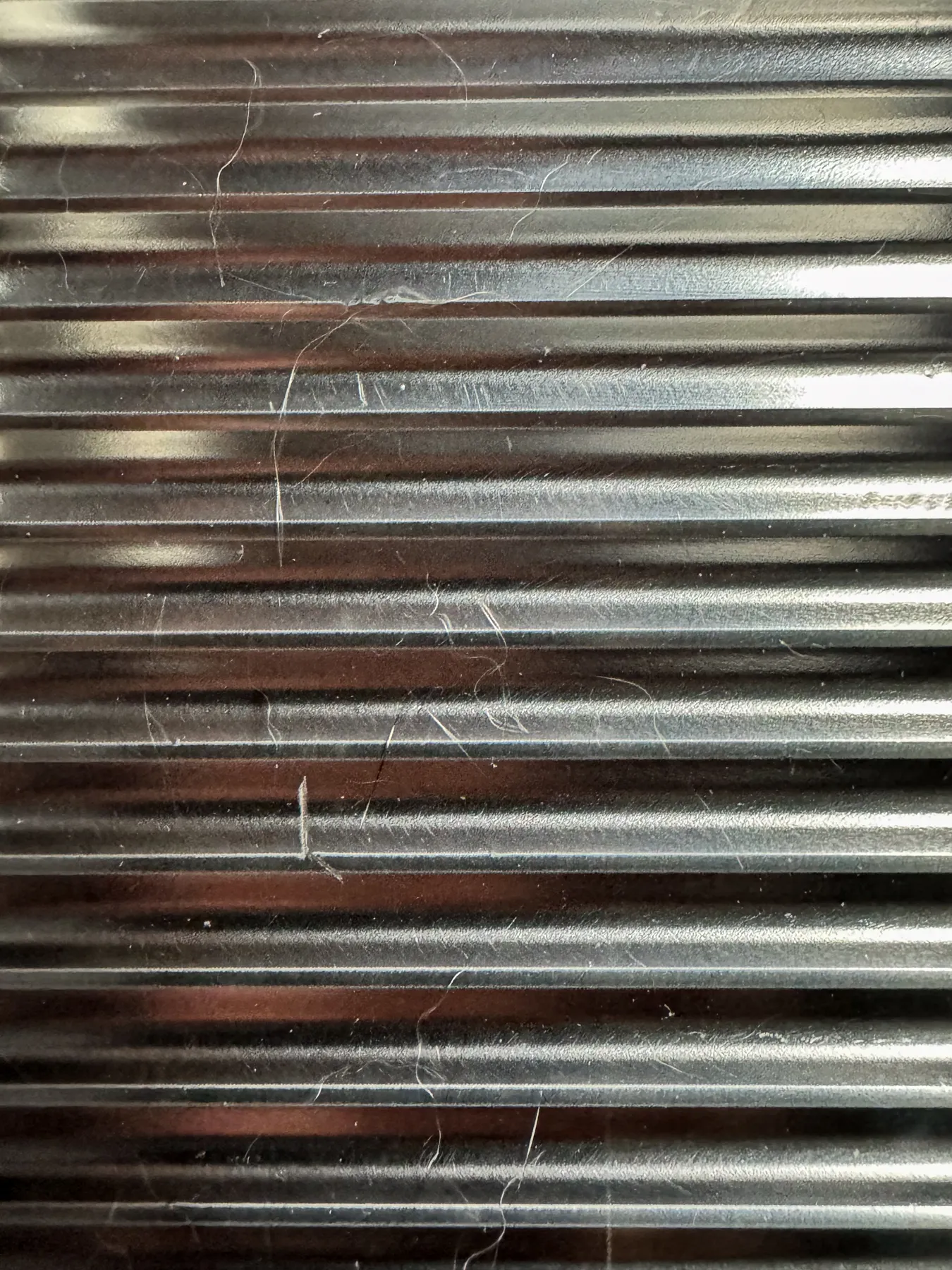
Because of that, I currently replace the water in our regular bowls three times a day, and sometimes four. I change it in the morning, during the day, and in the evening. If necessary, I replace it again before going to bed.
Managing two regular bowls this way is not difficult, but it is something I have to repeat throughout the day. That was when the practical advantages of the fountain began to stand out again.
I change the water in regular bowls three or four times a day
The main advantage of a regular bowl is simplicity. You can see the condition of the water immediately. If it looks dirty, you empty the bowl, wash it, and add fresh water.
At the same time, the entire water surface is exposed to the living environment, so hair and dust that fall in remain there. In our home, I deal with that by replacing the water frequently.
I still use regular bowls in two locations. The fountain has not replaced them; it has simply added a third option.
How I manage the fountain each day
The fountain has a filter, and its pump keeps the water circulating.
I do not consider it a device that sterilizes the water or keeps it clean at all times. After finding unexpected material inside the reservoir in June, I am even less inclined to assume that.
But since bringing the fountain back, I have not felt a need to replace its water three or four times a day as I do with the regular bowls.
Once a day, I empty all of the water, lightly rinse the main body and the easily accessible parts without detergent, refill it with fresh water, and start it again. So far, that routine has kept the fountain in a condition I am personally satisfied with.
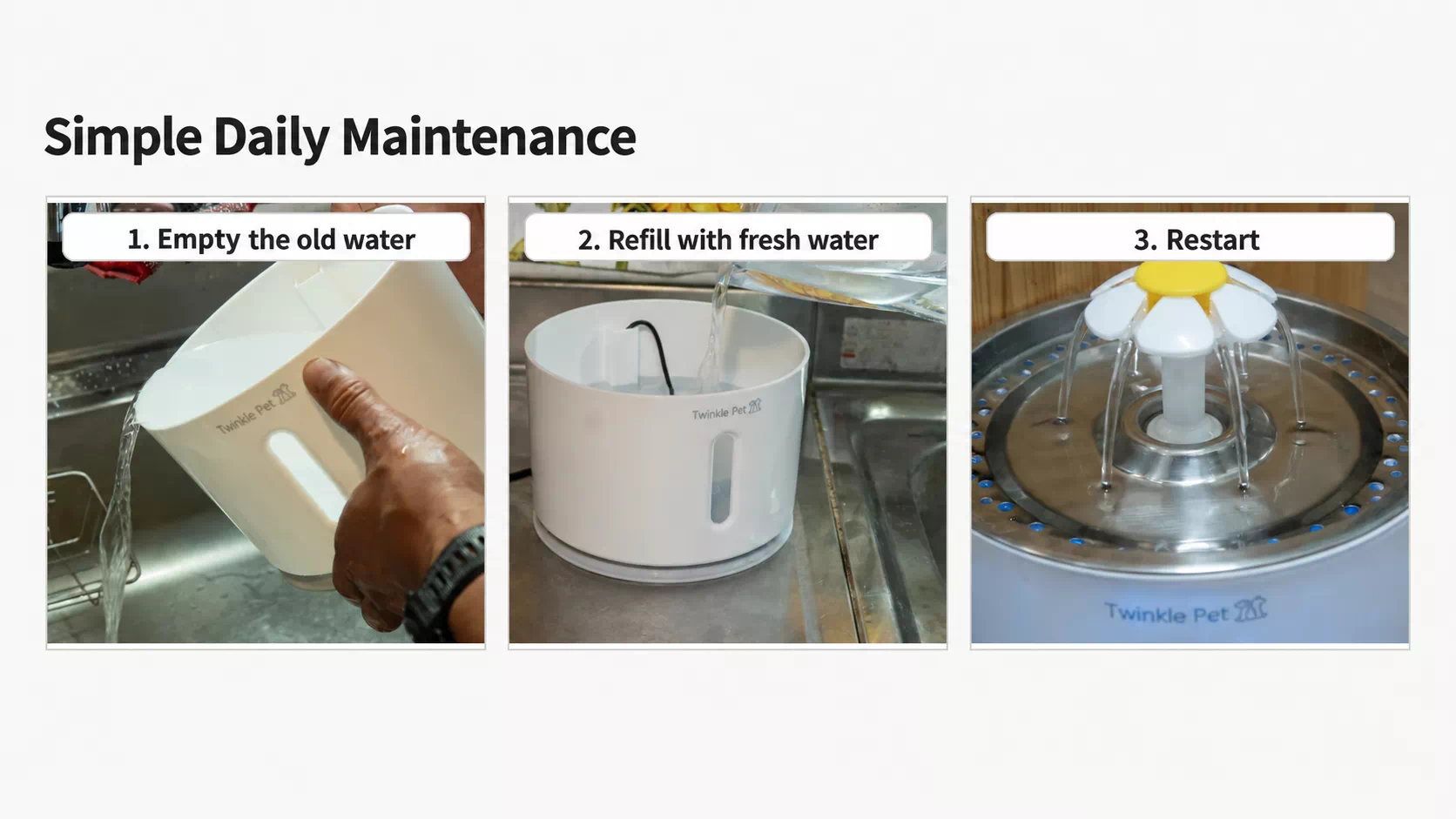
That does not mean every fountain only needs once-a-day maintenance. This is simply my experience with this particular product, in our environment, using my current maintenance routine.
If I added another regular bowl, I would need to change its water three or four times a day as well. The fountain, as the third water station, currently requires one light daily routine.
So the number of places to drink has increased by one, but the amount of maintenance I repeat throughout the day has not increased much.
That is one of the most practical reasons I started using the fountain again.
The three water stations serve different roles
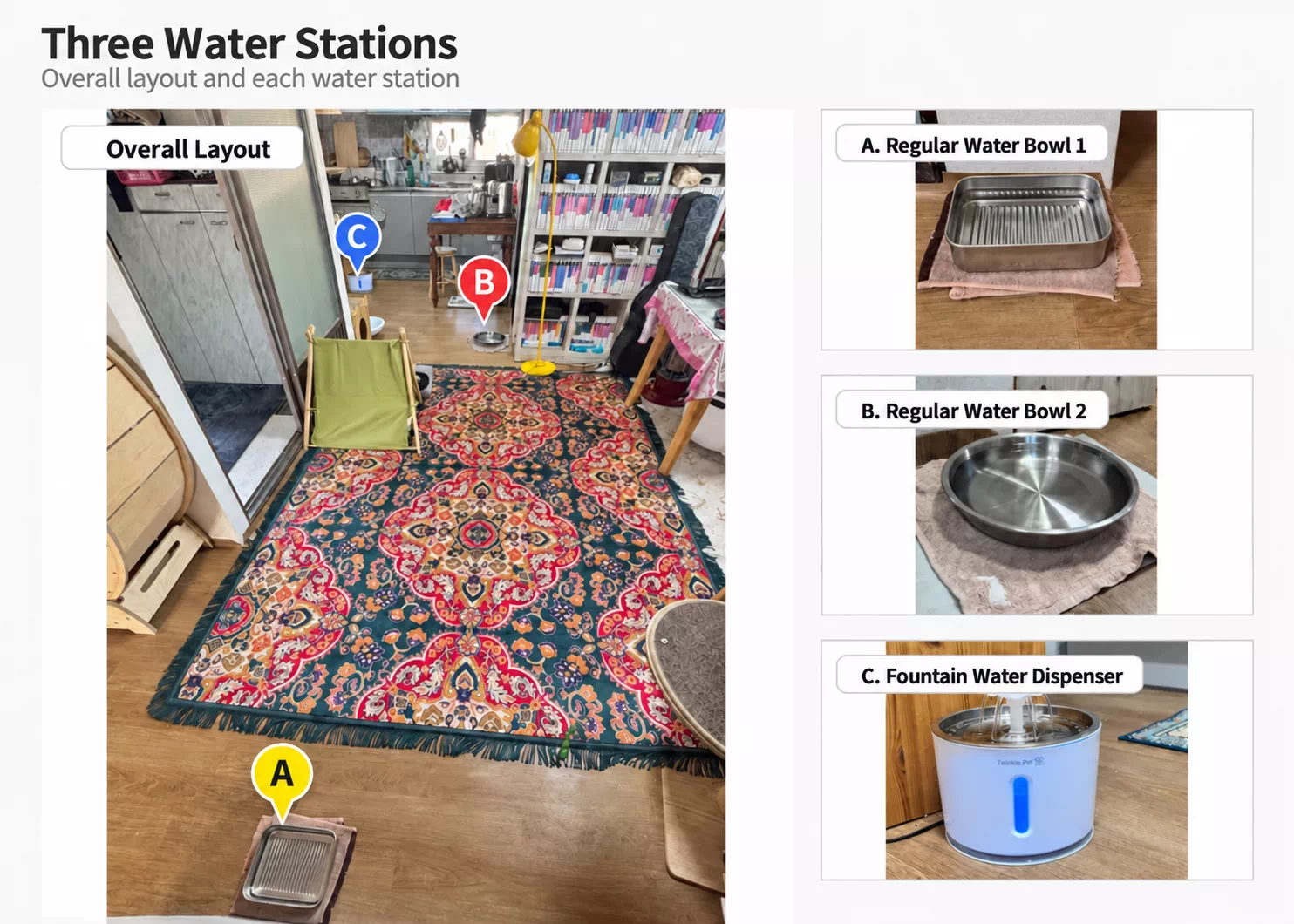
We currently have three water stations in the house: two regular bowls and one fountain.
I do not think any one of them is the single correct solution. Regular bowls are simple and make the condition of the water easy to inspect. The fountain is more complex, but it has a filter and circulates the water, and with the way I currently maintain it, I do not need to replace the water as often as I do in the regular bowls.
The three stations are also in different locations. The idea is to give the cats and Hodu access to water near different parts of their living space.
In the end, I have become less interested in asking, “Which water bowl is best?” I care more about how water stations are distributed through the living space.
Why I Pay More Attention to Hygiene in Shared Water Bowls
In our home, a water bowl is not used by just one animal. Five cats and Hodu share the same water stations.
That is why I do not think of water-bowl cleanliness as merely a matter of appearance.
Pet items such as bowls can become contaminated with microorganisms, and the U.S. Centers for Disease Control and Prevention recommends regular cleaning of pet supplies because germs can be present on them. Research examining microbial contamination in pet food bowls has also pointed to the importance of good bowl hygiene.
That does not mean that slightly contaminated water will immediately infect all six animals. But when several animals share the same water, multiple animals can potentially be exposed to the same contaminant.
There is another reason I think about this more carefully in our home. Hodu goes outside for three walks a day and often spends four to five hours or more in the yard. She comes into contact with soil, grass, dust, and other parts of the outdoor environment, then comes back inside and drinks from the same water stations as the five indoor cats.
That does not mean Hodu is carrying disease into the house.
But the fact that one animal with frequent outdoor exposure and five indoor cats share the same water sources is one reason I manage shared water somewhat conservatively.
If I see hair or dust, I replace the water rather than leaving it for a long time.
For us, changing the water often is not only about how much the animals drink. It is also part of keeping a shared resource clean for six animals.
My Fountain Cleaning Schedule: Daily Light Maintenance + Full Disassembly Every Five Days
Replacing the water less often does not mean that maintaining the fountain is simpler.
A regular bowl is just one bowl to wash. The fountain has a main body, a stainless-steel top plate, a pump, a filter, and the structure that holds the filter in place, among other parts.
Even if the water looks clean from the outside, I cannot assume that everything inside is in the same condition. The area around the pump and the places where parts fit together also need to be checked.
In the past, I completely disassembled and cleaned the fountain every three days.
I now use a different routine:
Once a day, I empty all of the water, lightly rinse the fountain without detergent, and refill it with fresh water. Every five days, I completely disassemble the fountain and clean the main body, stainless-steel top plate, area around the pump, and the parts where the filter sits.
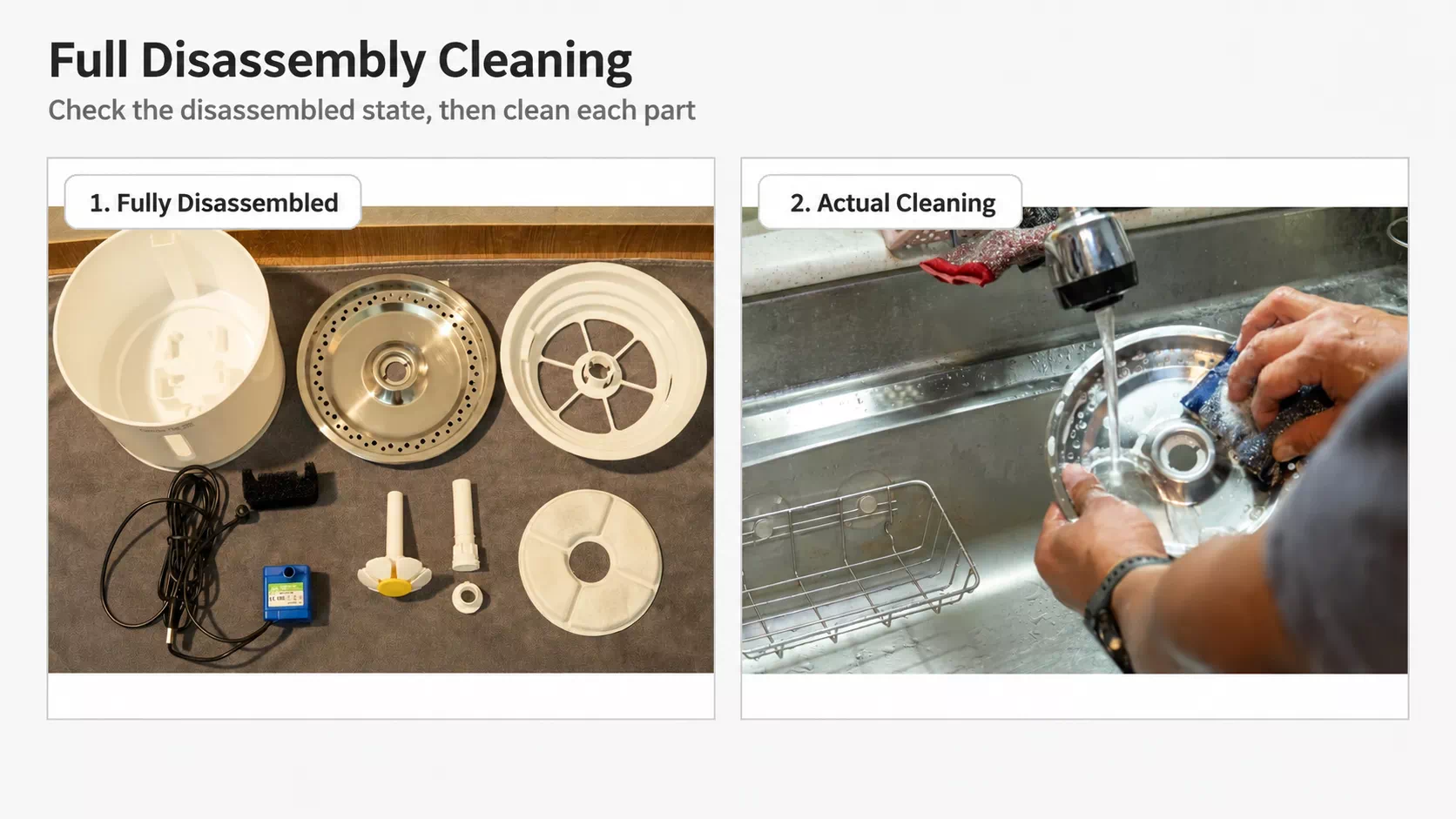
The interval between complete cleanings has grown from three days to five, but I now replace the water much more often than before and check the inside every day.
That is the routine I chose after what happened in June.
So far, I am satisfied with the condition I have been able to maintain.
The Four Things I Now Look At When Managing Water for My Cats
Buying the fountain, stopping its use, and eventually using it again changed the way I think about water management.
First is location and accessibility. I look at where the cats spend time and the routes they use around the house, then place water nearby.
Second is the number of water stations. I prefer giving the animals several places to choose from rather than making every animal rely on one location.
Third is the actual condition of the water and the hygiene of a shared resource. I check for hair, dust, changes in smell, or anything else unusual, and replace the water when necessary.
Fourth is watching how the cats and Hodu actually use the water stations.
Even when a product description says cats like something, whether the cats in my own home actually behave that way is a separate question.
Some cats may prefer moving water. Others may prefer a regular bowl. The same cat may simply use whichever water station is closest to where it happens to be resting.
So I now spend more time watching actual behavior than relying on product descriptions.
After Six Months, Will I Keep Using This Fountain?
For now, the answer is yes.
But the reason is different from when I first bought it.
At first, I expected my cats to prefer moving water and thought they might drink more because of it. That is no longer the most important reason I use this fountain.
I have not been able to confirm that my cats particularly prefer the fountain or that it has increased their water intake.
Instead, I found other benefits. The fountain gives us one more water station, and I can place it somewhere different from the two regular bowls, improving access to water around the house.
The fountain has a filter and circulates the water. With my current maintenance routine, one light daily cleaning has been enough to keep it in a condition I am satisfied with.
The tradeoff is that every five days, I still have to accept the more cumbersome job of completely disassembling and cleaning it.
Because I once found unexpected material inside it, I will not simply assume that the inside is clean in the future.
I do not think of this product as “a fountain every cat needs because cats prefer moving water.”
At the same time, I cannot call it “an unhygienic product” on the strength of one past experience.
For me, the fountain is now simply one of several water stations in the house. It serves a slightly different role from the regular bowls, and it requires a different kind of maintenance.
And when I think about water for the animals in our home, the first question I now ask is not whether the water comes from a fountain.
It is this:
Is there enough clean water close to where they are, and are they actually able to use it comfortably?