
Dog Walks Were Never Just About Bathroom Breaks: How the Way I Walk with Hodu Changed
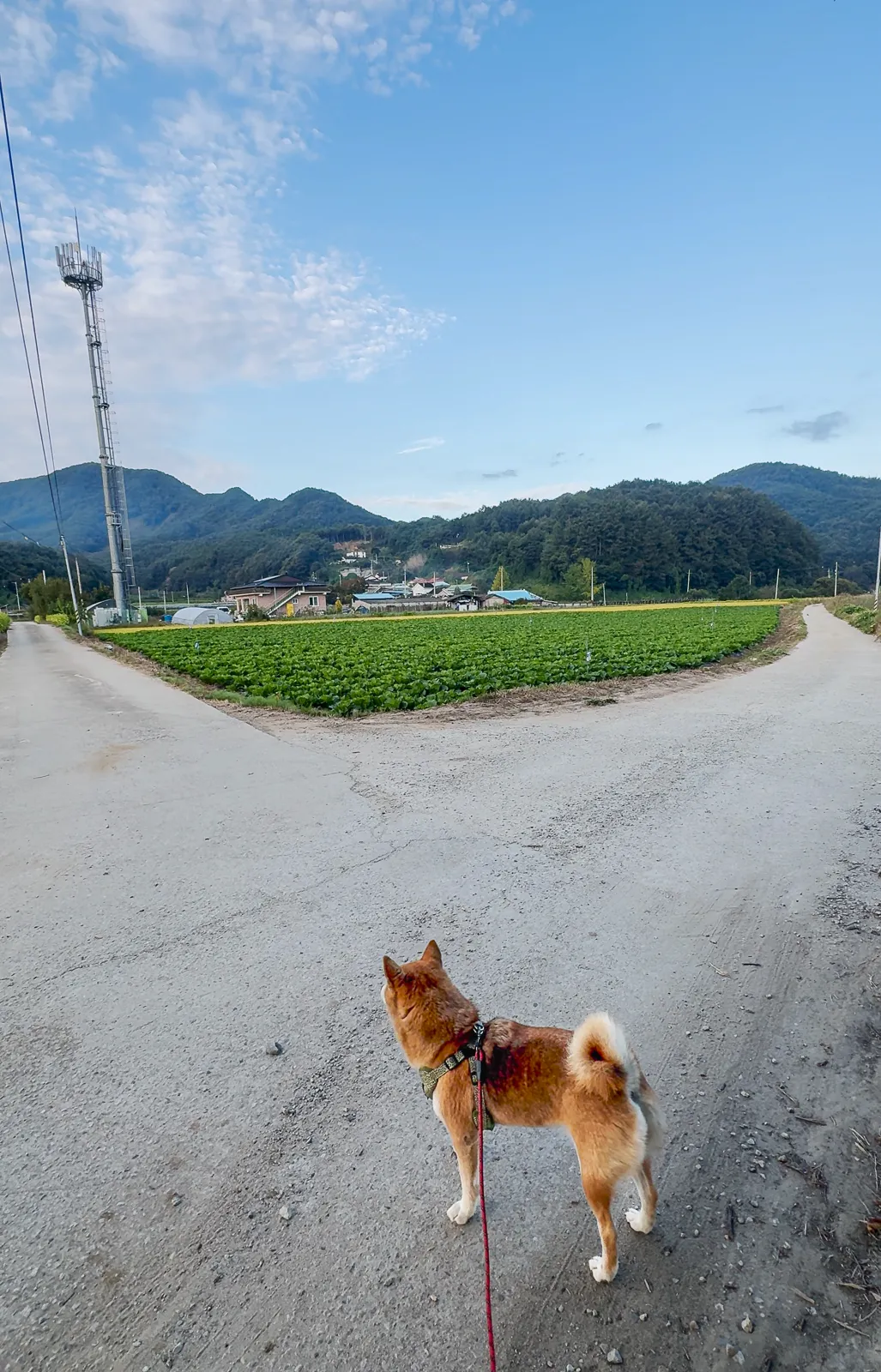
I walk Hodu three times a day.
I did the same before we moved to the countryside. On weekdays, each walk usually lasted about 30 to 40 minutes. On weekends, the morning and lunchtime walks could each last around an hour. So I never really thought I was neglecting Hodu’s need for walks.
But after we moved and the way I walked with her began to change, I started to notice something I hadn’t seen clearly before.
In the city, we had about three main walking routes. I varied them a little from time to time, but one thing mattered most when I chose where to go.
The route had to pass places where Hodu was likely to pee and poop.
After walking with her for years, I had learned which places gave us the best chance. If she didn’t go at the first spot, I could continue to the second. If that didn’t work either, there was a third.
Looking back, those routes were not so much Hodu’s walking routes as routes I had designed to increase the chances that she would get her business done.
We Walked Three Times a Day, but I Judged a Walk by Whether She Had Gone to the Bathroom
Hodu is very particular about keeping her living space separate from her bathroom spots.
Even when we lived in the city, she rarely peed or pooped close to our apartment building or within the familiar parts of the apartment complex. She seemed more likely to go only after we had traveled some distance from home and left the complex.
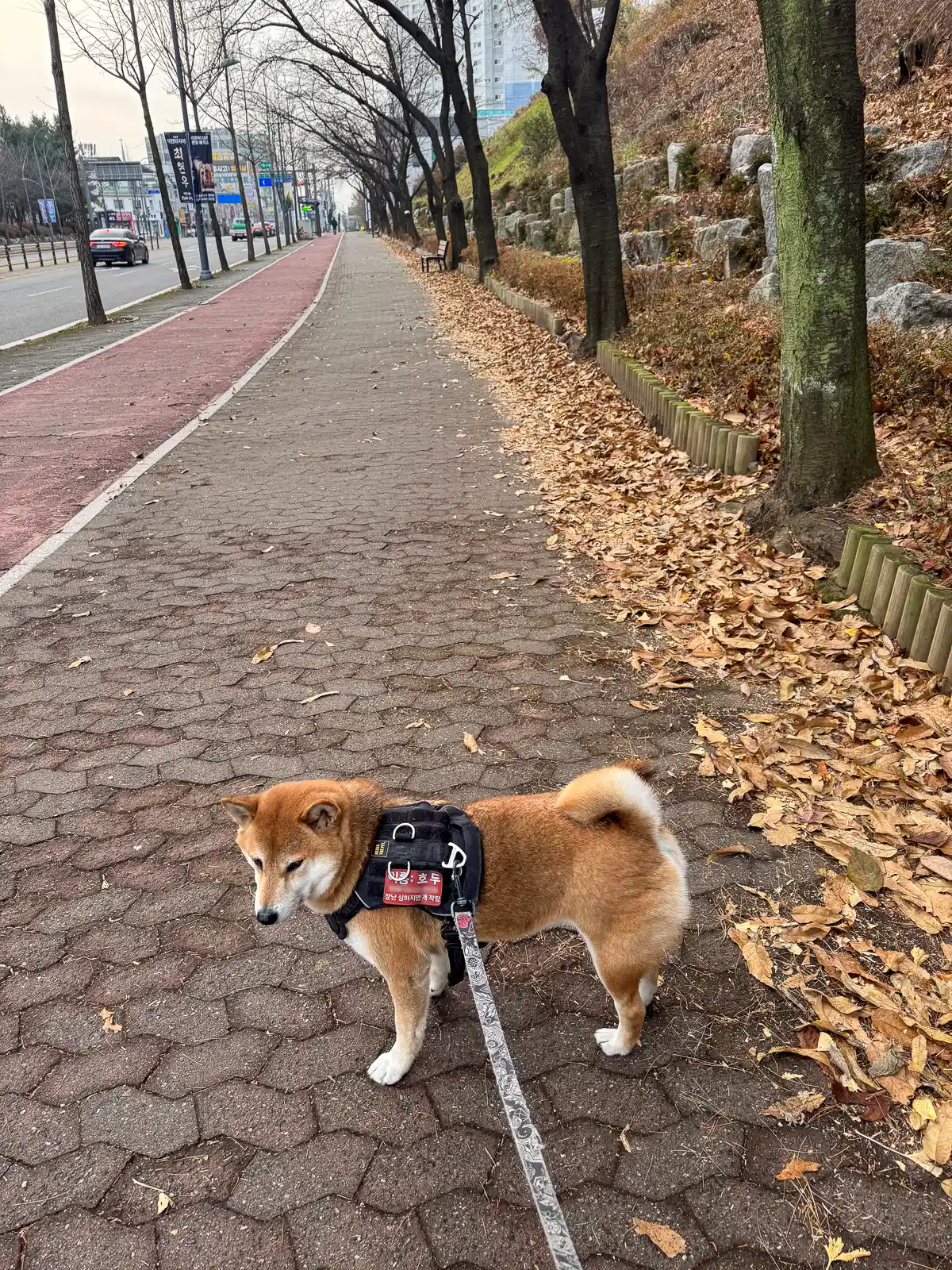
She also had preferences about the surface.
She almost never peed on asphalt or concrete, and she never pooped there. She wanted soil and grass.
But not all grass was the same.
If the grass grew so tall that it brushed against her rear end, she would often wander around for a while and then move somewhere else. I still see the same pattern today.
Something similar happened this summer.
One of Hodu’s usual bathroom spots on our rural walking route became overgrown. She stopped using it and kept walking until she found another place she liked better.
So one Sunday morning, I went out with a brush cutter.
I cleared the grass along the part of the path Hodu used.
Some older neighbors passing by thought I was clearing the road for everyone. They even complimented me.
I didn’t have the heart to explain.
I was cutting the grass so Hodu could pee and poop comfortably.
That day, without meaning to, I somehow became that rare thing: a good-hearted young man from the city. Around here, I still count as young.
Back when I had an office job, morning walks came with a time limit.
It was easier when Hodu went quickly. Then I could return home and get ready for work. If I left only a little later, traffic could make the same commute take much longer.
But I couldn’t simply end the walk because I was in a hurry.
That was especially true on days when everyone else was away and Hodu would have to stay home alone. If an appointment or departure time was approaching and she still hadn’t peed, I would keep trying different routes, hoping she would at least go once.
Rainy days were harder.
In my experience, Hodu often went less when she was wearing a raincoat. If she passed her familiar spots without going, I sometimes took her along routes we rarely used. In unfamiliar places, or places we hadn’t visited for a long time, I often saw her spend more time sniffing and scent-marking.
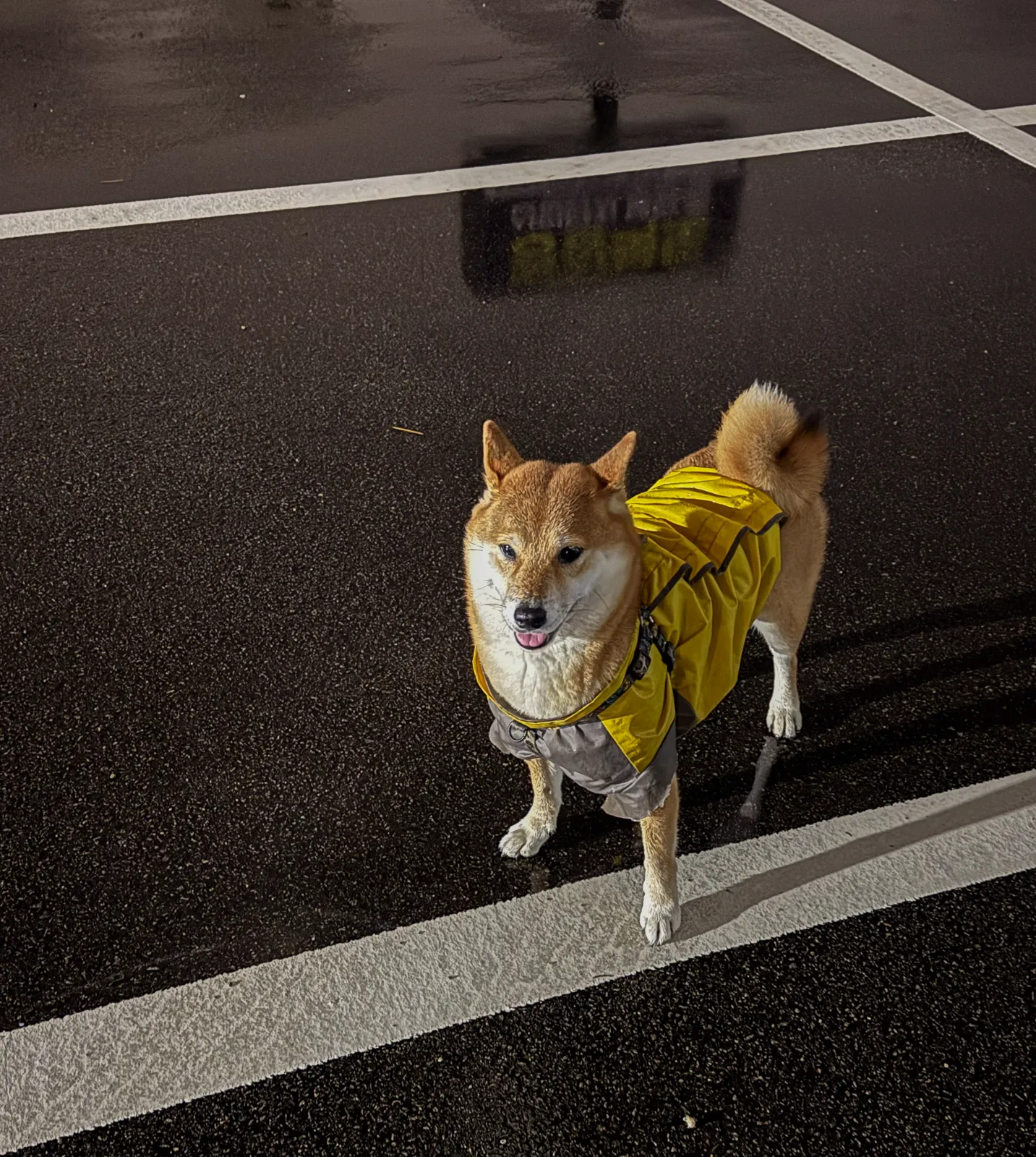
Even then, I tried to wait when she stopped to sniff. I also bought a longer leash so she would have a little more room to move.
But the standard I used to judge whether the walk had gone well was still whether she had gone to the bathroom.
Once she had peed and pooped enough, I felt relieved.
And as soon as I felt relieved, I wanted to go home.
I Don’t Think It Was Wrong to Focus on Her Bathroom Needs
I don’t look back and think those walks were wrong.
Going to the bathroom is a basic physiological need.
For Hodu, who doesn’t pee or poop inside the house, walking is essential for meeting that need. Making her hold her urine for a long time simply because I was busy wouldn’t have been a better choice.
The problem I only noticed later lay somewhere else.
While taking care of an important need, I had gradually started treating that need as if it were almost the whole purpose of the walk.
Had she peed?
Had she pooped?
If so, I felt that the most important task of the walk had been completed.
I loved Hodu then, too, and I believed I was being considerate. I spent time finding places where she could go, I went outside even in the rain, and I tried to wait when she stopped to sniff.
But looking back, I was walking while constantly watching the task I needed to complete.
I paid less attention to what Hodu herself was doing during that time.
After Moving to the Countryside, the Meaning of the Road Changed
On February 27, 2026, Hodu and I moved to the countryside.
It was a place I had come to after letting go of many things from my previous life in order to live in a way I had wanted for a long time.
I had enjoyed walking with Hodu in the city too. But there was always something waiting after the walk.
I had to go to work. I had things to finish. I felt pressure to use the day productively. For a while, I spent so much time trying to figure out how to manage my time better that the effort itself ended up eating a lot of my time.
Walks couldn’t remain completely outside that kind of life.
But when I first began walking around our new neighborhood with Hodu, it felt different.
Roads ran between mountains, rice paddies, and fields.
I enjoyed the act of walking itself.
Instead of thinking about getting Hodu’s bathroom needs taken care of quickly so I could move on to the next task, I liked the simple fact that I was walking this road with her.
Gradually, our morning walks changed.
Unless there is a particular reason not to, I no longer decide the route.
I follow Hodu.
We use a two-meter leash. When we reach a fork and Hodu chooses one direction, I go that way too.
She doesn’t choose the same route every day. Some days she stays nearby. On other days, she goes surprisingly far.
As far as I can tell, Hodu doesn’t deliberate for long at a fork.
She chooses a direction and goes.
So now I find myself wondering,
Where will Hodu go today?
Our morning walks are usually around two to three kilometers. Sometimes they’re shorter, and sometimes longer. On some days, after about half an hour, she naturally begins heading back toward home. On other days, she seems to want to keep going farther.
One recent Garmin record shows a walk that began at 6:14 a.m. and covered 3.00 kilometers in 1 hour, 6 minutes, and 42 seconds. I’ve recorded many of our walks since our city days, so if I ever want to compare distance and duration between then and now, I have plenty of data.
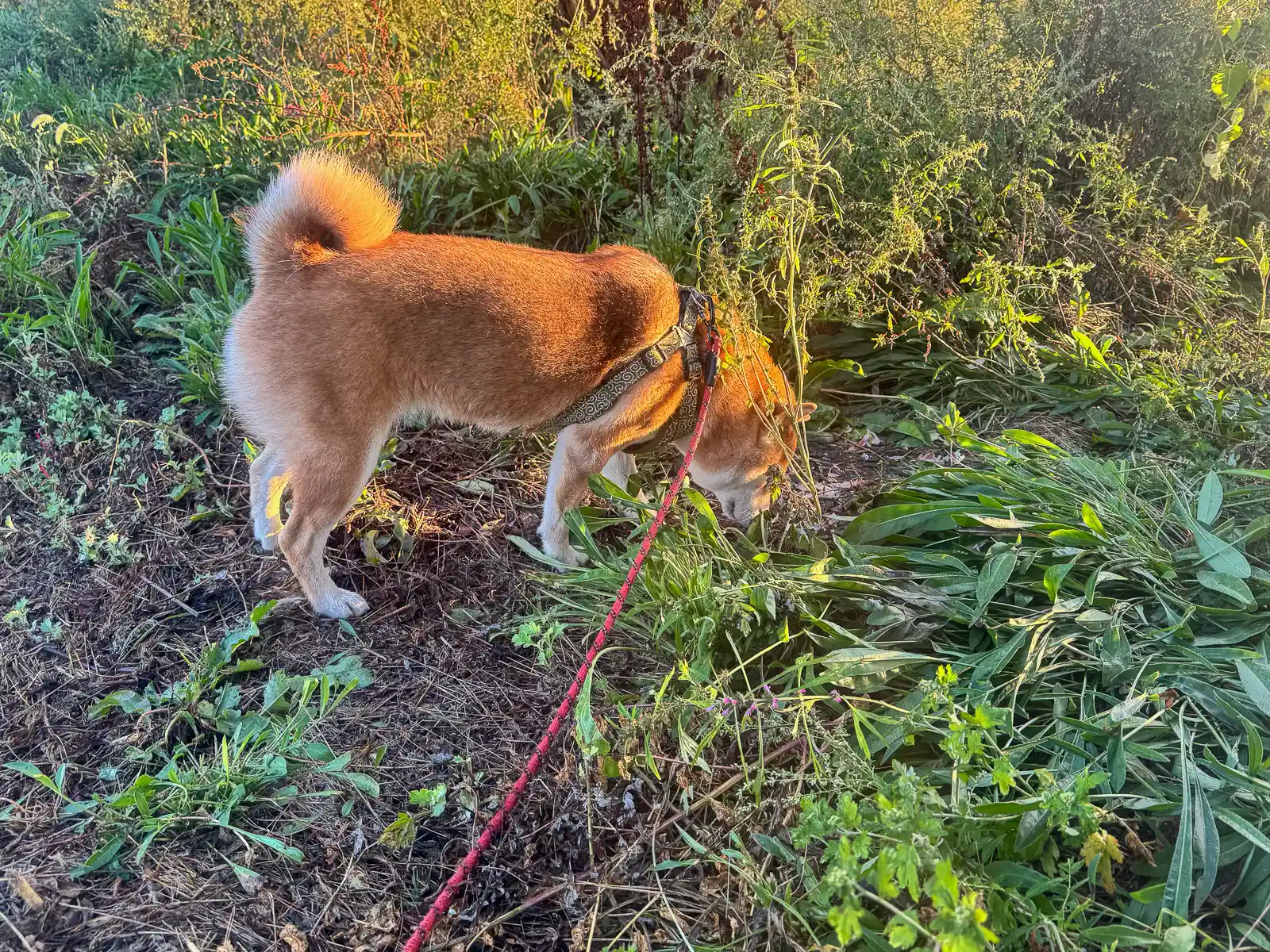
In unfamiliar places, or places we haven’t visited for a long time, Hodu often seems to sniff more and scent-mark more often.
When that happens, I try not to hurry her.
From a distance, rural roads can look almost the same every day.
But when you actually walk them, they’re never quite the same.
The light on the mountain ridges changes on autumn mornings. The color of the rice paddies changes. We pass people working in their fields, meet neighborhood dogs, and sometimes run into one of the cats who comes to our house for food.
Sometimes we see a small dead bird.
I notice ripe apples, golden rice moving in the wind, and stars at night.
Not long ago, during an evening walk, we even came across a little white piglet walking alone along the road.
I don’t know what Hodu is reading through scent.
But I no longer assume that because a road looks the same to me, it must also be the same road to Hodu.
Letting Hodu Choose the Route Does Not Mean Giving Her Complete Control
That doesn’t mean Hodu decides every part of all three walks.
In practice, the amount of choice I give her changes from one walk to another.
In the morning, she gets the most freedom.
If time isn’t a problem, I usually follow the direction she chooses and wait when she stops.
At lunchtime, things are different.
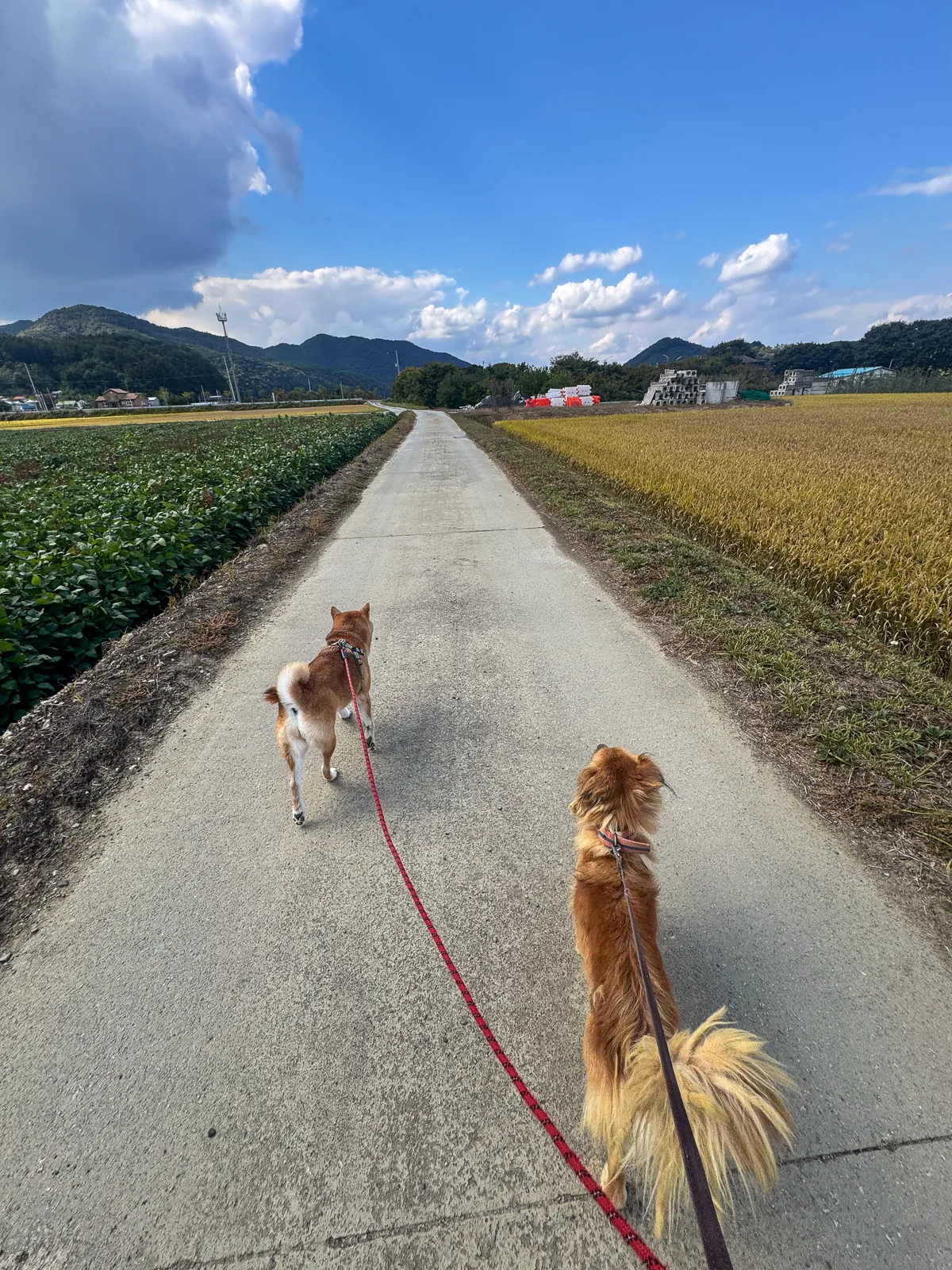
Kongi, a neighbor’s dog, often joins us.
Kongi has less walking experience than Hodu and can move this way and that unpredictably, so I often choose the direction for safety. After we’ve walked about one kilometer together, I guide Kongi back home so the lunchtime walk doesn’t become too long.
There’s another difference I’ve noticed.
From what I’ve seen, Hodu pees and poops noticeably less when she walks with Kongi than when she walks alone. She often goes before we meet Kongi, or after I’ve taken Kongi home and Hodu and I are walking back on our own.
I don’t know why.
All I can say is that I’ve noticed the same difference repeatedly.
In the evening, we usually take a fixed route.
About five or six nights a week, we walk roughly the same 1.2-kilometer course, which usually takes around 25 to 30 minutes.
That’s a limit I’ve intentionally set so the evening walk doesn’t become too long.
Hodu knows the route well. Sometimes she passes the spot where we usually turn around and seems to want to continue.
On weekdays, I guide her toward home.
But on Fridays or Saturdays, when there is less pressure from the next day’s schedule, I sometimes let her continue in the direction she wants.
So when I talk about giving Hodu choice on a walk, I don’t mean handing over all control.
It means leaving as much room as I reasonably can for Hodu to make real choices within the limits of safety, time, and the needs of the people and animals walking with us.
Why Sniffing and Exploring Matter to Dogs
The sniffing and exploring I began to pay more attention to after moving to the countryside are natural behaviors for dogs.
Research on canine olfaction describes sniffing and exploring through scent as species-typical behavior and argues that understanding a dog’s olfactory world is relevant to understanding canine welfare.
Veterinary and animal-welfare guidance also discusses walks where dogs can sniff and explore at their own pace as a form of sensory enrichment.
There have also been experiments involving olfactory activities.
In one study, pet dogs took part in either nosework or heelwork for a period of time and were later tested using a cognitive-bias task. Dogs in the nosework group approached ambiguous stimuli more quickly after the intervention, while the same change was not seen in the heelwork group. The researchers discussed natural olfactory behavior and opportunities for active choice in relation to welfare.
But that study didn’t test the kind of ordinary daily walks I take with Hodu.
So I don’t want to turn it into the claim that,
“Letting a dog sniff more on walks makes the dog happier.”
The degree to which animals can exercise choice and control over their environment is an important topic in animal-welfare research. That doesn’t mean that giving an animal more choice is automatically better in every situation.
The point where my experience and the research meet is modest, and I think that’s enough.
Opportunities to sniff and explore, and opportunities to make choices where possible, are worth considering when we think about what a walk is for.
Giving Her a Choice Is Not the Same as Ignoring the Risks
Even when I follow Hodu’s chosen direction, there are times when I intervene.
Near a road with traffic, I make the call.
If she stays in one place for too long, I say, “Let’s go.” Most of the time, she starts moving again.
Sometimes, while we’re playing with a ball, it rolls into a rice paddy.
Hodu loves balls, and if one goes into a paddy, she may rush straight after it. Then I end up running over, grabbing the leash, and pulling her back out.
By that point, her legs are usually already covered in mud.
I also stop her when she tries to rub or roll herself on a dead animal or another strongly scented object. I prevent her from getting too close to other dogs’ poop as well.
I want to give Hodu as much choice as I reasonably can.
But I can’t leave her to deal with every consequence of those choices.
The places where we walk aren’t untouched wilderness.
Cars use the roads. There are rice paddies, fields, and farms. Other people and animals live here. There are risks created by human activity.
That’s why I don’t see respecting Hodu’s choices and holding the leash as contradictions.
Where choice is possible, I let her choose. When risk has to be judged, I take responsibility.
The way I walk with Hodu now is an ongoing attempt to find the balance between those two things.
I Don’t Know Whether Hodu Is Happier
If someone asked whether Hodu is happier since we moved to the countryside, part of me would like to say yes.
There are moments when it looks that way to me.
When she explores a place for the first time, following scents, or when she’s playing with a ball, her expression and movement seem noticeably different to me.
But there is a problem with that interpretation.
I myself am much happier on our walks now.
Maybe Hodu looks happier to me because I’m enjoying the walks more.
Maybe I’m seeing in her the same sense of fulfillment I feel living here.
I can’t rule that out.
Since the move, I also feel that Hodu seeks physical contact with me more often than before. When I talk to or pet the cats, she sometimes comes over and reaches out with a paw. If I stop petting her sooner than she wants, she may ask again. When she hears the names of family members or the word “Mom,” I’ve seen her perk up her ears and sometimes head toward the front door.
I can look at those behaviors and think that Hodu is lonely or misses the rest of our family.
But that’s my interpretation.
What I actually observed was her behavior.
The same is true of our walks.
I feel that Hodu looks happier now.
But I can’t state that as a fact.
I have to separate what I observed from what I feel when I interpret it.
There is, however, one thing I can say with confidence.
I changed.
I used to think that I was giving Hodu some of my time by taking her for walks.
After the walk, I still had work to do, places to go, and obligations waiting for me. If Hodu had peed and pooped, I felt as if I had completed an important task.
Now I don’t mind waiting at a fork to see which direction she will choose.
While Hodu sniffs, I look around too.
Sometimes I talk to her. Sometimes we simply walk without saying anything.
And at some point, I began to think about our walks differently.
I wasn’t only giving Hodu my time.
Hodu was also spending time from her own life—time that will never come back—walking with me.
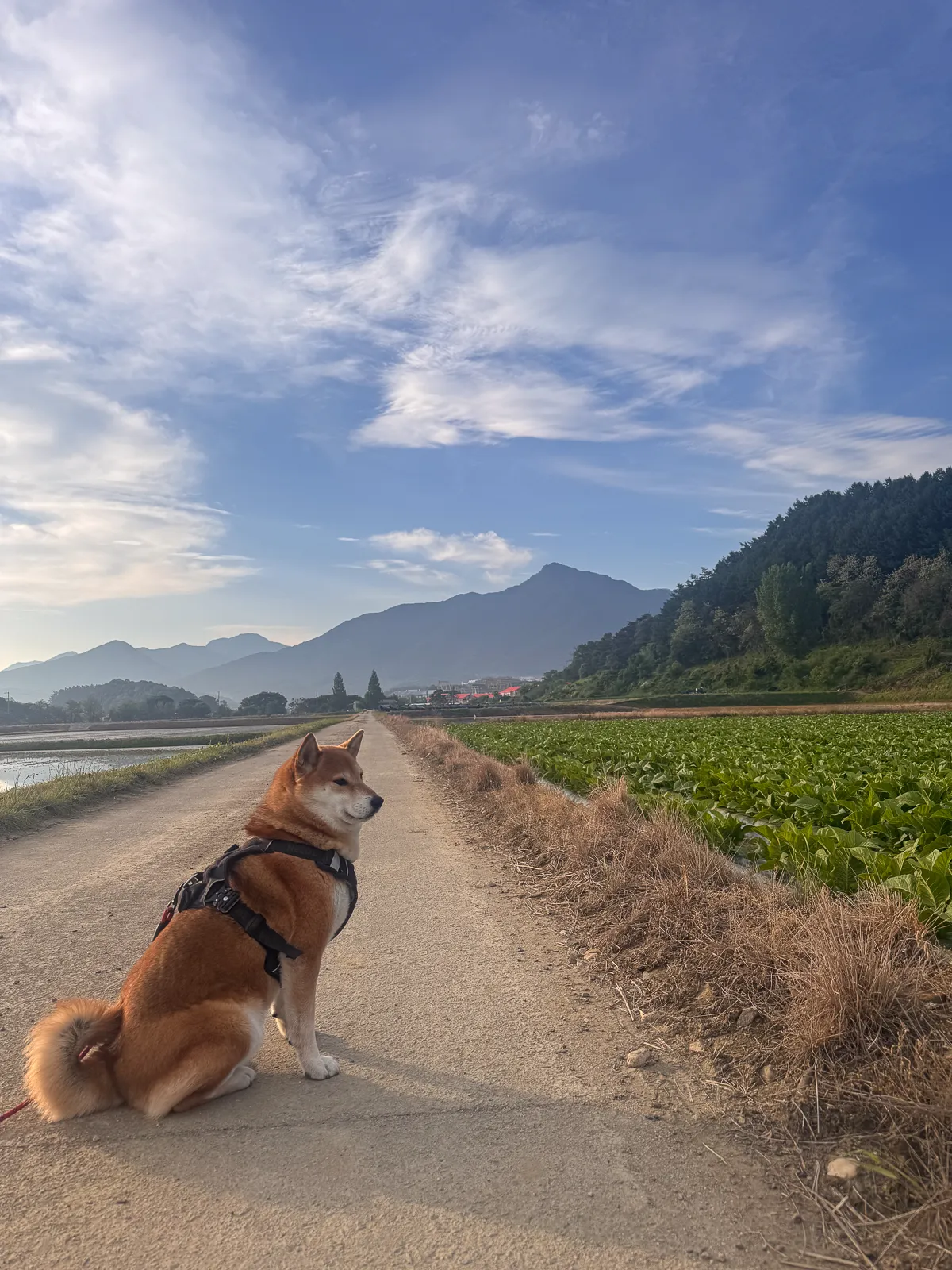
Since Hodu was born, we have walked countless roads together.
Looking back on those years has changed the way I think about walking with her.
I’m not saying that every walk should simply be made longer.
I’m not saying that every dog should be allowed to choose every route.
I only think there are questions worth asking on your next walk.
Am I thinking only about where we’re going today?
Or,
Am I also paying attention to what the dog walking beside me is trying to do?