
Eleven Bowls Under the Eaves
What changed when I started feeding the cats outside my door
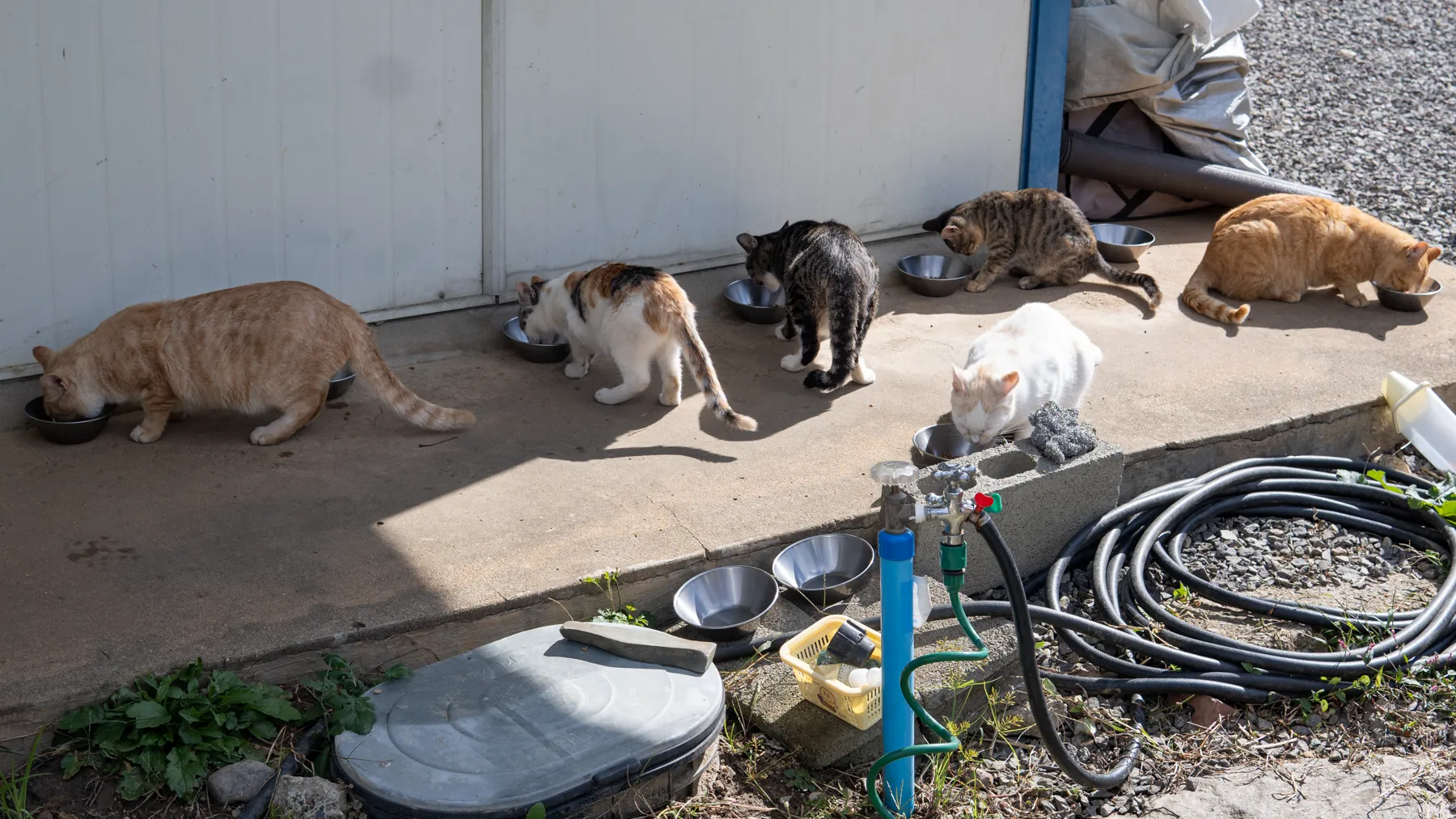
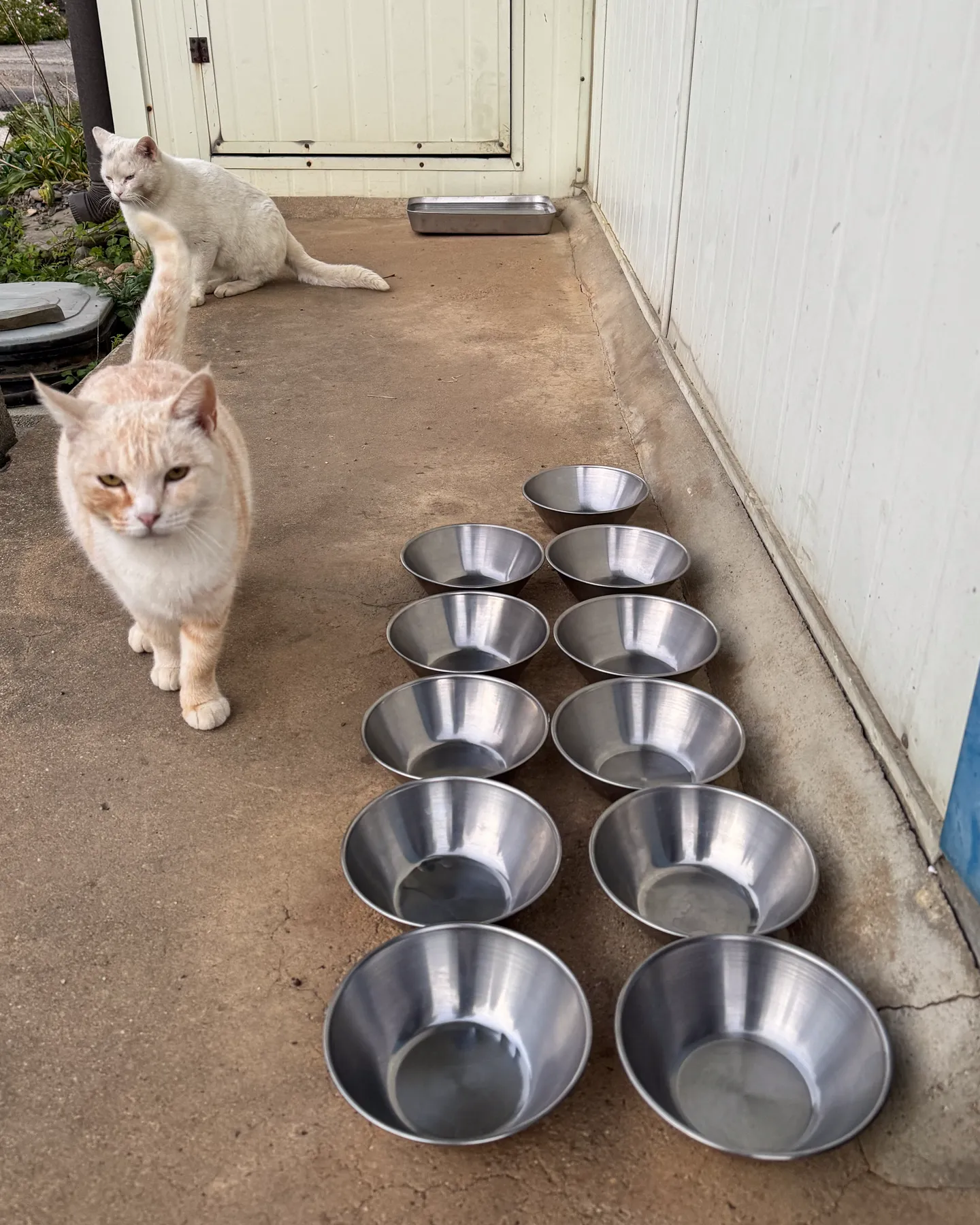
At 5:50 in the morning, I pick up two stainless steel bowls and knock them together a few times. It’s the signal for breakfast. Not that many cats need it. Most of them are already waiting under the eaves by my front door. I line up eleven bowls in front of them and fill a wide stainless tray with fresh water. I do this three times a day. A few of the cats who live in the yard get an extra meal in the morning and another at night. And if a cat from the next alley over doesn’t turn up at mealtime, I carry her food to her.
I never planned any of this.
At the beginning of March, it was nothing more than a scoop of Kant and Fooku’s kibble for whatever cat happened to cross the yard: one small shared bowl, no set time. The 20-kilogram sack of food for street cats that I bought on March 15 was nearly empty by May 30, when I ordered the next one. These days the same sack is gone in a little over two weeks.
In between, my days were rearranged, and the distance between me and the cats in the yard changed. I worry more now. I have questions I can’t answer. This is a record of those seven-odd months. It isn’t an argument for feeding street cats, or against it. It’s an account of what actually happened to one person in a Korean village who started putting out food.
A bowl for whoever wandered by
On February 27, 2026, I moved into the country house where I now live. The previous tenant had only come out on the occasional weekend, so for a long time the place had been, for all practical purposes, empty. Empty houses tend to collect cats. But this one has nowhere a cat could really hide. The yard and the vegetable patch beside it are fine for passing through or resting a while, but there’s no corner where a cat could let its guard down and sleep. When I saw cats crossing the yard, I guessed the place had been less a home to them than a shortcut, a stretch of ground nobody was using.
For Kant and Fooku, my two indoor cats, that shortcut was the best show in town. From the first day, they went from window to window, staring at every cat that crossed the yard and pricking up their ears at every cry from outside. I’d been counting on that. Even before we moved, I had thought the best entertainment a country house could offer two indoor cats was the view out the window.
I began putting out food for the outdoor cats in early March. I don’t know the exact first day; that’s how little I made of it. When a cat showed up, I shared a little of Kant and Fooku’s food. When none came, that was that. The earliest record I have is a video from March 16. Four cats appear in it. Three I can name with certainty: Nori’s Mom, Nori’s Dad (as I call him), and Jjaeksuni, the mother of a kitten named Daon. The fourth is probably Ippeuni. But the video only shows what feeding looked like by then. It doesn’t tell me when it began.
I had already met Nori and Witty by early March, too. On March 13, when friends came over and we were grilling in the yard, Nori begged them for food. Yet the first photo of the two of them on my phone is from March 17. Until then, I hadn’t thought them special enough to photograph. Nor did I take pictures and delete them. If I had thought them that special, I would certainly have sent the pictures to my family with a long story attached.
Around that time, the two also started spending their nights in the yard. As best I can remember, they slept there now and then from around March 8, and from around March 12 they settled in for good. Their first bed was a cardboard box I put together. Witty never slept apart from Nori. The nights were still cold.
In a message to my family on March 19, I wrote that about seven cats were coming to eat at our house. Nori, Witty, Jjaeksuni, Nori’s Mom, and Nori’s Dad I’m nearly sure of; the other two were probably Pink Yeppeuni and Pink Yeppeuni’s Mom. In the same message I attached a picture of Nori and said I was thinking of keeping him.
The March nights out here still felt as if they dropped below freezing, and that worried me. On March 18 I ordered an insulated winter house for outdoor cats and set it by the front door when it arrived on the 20th. Nori often rested and slept inside. Witty rarely went in on his own. But when I came in late at night from Hodu’s last walk, or looked out at dawn, there was Witty, inside the winter house, pressed up against Nori, asleep. Wherever Nori was, Witty ended up sleeping beside him and waking there. Watching him refuse to leave Nori’s side, I felt something toward Witty that was different from my closeness with Nori. It was nearer to respect.
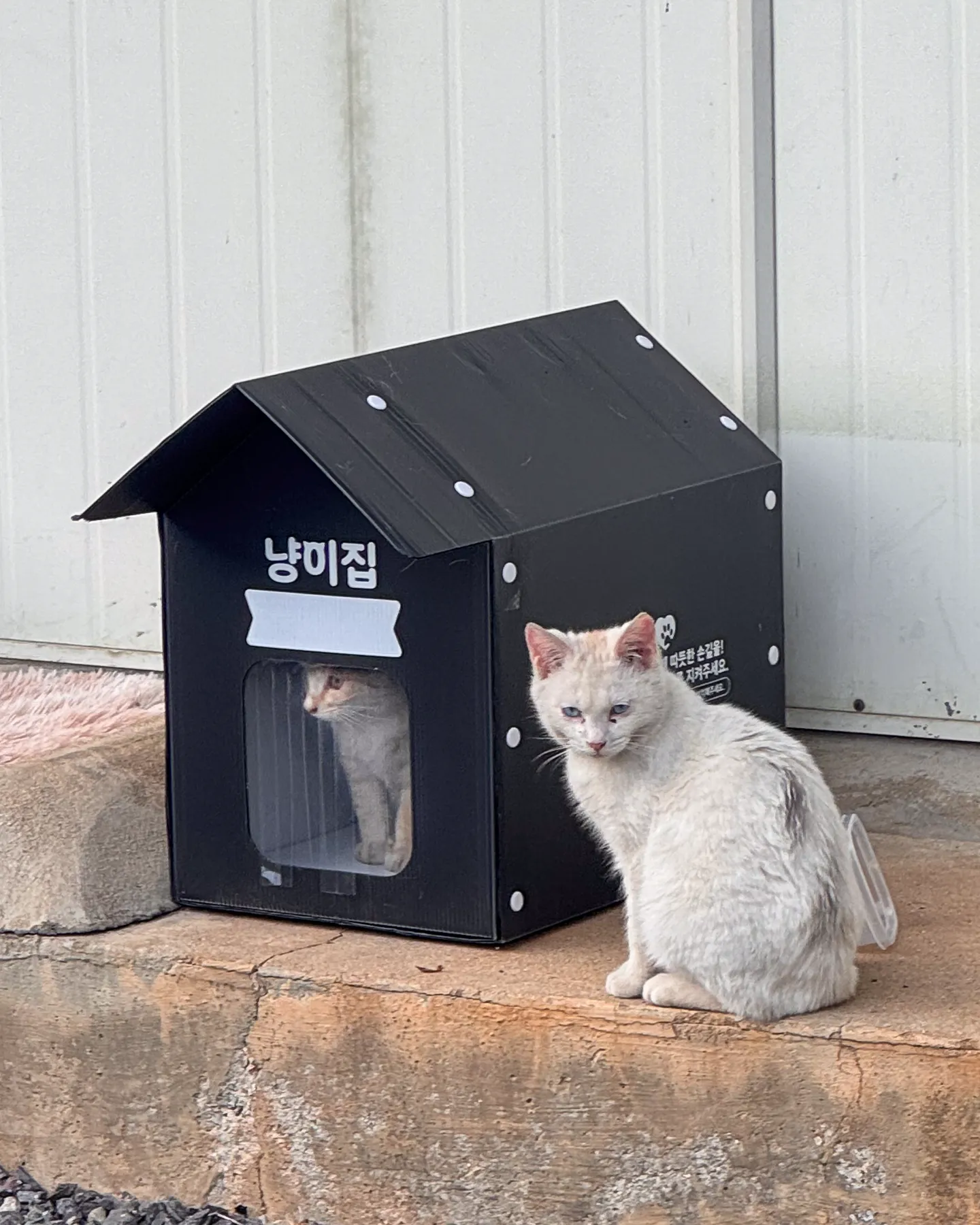
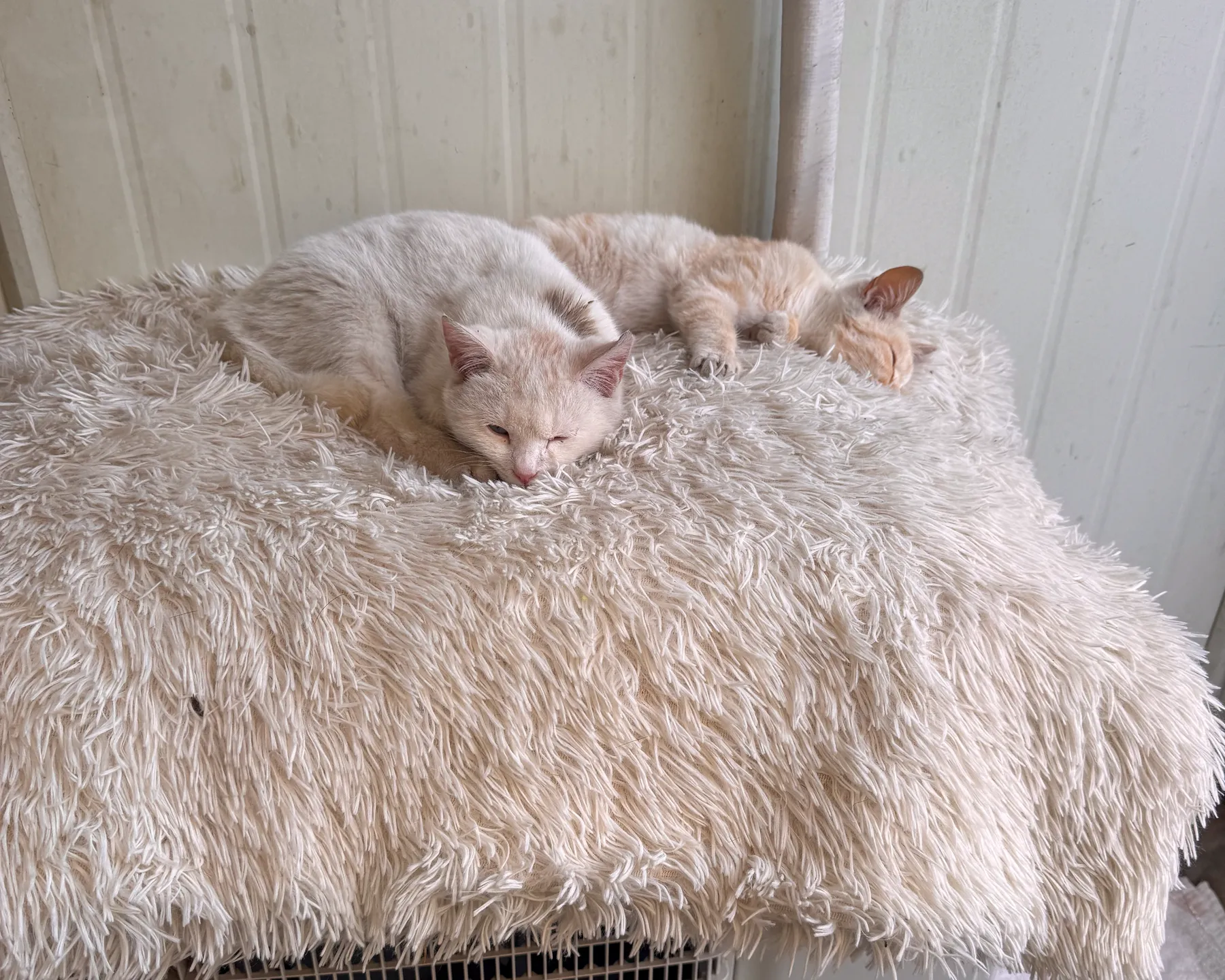
When Witty was on his own, he had a favorite spot: the folded rug on a camping chair I’d set in front of the winter house. The cement floor beneath the waterproof covers on the two bicycles parked under the eaves was a refuge for both of them, too. Later I laid rugs and old cloths in there, and the pair took turns choosing between the winter house and the bicycle covers. When it rained, water blew in under the bicycles and soaked the cloths, and on those nights they went into the winter house on their own.
How one sick cat set the schedule
Back then I still fed whoever showed up, whenever they showed up. But Nori and Witty got different treatment. Partly because they lived in our yard. Mostly because of Nori, who was much smaller and thinner than Witty, and coughed. Then a woman in the neighborhood told me that Nori’s siblings had coughed in just the same way and died, one after another. I didn’t see that myself. Still, after I heard it, I fed the two of them as carefully as I fed Kant and Fooku. Whatever the reason, they already mattered to me.
At the end of March, I took Nori, still coughing, to the vet in town. He got an antibiotic injection and a course of medicine to take home. The vet told me to feed him well and put some weight on him; reaching a normal weight would give him a better chance of surviving. On March 29, I gave the two of them their first dose of a spot-on treatment that protects against both parasites and heartworm: Bravecto Plus, the 1.2–2.8 kg size, chosen with the vet based on their weights at the time. On April 1, I took them both to a different clinic in a nearby city for a blood test to check for infectious disease, and had Nori’s cough examined.
Medicine meant regular meals. And the antibiotic powder tasted too strong to simply mix into dry food. So twice a day I made broth and stirred the medicine into it to hide the taste. To put weight on Nori, I couldn’t skip a meal, either. Witty was always at his side, so Witty ate too. That is how feeding on a schedule began: not with a plan, but with one sick cat.
The trouble is that eating can’t be hidden. Word that Nori and Witty were being fed soon got around the neighborhood cats, the way news travels among cats: by watching. It was hard to ignore the ones who sat nearby, staring, while the two of them ate. I started handing kibble to one, then another, and more cats came. Even so, it wasn’t regular feeding yet. I gave in only when they begged, putting a little kibble in a small bowl on the ledge under the eaves by the front door. That one sack from mid-March lasted me until the end of May.
There were reasons I didn’t simply start feeding the others on a schedule. My wife worried that if the neighbors were bothered, I’d be the one they resented. And I didn’t want the cats to come to rely on my food. I’ll come back to that second worry.
Nori and Witty went through a great deal after that, and since April 29 they have lived indoors with us. Both were neutered on May 15. How they came in from the yard is a story I’ve told separately Bringing Stray Cats Indoors.
I have no record of when I started feeding the other cats at the same times every day. But by May 14, the day I first found what I took to be the cats repaying me on my doorstep, feeding was already part of my routine. Early May is probably close.
Eleven bowls, three times a day
What follows is how things stand in October 2026. It’s a routine that grew to fit the cats in our neighborhood and my own life. I don’t offer it as a model for anyone else.
The schedule
Regular meals are at 5:50 a.m., 1:00 p.m., and 6:00 p.m. The most cats I’ve counted at a single meal is eleven, so I put out eleven bowls. Not that eleven always come. Breakfast and dinner usually draw nine or ten; lunch, eight or nine. Those are the numbers gathered at my door for one meal, not the number of cats in the neighborhood.
Four cats who live in or near the yard get two more meals: Nori’s Mom; Jjaeksuni and her daughter Daon; and a kitten who lives alone, whom I call Aegiya, roughly "little one." After breakfast I walk Hodu, our dog, and when we get back, at 7:10, the four get a little kibble in chicken-and-vegetable broth. At 9:40 p.m., after Hodu’s last walk, they get a little kibble and a treat. So food comes out of my front door five times a day, but not every cat eats five meals. I’ll explain later why only those four get extra. Lately Aegiya comes some days and not others.
I make the broth myself. I simmer chicken breast with cabbage, carrot, and Korean zucchini, then freeze it in small containers along with the shredded meat. Each morning I warm one up and mix it into dry food. No salt, no seasoning. I made a mistake once, before we moved here, and since then I’ve been careful about anything harmful to cats; onions, garlic, green onions and the like never go in. The cats love it. Now and then I stir in some newborn-kitten milk formula, left over from August or September, when I briefly looked after two kittens of about four weeks, Brown and Gray. I returned them to their mother the next day. That story means so much to me that I’d like to tell it on its own someday.
There are two other places I take food. Ippeuni, whose name means something like "pretty one," is a female who lives on the roof of an empty house up the next alley. I’m very fond of her. If she doesn’t come to my door at mealtime, I go to her: around 6:20 a.m., on the way with Hodu; around 1:10 p.m., straight after the lunch round at my house, when I wash her bowls and feed her; and around 6:10 p.m.
There are four houses on our alley. Three cats live at the house at the very top: Pink Yeppeuni (a different cat from Ippeuni, despite the similar name), Pink Yeppeuni’s Mom, and a tom called Ppeonppeoni, "the shameless one." That house doesn’t put out food at lunch or dinner. All three sometimes come down to my place, but not always. Pink Yeppeuni’s Mom, who recently had kittens, still comes down to eat. It’s Pink Yeppeuni who often stays away; she seems a little uneasy around the cats farther down. Some days she won’t come down at all and seems to be waiting for me to come up. So when I go to Ippeuni at lunch and dinner, I fill the bowls at that house too, and wash and refill their water.
Here’s how the day runs:
| Time | Where | Who | What |
|---|---|---|---|
| 5:50 a.m. | Under my eaves | Whoever comes (usually 9–10) | Breakfast |
| 6:20 a.m. | Ippeuni’s empty house | Ippeuni | Kibble on Hodu’s walk (if she didn’t come) |
| 7:10 a.m. | Front door | Nori’s Mom, Jjaeksuni, Daon, Aegiya | Broth with a little kibble |
| 1:00 p.m. | Under my eaves | Whoever comes (usually 8–9) | Lunch |
| 1:10 p.m. | Ippeuni’s place; house at the top of the alley | Ippeuni; that house’s cats | Wash bowls, then lunch (Ippeuni: if she didn’t come) |
| 6:00 p.m. | Under my eaves | Whoever comes (usually 9–10) | Dinner |
| 6:10 p.m. | Ippeuni’s place; house at the top of the alley | Ippeuni; that house’s cats | Dinner (Ippeuni: if she didn’t come) |
| 9:40 p.m. | Under my eaves | Nori’s Mom, Jjaeksuni, Daon, Aegiya | A little kibble and a treat |
Bowls and water
The main feeding spot is under the eaves at the entrance to my house. I line up eleven stainless steel bowls and put the shared water in a corner. Until recently the water went in a tub about the size of a washbasin. On the morning of October 21 I switched to a wide stainless steel tray I bought for 5,000 won at a household goods store. It’s easier to keep clean, and it’s low and broad enough for kittens to drink from comfortably. Around lunchtime, when the sun reaches under the eaves, I move just the water into the shade by the road.
About an hour after each meal, I scrape the leftovers into one bowl and throw them out, then collect all the bowls, wash them, and let them dry. Three meals, three rounds of dishes. The water gets changed three times a day, and any time I see it’s dirty. Each time I rinse the tray with the hose near the feeding spot; once a day, just before lunch, I scrub it properly. No detergent.
Ippeuni’s food and water bowls get washed once a day, just before lunch, when I change her water too. When she starts eating, I tell her she’s very pretty, and leave. There’s usually nothing left over. If there’s a little, I throw it out before the next meal. It’s hers, but another cat may have gotten to it while she was away.
There is some outside advice worth mentioning. Alley Cat Allies, an American nonprofit, recommends clearing away uneaten food within 30 minutes, because food left out overnight can draw insects and other wildlife. It also advises providing fresh water and feeding in one spot that’s kept clean. That’s an American organization’s advice, not Korean law or an official standard. At the moment, I clear the bowls after about an hour.
A day arranged around mealtimes
Since moving here, I haven’t slept anywhere but this house. Even at Chuseok, when Koreans go home to their parents, I hurry back for the animals: an undutiful son, and a social misfit by choice. I’ve almost never missed a meal. Without my quite noticing, my day got wedged between the cats’ mealtimes and Hodu’s walks. Breakfast out, walk Hodu, stop by Ippeuni’s, home for the broth round. At night, Hodu’s last walk, then the late snack. In the beginning, I fed the cats when they turned up. Now I’m the one who turns up on their schedule.
On days I go back to the city where I used to live, for an appointment or to see family, I put breakfast out a little early and plan to be home by lunch. A few times I’ve been late. The animals indoors keep their complaints to themselves until I take out the bowls, and then make more of a racket than usual. The cats outside each handle it in their own way. Some lie near the feeding spot and wait quietly. Others are nowhere to be seen; tired of waiting, I assume, they’ve gone off somewhere. Then the clink of stainless bowls, the rattle of kibble, and the stirring of the cats who stayed bring them back one by one. I apologize for being late and explain what held me up. They half listen.
That’s why, these days, I knock two bowls together softly before meals, for the ones who haven’t arrived yet. Most are there before mealtime anyway, some as much as an hour early. Rainy days are the exception. When it rains, fewer cats come.
A full bowl doesn’t mean every cat can eat
I don’t have a rule about feeding cats separately or together. Instead, I watch for a while as they eat. I look for squabbles, and for a cat who can’t get to an unclaimed bowl because reaching it would mean getting too close to another cat. If I see one sitting off to the side, as Jjaeksuni sometimes does, I pick up a bowl and move it over.
No cat has shown me more clearly than Aegiya that filling the bowls isn’t enough. Aegiya is a kitten who lives alone, one of three kittens on this alley who made it through late August and early September, when nearly all the others died. The other two are Daon and David. Aegiya cries far more than other cats do.
Aegiya is also unusually wary, and not only of me. An adult cat had only to come near and Aegiya would be over the wall. A kitten that kept apart from everyone. I doubt Aegiya ever touched noses with anyone. When the other kittens were dying, Aegiya was coughing too, but never lost appetite or energy, and pulled through. I believe that isolation kept the kitten away from the sick cats, and that is why Aegiya survived.
For a while Aegiya lived near the wall of my yard. A few days ago, by the look of it, Aegiya moved into the shed next door. Nori’s Mom and Jjaeksuni, who live in my yard, were never very tolerant of the kitten. More than once, I also saw two cats who don’t live on this alley, but come here to eat, threatening Aegiya near the house. I knew all this and had been worrying, and, just as I’d feared, Aegiya seems to have moved away. What the direct reason was, I can’t know.
After that, Aegiya stayed away from the broth breakfast and the late snack for days. On the morning of October 20, even getting to the regular breakfast seemed a struggle. Aegiya appeared only after Hodu and I were back from our walk and I was out in the yard. Had the kitten eaten anything at all? I brought over a bowl of breakfast leftovers I’d gathered, but Aegiya just kept glancing around. Then Nori’s Mom came over and hissed, and Jjaeksuni came and stared. Aegiya froze in front of the bowl. Only after I grumbled at Nori’s Mom and shooed her off did Aegiya start to eat. There was no sign of the kitten at the broth round that morning.
It wasn’t the only time. These days Aegiya is warier of the other cats, often hesitating at a bowl or leaving altogether. And yet Aegiya lets me come closer than before. When I stand nearby and keep the others away, Aegiya often eats to the end, still glancing around. Maybe the kitten feels a little safer near me. Or maybe the other cats simply come closer less often when I’m there. Whether Aegiya understands what I’m doing, I don’t know.
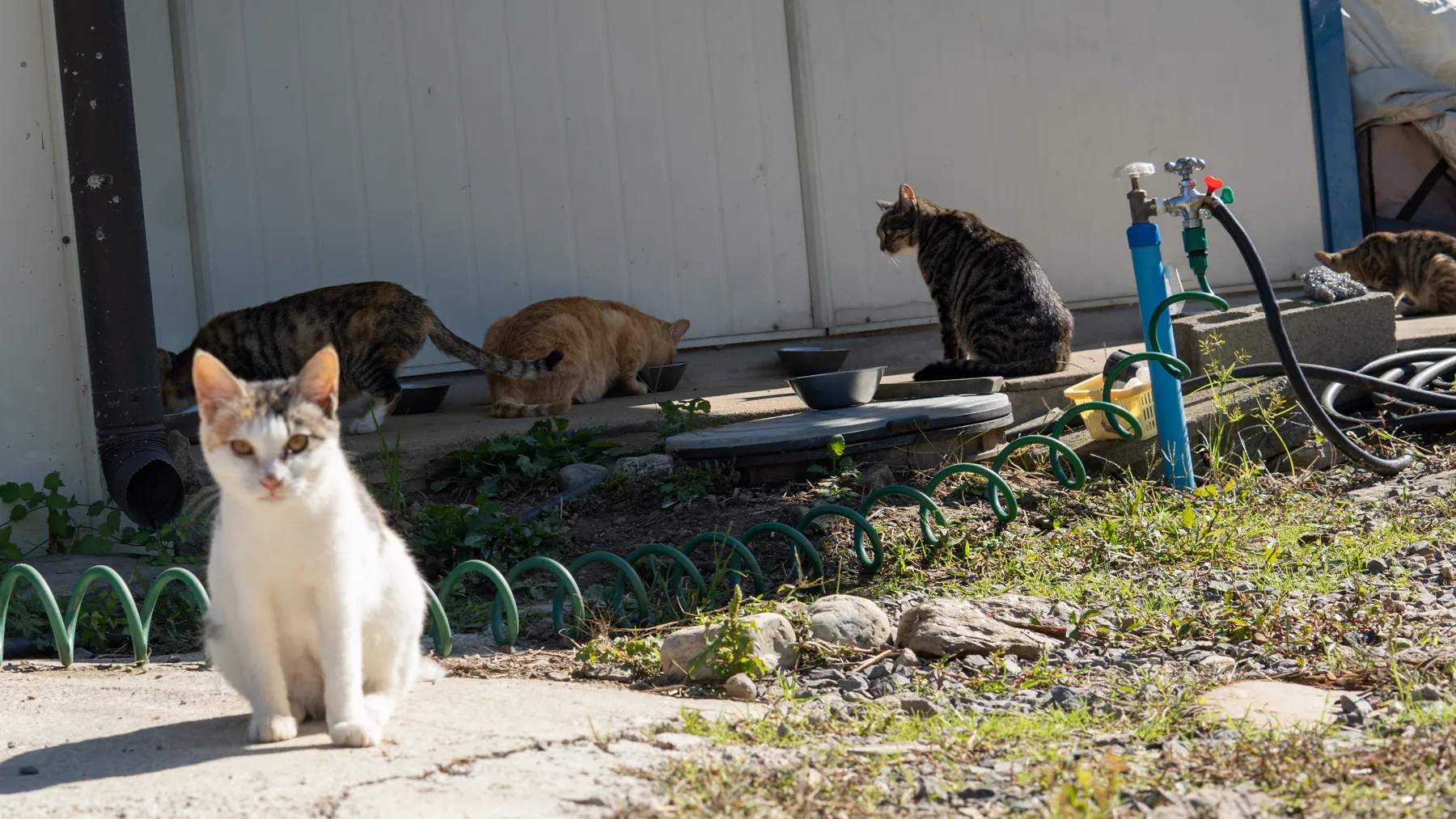
The American Association of Feline Practitioners’ 2024 guidelines say that tension between cats is common but that its signs are mostly subtle and easy to miss, and that separate feeding areas help reduce competition and stress. They’re written for homes with several cats, so I can’t apply them directly to my yard. Still, they match what I’ve learned out there. Eleven bowls don’t mean eleven cats can eat. What matters as much as how many bowls I set out is who can get to them.
Why they don’t all get the same
The four get two extra meals for a simple reason: they live in my yard. I accepted that, and gave them places to stay, however makeshift. Once my hands and my heart were in it, worry and affection followed. When I open the front door, I expect them to be there, and quietly hope they will be. It’s an entirely subjective feeling, but it’s what makes these four special. I think of them as close to me, as creatures I’m genuinely connected to.
The extra meals weren’t planned, either. When I put out breakfast for Hodu and the indoor cats, I always play the same music. Nori’s Mom seemed to work out that the music meant food. When it played and the house got noisy, she would sometimes sit at the screen door and stare inside. I found her stare hard to ignore, so now and then I’d share a few treats. Daon, Jjaeksuni’s daughter, still wary of me back then, would watch, so I gave her some too. Aegiya, who lived near the yard wall at the time, would cry for a share whenever Nori’s Mom was eating, so Aegiya got some as well. But it wasn’t every day. And Nori’s Mom didn’t come to the screen every time the music played.
It took something that happened in early October to turn treats into daily meals.
On the morning of October 4, Nori’s Mom didn’t come to breakfast. It seemed strange and I started to worry; a few hours later she turned up soaking wet. You don’t often see a cat that wet on a clear day. I wondered whether she’d fought another cat in a flooded rice paddy. That night, giving out the late snack, I found a fairly large wound on the heel of her hind leg. It looked like a bite from a fight. The wound still looked raw, so I took it to be fresh. If it got infected, it could turn dangerous.
The next day, October 5, I had to take David for his second vaccination and Hodu for her second booster at the clinic in a nearby city. I showed the vet a close-up photo of Nori’s Mom’s wound and explained. I also mentioned Aegiya, who had a mild cough. After watching kittens suddenly fall ill and die one after another from late August into early September, I couldn’t dismiss that cough. The vet prescribed medicine containing an antibiotic and some cold medicine.
From that night, I mixed the medicine into Nori’s Mom’s portion of broth at the late snack. Into Aegiya’s I put the amount the vet advised for Aegiya’s weight. Daon got broth with no medicine. From the next day I did the same in the mornings, with broth set aside from the indoor animals’ breakfast. Three days, twice a day. At some point Jjaeksuni joined in. The meals that began as a way to give medicine outlasted the medicine. They are the 7:10 broth breakfast and the 9:40 snack.
The fur around Nori’s Mom’s wound has grown back. But on October 21, looking closely, I could still see the wound. I have photos from the day I found it and from this time. She’s active and shows no obvious problems. Aegiya’s cough has eased a lot, but the kitten still coughs now and then.
Then there are the cats I deliberately don’t give the extras to. Witty’s Dad, Nori’s Dad, and Ppeonppeoni from the top of the alley sometimes come and won’t leave until they get a share. All three are big toms. If I weakened and gave them something once, nine times out of ten they’d be back the next morning or night, waiting outside the front door. More than once I’ve been startled to see Witty’s Dad and Ppeonppeoni come out of the winter house I’d set up, after a night inside.
I thought that if those toms settled here, Nori’s Mom and Jjaeksuni might cope, but young Daon and Aegiya would be pushed out. Apart from keeping each other in check, those three have no natural enemies around here, and I figured they were strong enough to hunt without much trouble. That’s why I rarely give in when they beg.
Not that I always keep to the rule. Witty’s Dad is often late for dinner and stands at the front door, grumbling for food. Lately he’s started asking for the 9:40 snack meant for the yard cats, too. But he is the father of Witty, who is one of mine. So I end up making allowances. And lately he has started, a little at a time, to let me touch him.
This is my own judgment, from watching a handful of cats in and around my yard. I don’t think of it as a rule for cats anywhere else.
Questions I haven’t answered
Besides my wife’s worry, I had hesitations of my own when I held off feeding the other cats regularly. I didn’t want them to depend on my food. I wasn’t sure that food and water from a person were help that cats in the countryside really needed. And even if they were, there was a paradox I feared: that my help might weaken their ability to survive.
I see it differently now. Not because I arrived at some clear argument. But I do know that my help doesn’t make them wholly dependent on me. The rest is simple: helping them a little is something I want to do.
I do have a vague hope. That the food and water I put out cut down the time and the risk of wandering all day in search of something to eat, and that they spend that time resting and playing instead. That a mother with kittens can eat her fill quickly at a fixed hour and get back to them, so her kittens spend less time alone and in danger. That the kittens can nurse on warm milk and feel safe and content. Or, more simply, that they get a little time to forget the unrelenting stress of staying alive.
On hunting, there is one study worth knowing about. A team at the University of Exeter, publishing in Current Biology in 2021, studied pet cats living in their owners’ homes. In households that switched to a high-meat, grain-free food, the number of animals the cats caught and brought home fell by 36%; in households that added five to ten minutes a day of hunting-style play, it fell by 25%. So cats who are fed at home still hunt, and what they eat and how they play can change how much. But the study counted prey brought home, not all the hunting cats do. And it didn’t look at whether street cats lose the ability to hunt because people feed them. It doesn’t directly answer the question I started with.
Our neighbors are another open question. So far there hasn’t been a single quarrel over the feeding. But two things are worth writing down.
One is the elderly woman next door, whom I’m on friendly terms with. She says the cats do their business in her vegetable patch, and that I feed them too often. These days she seems to have quietly come to accept it. She’s a kind woman.
The other is the older man over the wall. He says that since the cats multiplied, there’s less wildlife around: noticeably fewer red squirrels and some kinds of birds, and he blames the cats. He keeps a few chickens in a small coop at his house, and says the cats break and eat the eggs. We’ve had two conversations, closer to debates than quarrels, about cats upsetting the local ecosystem.
I have no way of knowing whether what he says is true of this village. There is plenty of research on cats and wildlife. A 2022 review in the Journal of Animal Ecology searched 2,245 publications and analyzed the 332 that met its criteria. It sums up a vast body of research showing that free-roaming cats have substantial negative effects on wildlife, not only by hunting but through fear, disease, and competition, and have contributed to extinctions and population declines around the world. It also points out that this research is concentrated on oceanic islands, Australia, Europe, and North America, and that regions such as Asia are understudied. So these studies can’t settle what has happened to the squirrels and birds of this village, or to his eggs. Nor can I dismiss what he says as groundless. My experience of feeding cats and my neighbors’ experience of living with them are both things that really happen here.
More than visitors, not quite family
On May 14, there was a bone lying in front of my door. I took it as the cats repaying me. Koreans have a word for this, boeun, the returning of a kindness, and it was the word that came to mind. It happened twice more. On the morning of Monday, July 27, heading out with Hodu, I found a rib bone near the door, dropped, it seemed, at a neighbor’s barbecue and carried over by someone. Around 2 p.m. the same day, there were bones from braised pig’s trotters on the doormat. From Friday to Sunday this village fills with families visiting their parents. The usually quiet alleys are full of voices and the smell of grilling meat. The cats who watch it all from hiding apparently throw parties of their own with the leftovers.
Whether any of it was really meant for me, nobody knows. I never saw which cat left those bones. I simply choose to believe it, and to be glad and grateful. It’s a bond I’ve imagined. But not everything is imagined. Something real is there too: the distance between us, closing a little at a time.
Every cat that began coming around was intensely wary at first. None of them would let me near. They ate what I put out, but if I came close mid-meal, they all ran. Little by little, they closed the gap. Now some let me stroke them; some rub against my legs. They wait for food at the screen door, and watch Hodu and me from a distance on our walks. One or two mutter at me the way house cats do.
Not all of them, of course. Sometimes it seems they care about nothing but the food. Jjaeksuni has been eating my food since right after I moved in, and still keeps her distance when I come close. A cat who lets me pet it one day will run if I so much as come near the next. Still, at mealtime, or as much as an hour before, they’re at my feeding spot, waiting.
Until recently, Nori’s Mom hissed at me. During what I’ve come to call the dark weeks, from late August into early September, when the neighborhood kittens suddenly fell ill and died one after another, I took sick kittens to the vet, and went searching with medicine for the ones I couldn’t take. Even so, I saved only two: David, Nori’s Mom’s son, and Daon, Jjaeksuni’s daughter.
David is Nori’s younger brother by the same mother, born roughly six to eight months later, with almost exactly Nori’s coloring and markings. I suspect they share a father too, the tom I call Nori’s Dad. After the vet, I nursed David indoors, and in the end he became family. I couldn’t bring Daon in. Instead I went looking for her and her littermate Kkeunkkeuni, carrying broth with medicine in it and the canned food they liked, and set it down in front of them whenever I spotted them. Sick cats often hide before they die, so finding them wasn’t easy. Daon survived. Kkeunkkeuni didn’t.
Nori’s Mom had already sent David off on his own before he fell ill. And yet, to my surprise, a few days after I brought David inside, Nori’s Mom began living in my yard. She stopped hissing at me and started rubbing against my legs. In heat, she rolled on the ground in front of me. These days she seems to ask to be petted.
The others vary in pace and manner, but the feeling that we understand each other, that a bond is deepening, is unmistakable. I can’t put it into words, so it never arrives as a clear thought. But if intuition can be trusted, I’d say I simply know. That’s why the bond feels so intense. To share feelings with a creature beyond other people, beyond myself, almost from another world: that alone is a thrill. Above all, when they show they like me, it brings back, like nostalgia, a happiness as intense as any I’ve known: the happiness of the years when my children were small and adored me. So I’m truly grateful to them, and I cherish them. Rather than look for a justification for feeding them, I just enjoy the happiness the whole thing gives me.
They are my jimyo (知猫). Creatures who are special to me, and to my life.
Jimyo is a word I made up, borrowing from jiin (知人), literally "a person one knows." But a jiin isn’t just someone you’ve met. It’s someone you have a relationship with, who means something to you personally. With a jiin, goodwill comes before calculation; Koreans joke about the "jiin chance," the small favors that come from knowing someone. A jimyo, then, is a cat I know in that sense. Among my jimyo, the four in my yard, Nori’s Mom, Jjaeksuni, Daon, and Aegiya, are especially dear; they’re closer to me than the other cats who come to eat. You could call the 7:10 broth and the 9:40 snack the jimyo chance.
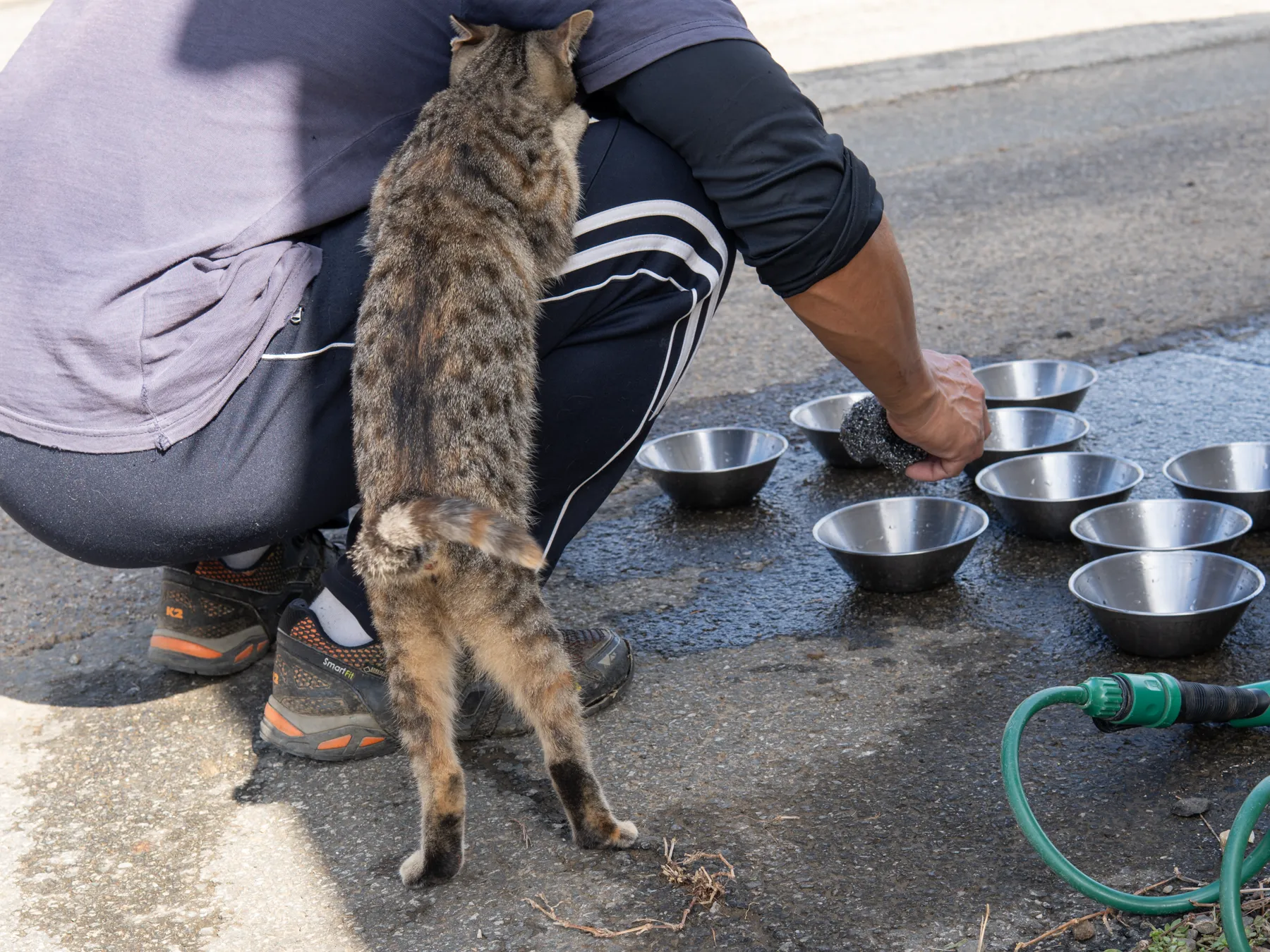
But a jimyo isn’t family. In my mind, jimyo sit somewhere between the cats who come to eat and the family I live with indoors: Hodu, Kant, Fooku, Witty, Nori, and David. The trouble is that this in-between place doesn’t stay put. In my heart, my jimyo keep edging toward family.
I try not to think of them as family. Maybe I believe family has to share blood or live under one roof. But that doesn’t explain it all. I draw the line on purpose, and for reasons.
The first is that it’s a minimal defense mechanism. They could leave my yard any day, or die from an accident, an illness, or a fight. If they aren’t family, I might worry a little less, and grieve a little less. Aegiya, in fact, seems to have left my yard for the shed next door a few days ago. I felt sorry for the kitten, and, I’ll admit, a little hurt.
And there’s a bigger reason. I take my responsibility to my family seriously. I love them a great deal, which means I miss them and worry about them a great deal, and that costs me a lot inside. I can bear that much, hard as it is. But if that cost left me with less attention and care for the family beside me now, I’d be failing in my responsibility to them. Nor is it right to fail to spend the time I’ve been given on the work I mean to do and on my own life. So I share my life’s resources with the family that is already part of it, and I try, in practice and in my head, not to let the animals or people I’m connected to outside it into the place of family, or anything close to it.
Honestly, given my temperament, if I don’t keep my wits about me, my jimyo will become family in my heart before anything else happens. Then not only I but my family will struggle. It’s what I’m most on guard against these days. When Nori’s Mom, mother of Nori and David, both my family, looks at me with a familiar, family face and rolls over to show her belly; when Daon, whom I followed around with medicine and who came back from the edge, no longer runs from me but purrs to be picked up: that is when I bite my lower lip, keep my head, and hold them inside the bounds of jimyo.
What I don’t know yet
Winter is coming. It’s my first here, and I don’t know their winters. I can only guess that it will be hard. I don’t know yet how cats here get through it, or what I should do to help. I’ll find out soon enough. I’ll learn as I go, and do something.
In November and December, the neighborhood females, most of whom look pregnant to me now, will have their kittens. I’ve heard that Pink Yeppeuni’s Mom has already given birth, in a storage container beside the house at the top of the alley. And again, many kittens will die. Will the dark weeks of late August and early September come around again?
The truth is that kittens born outdoors have a very poor chance of surviving, and they die for many reasons. It was during those weeks that I first learned how common it is for kittens born outdoors to die young. The vet said it is always like this. In one study that followed outdoor cats in the United States, 75% of kittens died or disappeared before they were six months old. The winter cold, almost here, will be one more of those reasons. Will I sink into grief and panic again? Or will even death become something I’m used to?
Feeding street cats doesn’t end with feeding them. It has been joyful, worrying, sad, tiring, and now and then it has earned me some grief. For someone who has lived inside human civilization and society since birth, sharing feelings with beings outside it can open up new ways of thinking. And it isn’t something you can drop just because your mood changes. Nor is it anything noble, like saving a dying human child. I’m just an ordinary person living an ordinary life, giving a little help to the cats of my small alley, my small world, and being happy doing it.
I believe dogs and cats have already come inside human civilization and live as part of it. They aren’t like gorillas, lions, or giraffes in the wild. They live within our civilization, on our side. They may not be family inside the house, but out in our yards, aren’t they at least jisaeng (知生), to borrow my own word again: lives we know? So, without any elaborate ethical argument, I simply hope people will live alongside dogs and cats. I don’t have grand expectations, and I’m not going to join a campaign. This isn’t an animal-rights crusade.
To my mind, coexistence between people and these animals doesn’t come about through policy. Whether the eyes we turn on them are warm or cold, it begins with the wish to respect other lives and to live with them in this civilization and this ecosystem, the way we respect other people and their lives in our society. And that wish, I think, comes from realizing that this earth doesn’t belong to humans alone, and that every creature here has had, from the start, the right to share it. ■