
How Do You Manage Each Cat’s Food in a Multi-Cat Home? — Meal and Weight Records of Five Cats
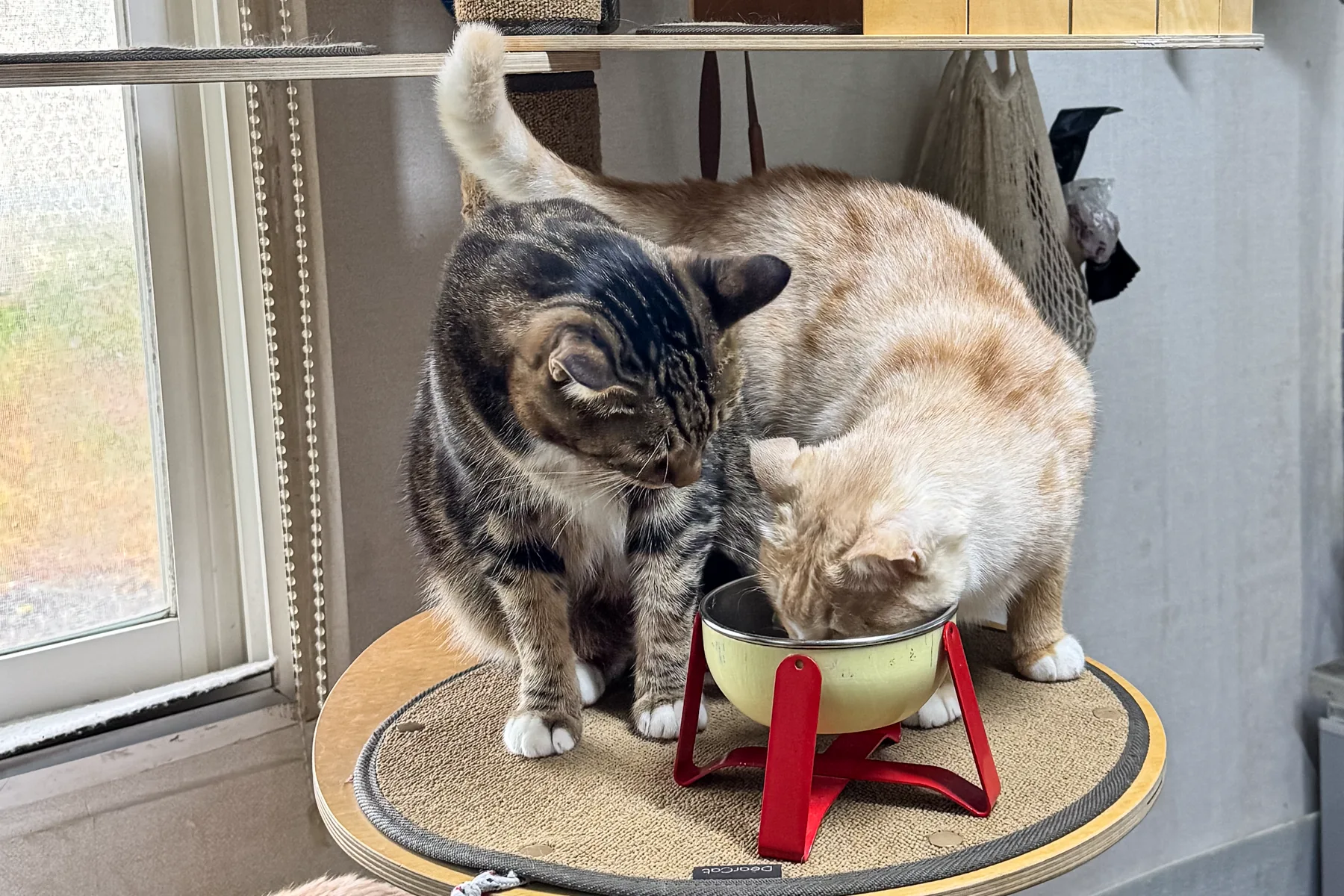
In our kitchen, five cats and a dog eat at the same time. Fooku and Kant eat on the high platforms of the cat tree, David on the platform below them, Nori and Witty on the floor, and our dog Hodu beside the dining table. Every bowl has an owner, and every spot is fixed. Still, having a bowl doesn’t mean everyone always eats exactly their own share.
The last to finish is Kant. It feels to me like he eats several times slower than the others. Nori is the opposite. He empties his bowl at the speed of light and heads for the bowl of another cat who is still eating. By then, Kant’s bowl still holds plenty of kibble soaked in broth. So I can’t leave the kitchen until Kant has finished and the meal is completely over. This is why managing food portions for multiple cats is hard: I can’t trust that the amount I put in a bowl is the amount that goes into that cat’s mouth.
First, here is how we do it in our house. Every morning, I weigh each cat’s daily dry food on a scale, put it in a container with that cat’s name on it, and divide that amount into four meals a day. I let the slow eaters start first, and I stay nearby while they eat. If Nori eats another cat’s food, I stop him, then take the amount he ate from what is left of Nori’s food for the day and put it back in the bowl of the cat who lost it. I never give one cat’s leftovers to another.
And I weigh the cats, record the numbers, and use the trend to judge again whether each daily amount is right. Even so, I can’t say I know exactly how much each cat actually eats. They sometimes leave food, and I correct for stolen food by eye. I also don’t calculate total daily calorie intake, including treats and broth. This post is our household’s record, limits and all.
Starting from the Feeding Guide on the Bag to Find Each Cat’s Daily Baseline
It starts with the food bag. I find the daily amount recommended for the cat’s age and weight and use it as the starting amount. That is as far as I rely on the bag. A cat’s weight is affected by activity level, metabolism, sex, whether the cat is spayed or neutered, age, and even the season, so I don’t expect the number on the bag to fit each individual cat as it is.
At first, I sometimes fed the amount recommended on the bag, and sometimes gave a little less dry food to make up for the treats I gave. Later, I kept the type and daily amount of treats constant and watched how their weight changed. When, after a few weeks, I find a daily amount at which a cat’s weight barely changes, I write it down as that cat’s baseline. For me, finding this amount is what matters most. I look at the trend rather than any single reading. I don’t react to ups and downs of around 100 g; I watch to see whether a similar weight shows up two or three times in a row.
I adjusted portions in small steps. If a cat I had judged to need weight loss stayed at the same weight for a while, I considered cutting a little more; if the weight was already going down, I didn’t cut further and watched the trend. Each change was usually 5 g. Rather than cutting a lot at once, I wanted to reduce gradually and watch how the weight changed. This is not a veterinary-validated procedure, just the approach I chose. I also don’t conclude that the current amount is too little just because the cats beg for more food. I tried to adjust portions by watching changes in their weight and body shape.
As of November 2026, the daily dry-food portions I set are: Kant 40 g, Fooku 45 g, Witty 50 g, Nori 50 g, and David 45 g. These are the standards we set at home after watching each cat’s weight changes and daily life. Every cat needs a different amount, so these numbers can’t be applied as they are to other cats.
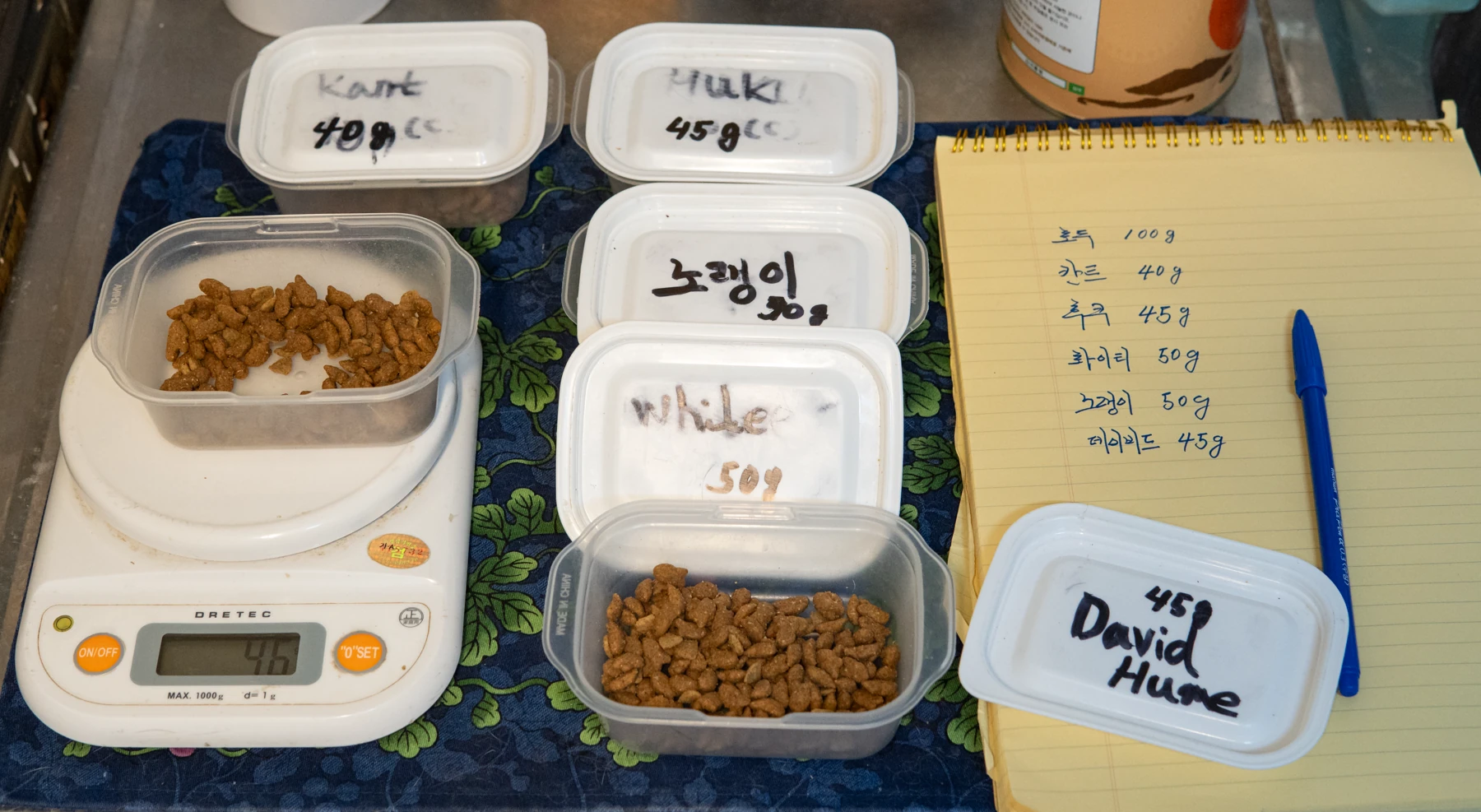
David’s goal is different from the adult cats’. For a cat who is still growing, I can’t use an amount at which his weight stays the same as the baseline. After David joined us, I gave him 50 g a day, then cut it to 45 g in early October, when he reached 3.0 kg. The aim was to keep his weight from rising too quickly. My reference point was Nori. When Nori weighed 3.0 kg, about what David weighs now, I was giving him 40–45 g. That was the amount I gave, not the amount Nori actually ate. Behind this was a guess: since David is Nori’s younger brother, perhaps he would grow in a similar way. Of course, being Nori’s younger brother is no guarantee that his growth rate or calorie needs are the same, so this was simply my judgment at the time.
On November 2, David weighed 3.1 kg. If his weight stays about the same, I’m considering adding the 5 g back, and I plan to keep adjusting his amount as I compare his weight trend with how Nori’s and Witty’s weights increased. Whether 45 g is enough for David still needs to be confirmed. Fortunately, David’s body condition score (BCS), which I rated on a nine-point scale, is about 5, so for now he looks neither thin nor overweight. Still, that alone doesn’t tell me whether his current amount is enough for a growing cat like David.
Four Meals a Day: The Order for Feeding Fast and Slow Eaters Together
Each morning, I weigh out the daily dry food for Hodu and the five cats one by one and put each portion in a plastic container with the name written on it in marker. At every meal, I take that meal’s share from the container by hand, without weighing, and put it in each bowl. Everyone, Hodu included, gets the same split: roughly 35% of the daily amount in the morning and again in the evening, a small amount in the afternoon, and whatever is left at night. The amount at each meal is approximate, but the daily total is the same every day. The times aren’t strict either—roughly 7:30 a.m., 2:45 p.m., 6:30 p.m., and 9:10 p.m. I aim to finish the morning feeding by about 7:50.
I consider the order in which I set down the bowls very important. Kant and Fooku, the slow eaters, get their bowls first, followed by David, the youngest; Hodu, our Shiba Inu; and then our two competitive eaters, Witty and Nori. Nori comes last. In practice, the order in which they finish is: Hodu first—she has been on a diet for a long time—then Nori and Witty at almost the same time, then David, then Fooku. Kant finishes long after the rest. He gets his bowl first and the smallest portion, yet he is the last to finish.
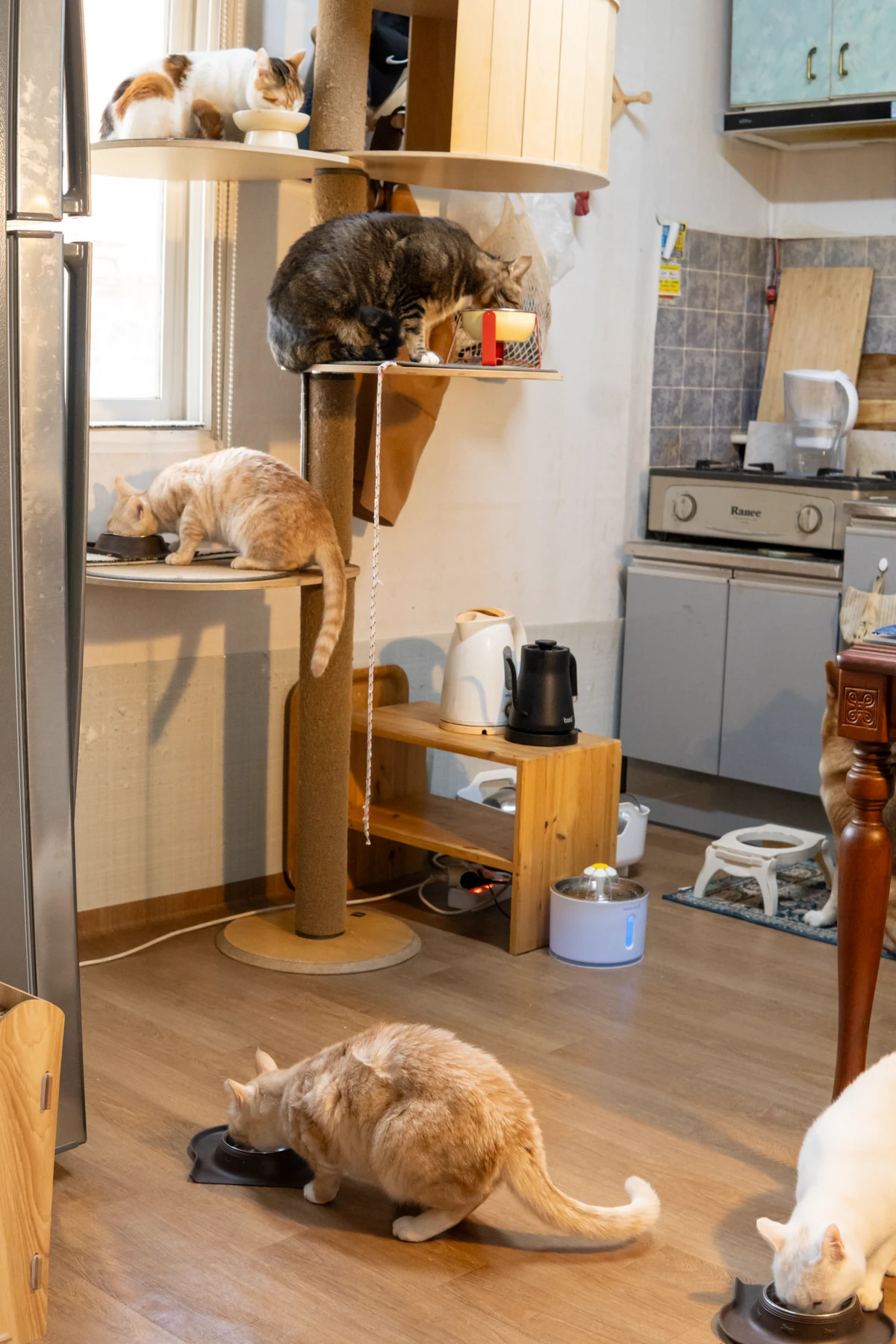
From the moment Nori finishes his broth meal, I’m on alert. I watch to keep him away from the bowls of the cats still eating, including Witty, who eats right next to him, and if he tries to go, I stop him right away. Around the time Fooku finishes, I hand out three pieces each of Jeoyo Jeoyo, a Korean cat treat I jokingly call the country’s national snack—or rather, its national cat snack—in the order Fooku, David, Witty, Nori. Next come dental treats, which are said to help with dental care, in the same order. Hodu gets a small treat of her own and, last, a dental chew. By this point, everyone except Kant has finished eating.
Even then, a good amount of broth meal is still left in Kant’s bowl. I keep watching so that Nori and David can’t get near it. When Kant finishes, I give him the same treats as the others. I don’t know when it started, but Kant doesn’t eat treats well if I put them in the bowl he has been eating from, so I put them on a small, clean plate. With that, the whole meal is over, and I do the dishes.
What Do I Do When One Cat Eats Another Cat’s Food?
Nori eats fast. Once his bowl is empty, he goes to the bowl of a cat who is still eating. Witty eats fast too, but he doesn’t eat other cats’ food. That is where he differs from Nori. David is at a stage I call “snatching practice.” After eating his own share, he shows interest in other bowls and sometimes goes over to them, but he isn’t as bold as Nori.
Kant is the one I worry about most. By the time Nori empties his bowl, the others besides Kant have mostly finished, so not much is taken from their bowls. Kant’s bowl is a different story. There is still a lot of food in it at that point. When Nori starts eating from Kant’s bowl, about five seconds later Kant hisses and swipes with his paw. On the occasions when my attention has drifted elsewhere, this is usually about when I notice and stop Nori. If Nori doesn’t stop even after the warning, Kant sometimes gives up the bowl and backs away. I stay close to prevent this. Whether this behavior has anything to do with hierarchy among cats is something I covered in a separate post.
I often notice after Nori has taken just one bite. I then estimate by eye how much he ate, and right then I take that amount from Nori’s container and add it to the bowl of the cat who lost it. If Nori ate Kant’s food, I take that much from Nori’s remaining food and add it to Kant’s bowl. I don’t put it off until the next day; I balance the set amounts within the same day. It feels like retribution for Nori’s injustice, which I find rather satisfying—though Nori himself shows no sign of having suffered any psychological blow. On paper, both cats’ daily amounts are preserved. Only on paper.
It isn’t precise measurement. I don’t weigh how many grams he ate; I correct it by eye. There has hardly ever been a time when Nori ate so much that I couldn’t correct it by eye. Sometimes, when I turn away briefly to do something else, like washing dishes, Nori eats from someone else’s bowl, but because I’m close by, I usually catch it quickly. Most of the time, I watch closely from right beside them. Kant is losing weight right now and eats only a small amount, so losing even part of that would be a problem. And above all, wouldn’t that be pitiful?
Why I Don’t Give Leftovers to Another Cat
Fooku leaves food only occasionally, roughly once a week. When she leaves some of her broth meal, she eats almost all the broth and leaves only the dry food that was mixed into it. How much she left varied with the type of food.
Here is how I handle leftovers. If she leaves some when I have given only dry food, I keep it and offer it to Fooku again. Dry food soaked in broth I don’t keep; I throw it away. Either way, I don’t give what Fooku leaves to another cat.
Whether Fooku walks away from her bowl because she is full or because another cat has come near differs from one time to the next. In the past, when Nori or David pushed his head into Fooku’s bowl, she would escape to the top of the refrigerator, and when I put her bowl up there, she would eat again.
I used to let Kant eat what Fooku left. That went on for a while, before we moved to the countryside. During that time, Kant gained a lot of weight, and his belly began to sag. I believe that my neglect in letting Kant eat Fooku’s leftovers contributed a great deal to his weight gain. Still, growth, activity, and his food were also factors, so I can’t say that was the only cause. Now I have one rule: I don’t give one cat’s leftovers to another cat. It isn’t that I don’t mind wasting food I prepared with care. It is to protect the daily amount I set for each cat. Once eating another cat’s leftovers enters the picture, there is no way to tell who ate how much. The baseline gets contaminated. In other words, the daily amount I set in the morning is no longer an accurate baseline.
Feeding Them Separately Was Easier, but I Didn’t Keep It Up
Meal prep is the most hectic part. In the morning, I weigh each cat’s daily dry food on the digital scale and put it in their containers. Then I warm the broth and divide it into bowls, and take the dry food from each daily container. While I’m doing all this, Nori, Witty, and David rush at the food. Thanks to those little rascals, food often gets spilled, or kibble from the containers ends up on the floor. When the same cat charges in about three times in a row, I put him in the space between the front door and the inner door for a while and carry on.
For a while, I used this method at mealtimes too. When a meal began, I had Nori eat in the space between the front door and the inner door. It made things much easier to manage. There was also a time when I had Kant eat alone in another room, away from Nori. To my eyes, Kant ate more comfortably. With fewer places to watch, it was honestly easier for me too. Even so, I no longer use either method.
I felt sorry about “isolating” the cats at every meal, and that brought a mental burden with it. There were practical reasons, too. The front door just past the inner door, where Nori ate, is usually left open, with only the screen door closed. That spot was in full view of the cats outside. At the time, Nori’s mother was watching it. Rather than the heartwarming sight of her child eating, wouldn’t it have been mostly despair—delicious-looking food right in front of her that she couldn’t eat? I can’t know what a cat feels, so this is only my imagination. Moving Nori there and bringing his bowl, and moving Kant to another room, closing the door, checking that he had finished, and then bringing him treats twice—all of it was a hassle.
So I stopped, and decided instead to stay by the cats for the few minutes they eat, watching over them like a proper cat butler. I didn’t give up feeding them separately because it didn’t work. It was a compromise between what is easier to manage and what doesn’t weigh on my mind. I still sometimes set a cat apart briefly when it gets in the way while I’m preparing food. What I stopped was keeping cats apart for the whole meal, at every meal.
There is an easier way to stop them. If I switch on the head of my Dyson vacuum and make a loud noise, the cats that were charging in run off. I don’t even have to pick up Nori, Witty, or David and move them myself. But to me this also feels like a threat, so I’m reluctant to use it. I’m still looking for another way.
Weighing the Daily Dry Food Didn’t Tell Me Every Calorie
I weigh the dry food every day, but I don’t handle everything they eat that way.
Instead of weighing treats or measuring their calories, I give nearly the same kinds and numbers every day. Jeoyo Jeoyo: three pieces per cat each time, four times a day, 12 pieces in all. At one point I gave every cat five pieces each time, but I decided that was too many and cut back to three, starting with Kant, who is on a diet. Now all five cats get three. Dental treats are given twice a day, in the morning and at the late-night meal. I don’t count them exactly; I give them by hand, about 10 per cat each time.
The morning broth meal is made by boiling chicken breast, cabbage, carrot, and zucchini. I divide the broth into portions and freeze it, then thaw and warm it in the microwave each morning. I add a little more chicken breast, put about 35 g per cat in each bowl, and soak the dry food in it. I don’t always weigh the 35 g, either. Usually I estimate it with a ladle. Hodu, of course, walks off with far more than 35 g.
I don’t calculate each cat’s total daily calorie intake. I don’t go out of my way to find the numbers that calculation would need, either. I don’t weigh treats, and I don’t work out the calories on the labels against what they eat in a day. I don’t know how many calories are in the broth, the amount Nori steals and I correct is an eyeball estimate, and how much Fooku leaves changes from day to day.
So instead of filling the unknowns with numbers, I keep what I give the same every day. I weigh the dry food the same way, and give the same kinds of treats in roughly the same numbers. Then I look at how the result shows up in their bodies through their weight. I can’t say this is the same as feeding by calculated calories, and it is hard to call it scientific. Still, this way of managing weight—watching the long-term weight trend and adjusting amounts to match it—seems to be working for our cats.
Looking Back at the Weight Records and Readjusting Kant’s Portion
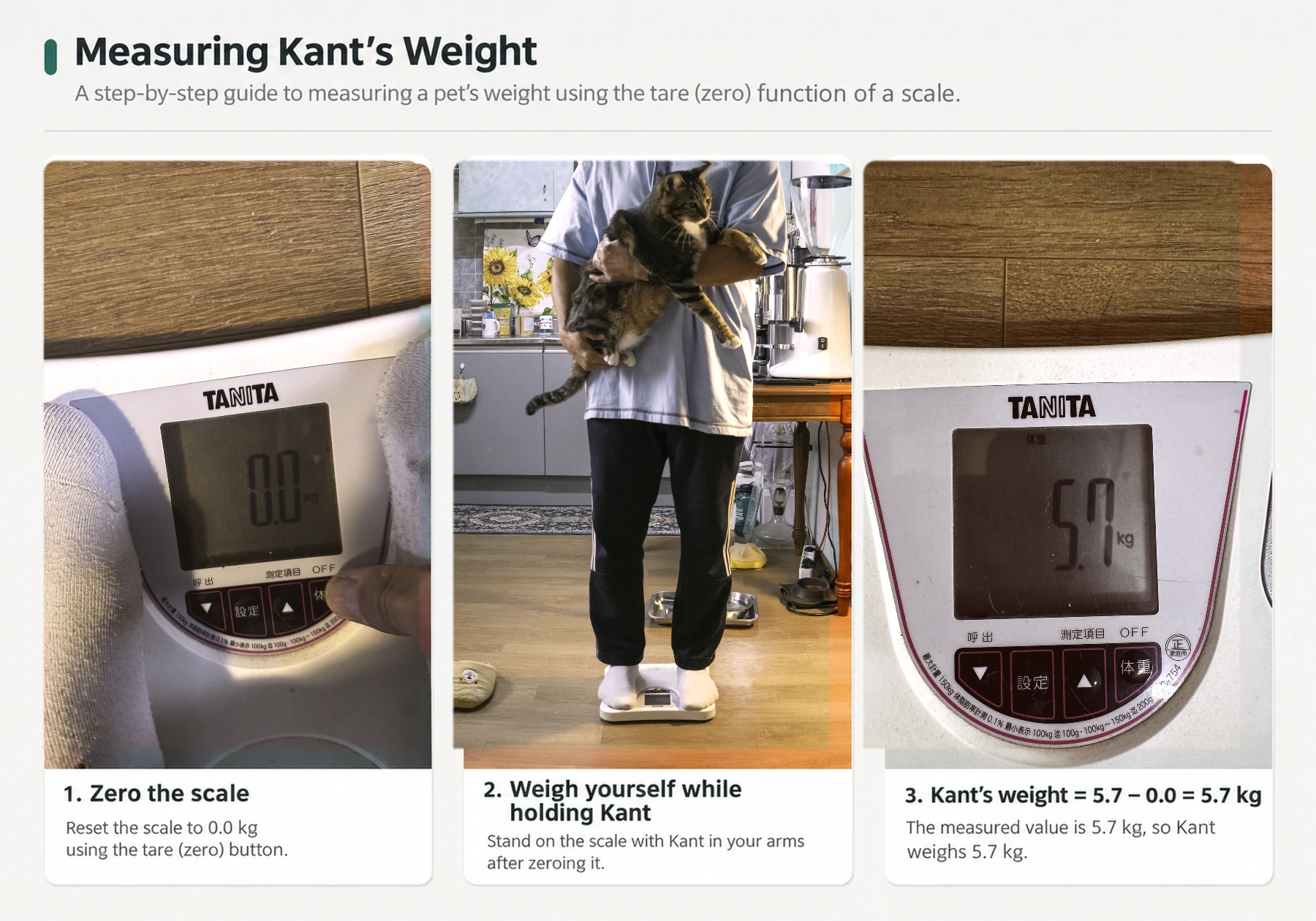
I weigh the cats on a digital scale with a zero function. First, I step on the scale myself and press the zero (tare) button, which sets my weight as 0 kg. When I step back on holding a cat, the display shows only the added weight—that is, the cat’s weight. At the vet clinic, the scale wasn’t easy to use because the cats moved around or climbed off. That is why I have kept this scale instead of throwing it out, even though I also have one that measures body fat. To reduce error, I weigh them before breakfast under the same conditions whenever possible. I decided to weigh them about every two weeks, but after we moved to the countryside, caregiving work pushed it aside and there were stretches when I didn’t weigh them, so the intervals between records are uneven.
Kant’s records begin with 1.2 kg, scribbled any old way on a handwritten board on September 22, 2024. On October 10, 2025, he weighed 5.2 kg, and on March 19, 2026—about 20 days after we moved to Goesan—he weighed 6.0 kg. After the move, Kant’s belly was visibly sagging.
After March 19, Kant’s next record is May 7. I didn’t weigh him for a while in between. The 6.2 kg (13.7 lb) on May 7 is the highest value in Kant’s weight records. More than a little shocked, and feeling sorry for Kant, I cut his daily dry food from 60 g to 55 g starting that day. Until then I had also been giving him quite a lot of treats without any real rule, but around that time I began cutting back on the types and amount of treats and keeping them consistent. At the time, four cats lived indoors with us: Kant, Fooku, Nori, and Witty. David joined us in September, so he wasn’t part of the May decision.
After that, I reduced his dry food to 50 g around the end of June, 45 g in mid-August, and 40 g at the end of September. Here is how Kant’s weight changed.
| Date (2026) | Kant’s weight (kg) |
|---|---|
| May 7 | 6.2 |
| June 7 | 6.2 |
| June 17 | 6.1 |
| June 28 | 6.2 |
| July 14 | 6.2 |
| July 31 | 6.1 |
| August 13 | 6.2 |
| August 21 | 6.1 |
| September 9 | 6.0 |
| September 23 | 5.9 |
| September 30 | 6.0 |
| October 5 | 5.8 |
| October 16 | 5.8 |
| October 25 | 5.8 |
| November 2 | 5.7 |
From May 7, when I started cutting his dry food, through August 21, his weight moved between 6.1 and 6.2 kg. In September, readings of 6.0 kg and 5.9 kg appeared. That was before I cut him to 40 g. On September 30, he was back at 6.0 kg. I took the changes of around 0.1 kg in August and September as temporary ups and downs or measurement error, and only when I saw 5.8 kg on October 5 did I judge that his weight was clearly going down. He stayed at 5.8 kg through mid- and late October and was 5.7 kg (12.6 lb) on November 2. That is a drop of 0.5 kg (1.1 lb), about 8%, from 6.2 kg on May 7.
I can’t say this loss was the result of the 40 g of dry food alone. Going from 60 g to 40 g means the weight of his dry food fell by 20 g, about a third; it doesn’t mean his calorie intake fell by a third. During the same period, I cut back his treats; from late June to mid-July, there was a stretch when I mixed his food with another product; and Kant’s daily life changed too. After the move and after Nori and Witty joined us, Kant spent more time alone and more time lying down, and he played with Fooku and groomed with her less. Instead, he began coming to me to be held more often, and that still continues. I suspect that his lower activity may be one reason his weight didn’t come off easily for a while, even after I cut his portions.
On the nine-point body condition score (BCS), I rate Kant a 7, which falls in the overweight range. It isn’t a score from a veterinarian; I gave it after reading a BCS guide and then looking at and feeling Kant’s body. For reference, the World Small Animal Veterinary Association (WSAVA) provides a nine-point body condition scoring chart for cats. I haven’t consulted a vet about his weight management. That means no one has confirmed whether this method, or the pace of his weight loss, is medically appropriate for Kant. The weight-control method in this post is entirely my own record, a way I found through my own experience. In particular, I hope readers won’t take David’s 45 g a day or Kant’s rate of weight loss as the right amount or a weight-loss standard for other cats. If it becomes clear that his weight has plateaued on the same amount, I’ll consider cutting a little more; if he keeps losing, I won’t cut further and will keep watching.
I have weighed Hodu the same way. She went from 15.2 kg on May 7 to 14.0 kg on November 2. The story of Hodu, our Shiba Inu, is beyond the scope of this post, so I’ll leave it there.
Why I Look at Weighing, Watching, and Weight Records Together
My method is to layer three things. Weighing tells me how much each cat was given in a day. Watching lets me estimate whose mouth that food went into—though because I correct for what Nori steals by eye, that part isn’t precise. Weight records show how what they ate turned up in their bodies. Those results also contain the treats and broth I didn’t weigh, along with the errors of my eyeball estimates. So none of the three alone can tell me how much each cat actually ate. Only by putting all three together can I separate what I know for sure from what is just an estimate.
This method takes time. The meal itself is over in about five minutes, but with prep, treats, watching until Kant finishes, clearing the bowls, and washing up, it takes much longer. My goal is to get from the meal through the dishes in under 20 minutes, but it isn’t easy. In the morning, I first take care of the broth meal for the cats outside, then come in and start the first meal for the indoor crew, so there is even more to do. The most tiresome part is when the cats rush the food while I’m preparing it. Chasing them off with the sound of the vacuum makes me uneasy, so I rarely do it. But that doesn’t mean I’ve found anything to replace it.
The easiest way to manage things and the way that sits right with me haven’t always been the same. Keeping each cat apart at every meal was easy, but it weighed on me, so I stopped, and now I stay by them for the whole meal. Even so, I haven’t stopped weighing. I believe it is clear that without measuring, I can’t manage their weight. Only by measuring and recording can I decide how to manage things from here. Looking back, I think I should have kept a closer, steadier eye on Hodu’s and Kant’s weight earlier. There must have been things I missed while they were putting on weight. Considering the health problems that being overweight can cause, I intend to manage it more carefully, even now.
Even in a home with just one cat, you can do the same things: weigh the food, keep treats consistent, and record weight. When several cats live together, one more thing is added: you have to watch even the mouths heading for another cat’s bowl. I can’t perfectly protect each cat’s share, either. Still, every day I weigh out the daily portions, watch over mealtimes, and open the weight records again.
As long as there is broth meal left in Kant’s bowl, I still can’t leave the kitchen. ■