
How Do I Manage Three Outdoor Cat Feeding Stations?
Changing my hygiene routine and preparing for winter
I feed street cats in three places. The main feeding station is under the eaves at the entrance to my house; the other two are at a neighbor’s house at the top of the alley and at an empty house up the next alley. It wasn’t three places from the start, and I didn’t always look after them the way I do now. Only in late summer 2026, after kittens fell ill and died one after another, did I start looking hard at the bowls and water I’d been putting out. How I came to feed these cats in the first place is a story I’ve told in an earlier post. This is a record of what came after: how I actually run the feeding stations, and what I’ve changed.
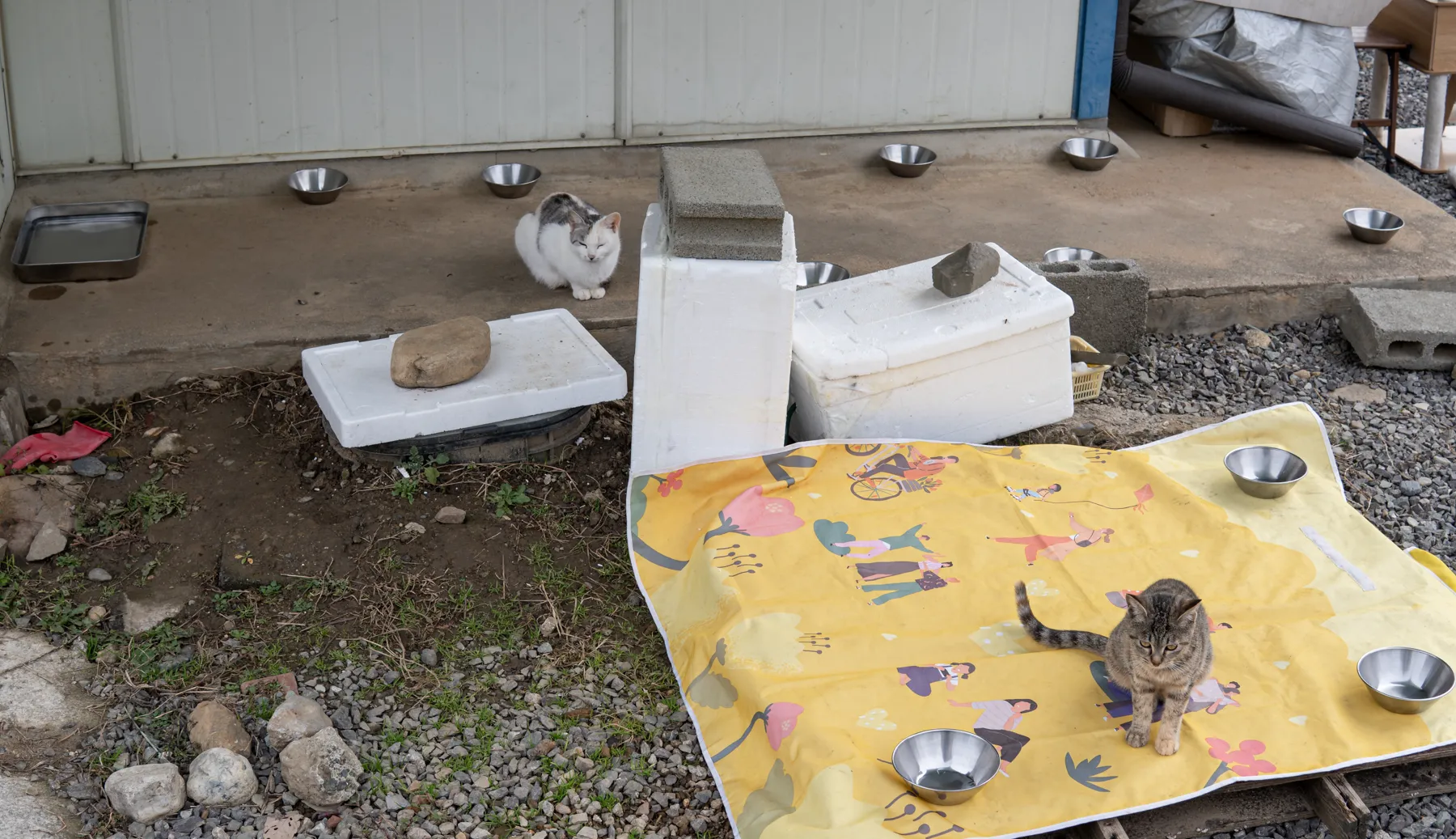
Here is my routine as it stands. At the main station, the food bowls are washed with detergent and a scrubbing sponge at least three times a day and dried indoors. At lunch and dinner, I take up the bowls about 30 minutes after feeding; at breakfast, about an hour after. Whatever food is left goes in the trash. For the shared water, I rotate two stainless-steel trays and change the water three times a day. I space the bowls so the cats can eat at a distance from one another, and I look for spots that keep them out of the sun in summer and out of the rain and snow in winter. I’ve also learned that when a cat looks sick, washing with detergent may not be enough. That’s a principle I learned late, from reading up on the subject. None of this is the right answer. It’s simply where my changes have brought me so far, and it will keep changing.
What Made Me Change My Routine
Until this summer, I usually changed the water once a day and washed the food bowls only once a day. The shared water bowl was a pink plastic basin. I made no special effort to keep things clean.
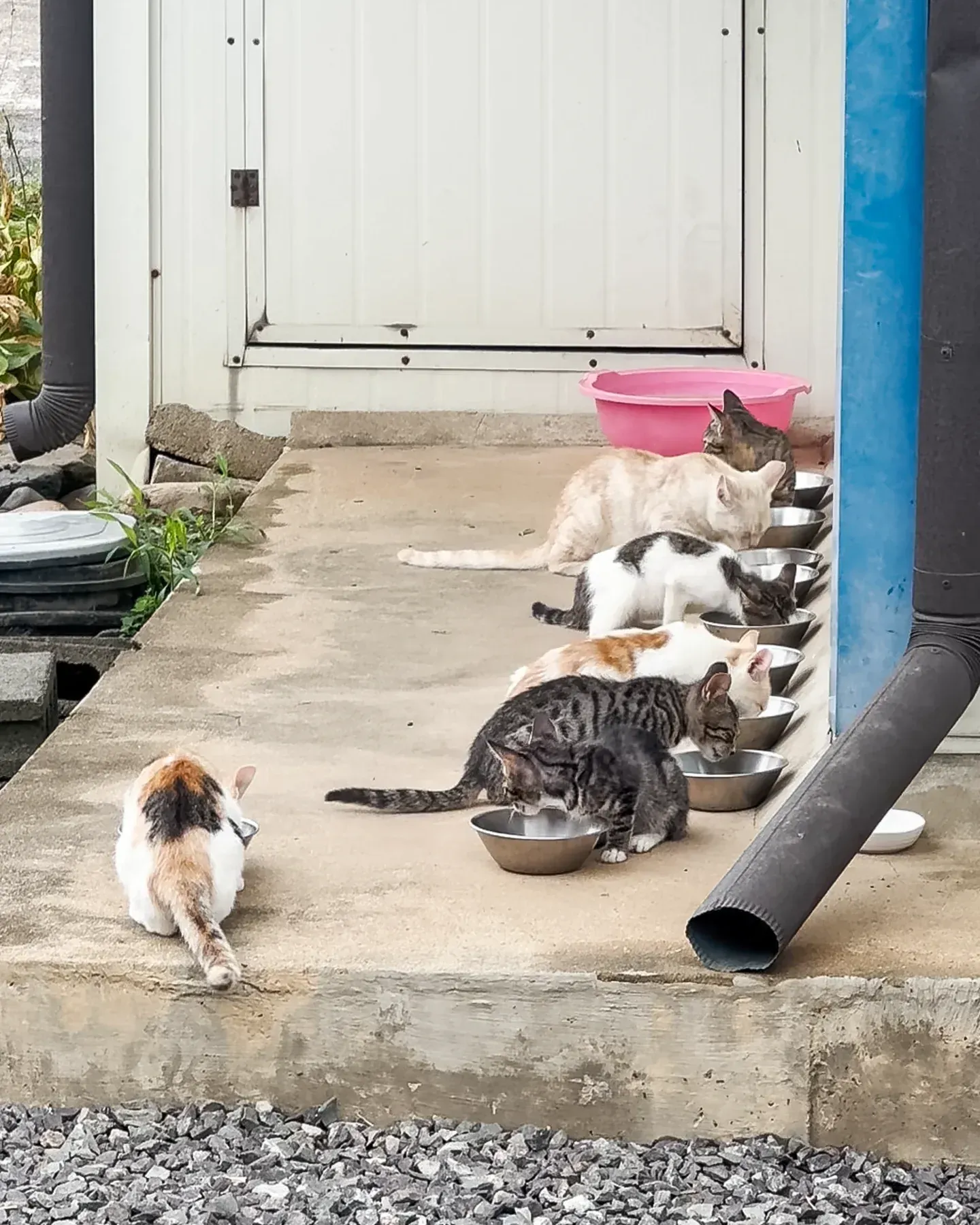
By August, I noticed that the many kittens around were dwindling, one by one. These were the kittens who had tumbled through the neighborhood wrestling with their siblings and scampered off, adorably, whenever they saw me.
Then, in late August and early September, just as the kittens were starting to leave their mothers’ sides, sick ones suddenly turned up everywhere: listless kittens who no longer ran when they saw me. I took some of them to the vet and nursed them at home, but most didn’t last 48 hours. One died in the car on the way to a clinic in another county. At almost the same time, the kittens who slept and played together in my own front yard fell ill, one after another. Of Jacksooni’s three kittens, the small, weak one (I never got to give that kitten a name) was the first to stop eating, and soon after, Daon and Sticky stopped eating at almost the same time. They sat hunched in the loaf position, then began to hide. After that, Hanna and then David fell ill. The small, weak one was also the first to disappear, and later came back to a favorite spot in my yard, where I found the kitten dead. All over the neighborhood, kittens were dying. Some I watched die or found dead. Some vanished while sick and were never found. And some, like Jacksooni’s kitten Sticky, went missing and were found only much later. In October, while digging up sweet potatoes, I found Sticky at the edge of the vegetable patch. It was where Sticky had often played and rested with the rest of the litter. Jacksooni, their mother, often sat nearby.
During that time, which I came to call the dark weeks, it occurred to me that the food bowls and shared water I was using might have become a pathway for disease. At times I was gripped by the fear that my feeding of street cats was the cause of the kittens’ deaths, or one of the causes. I asked the vet who had examined them, and afterward I read up on the subject quite thoroughly. My heart pounded as I read. Part of me, hoping it couldn’t be so, was looking for an excuse for what I had done. But what mattered more was this: if it had happened through my mistake, I had to make sure I didn’t repeat it with the kittens yet to be born, or else stop feeding street cats altogether.
After all that reading, this is the conclusion I came to. Infection through a water bowl is clearly possible. But I found no grounds for saying the shared water bowl was the main cause of those deaths. Things were not calm enough at the time to have the sick kittens I took to the vet tested for the pathogen. So what the disease was, how it spread, and how much my feeding station had to do with it, I still can’t know. Nor can I say the bowls played no part at all.
What I could do right away was keep the bowls cleaner. Around the time I took David and Hanna to the vet for treatment and began nursing them indoors, I started washing the bowls three times a day and changing the water three times a day. From September, I added more stainless-steel food bowls and changed the water anywhere from three to five times a day. After that, looking for a lower, wider water bowl that Daon and Aegiya could drink from easily, I found a stainless-steel tray at Daiso, and I’ve been using it since October 21.
Where and How I Place the Food Bowls
The main feeding station is the concrete floor under the eaves at the entrance to my house. When it rains, the area around it stays relatively dry, and even at midday part of it is in shade. There are about eleven food bowls in all. Eight or nine go under the eaves and two or three on the ground in front. I leave roughly 50 cm (about 20 inches) between bowls, and more out on the ground. The idea is to let the cats choose for themselves where to eat. That spacing is simply the distance I’ve found for our cats in this space; it isn’t a standard that fits everywhere.
I space the bowls because some cats don’t like to eat close to one another. Even with an empty bowl free, some hesitate to approach it if it means getting too close to the cat beside it. Aegiya especially. Aegiya is often picked on by Boksuni, a cat who has recently started coming to eat, and by Jacksooni, who has lived in my yard for quite a while. So Aegiya sometimes skips mealtime altogether, or hangs around nearby and comes in to eat only after the other cats have finished and left.
When I choose a spot, sun and rain aren’t the only things I consider. In summer, the sun grew strong from the afternoon on, so I moved some of the bowls to follow the shade, and the shade fell along the alley outside the house. I didn’t like having the feeding spot move around, and I was also conscious of the neighbors. On top of that, the neighbors’ cars and trucks came and went along that alley, and delivery trucks came through often. Most of the parcels were mine. I worried a great deal that there might be an accident. Having shade didn’t make it a good spot.
What I Do with Leftovers and Used Bowls
Each of the three places is managed differently, because how much responsibility I can take for each place is different.
Here is how it came to be three places. At the house at the top of the alley lives a woman who was feeding the neighborhood cats long before I moved here. She would pour food into a few bowls, large and small, in the morning, and the cats who live at that house and cats from around the area would come by to eat. She told me that Nori and Witty, too, used to eat there before they came to live with us. Ippeuni, who lives in an empty house nearby, sometimes comes to eat there as well. At first I dropped by only now and then, at lunch or dinner when she wasn’t home. But after she started working in another county and could no longer feed them in the evening, I began going up every day at lunch and dinner. Ippeuni, who lives in the empty house up the next alley, is a cat who used to come to my house to eat now and then from early on. Since I found out where she lives, I go to her on the days she doesn’t come to me. Why I go as far as places that aren’t my own house, I honestly can’t say. It simply comes down to a bond. And my bond with Ippeuni came about purely by chance. Just as you sometimes meet someone for the first time and feel drawn to them, that’s how it was when I first saw Ippeuni, though there was nothing particularly remarkable about her.
The main feeding station at my house. At lunch and dinner, I take up the bowls about 30 minutes after feeding; at breakfast, about an hour after. Breakfast takes longer because after feeding the cats, I feed Bokdaengi, a neighbor’s dog, and then take Hodu on her morning walk. I gather up the leftovers and throw them away. Since the weather turned cold, I’ve been taking the used bowls inside, washing them with detergent and a scrubbing sponge, and drying them indoors. These days I do this three times a day.
The neighbor’s house at the top of the alley. I fill three food bowls at lunch and dinner. I supply the food, but I’m not responsible for the bowls and dishes overall. About once a week, I check on the state of the bowls and, when the mood strikes, wash them. I don’t deal with leftovers separately. By the time I come at lunch and dinner, there’s hardly any food left. I assume the cats who live there and the cats passing through eat it. When a little is left, I don’t throw it out; I pour fresh food on top. Around lunchtime, I wipe the water bowl with a sponge, without detergent, and change the water.
Ippeuni’s empty house up the next alley. There’s one food bowl and one water bowl. I feed three times a day, and if there’s food left, I throw it out before putting out more. I wash the bowls only at lunch, using the tap at the empty house just below, with the owner’s permission. I don’t wash them at breakfast or dinner.
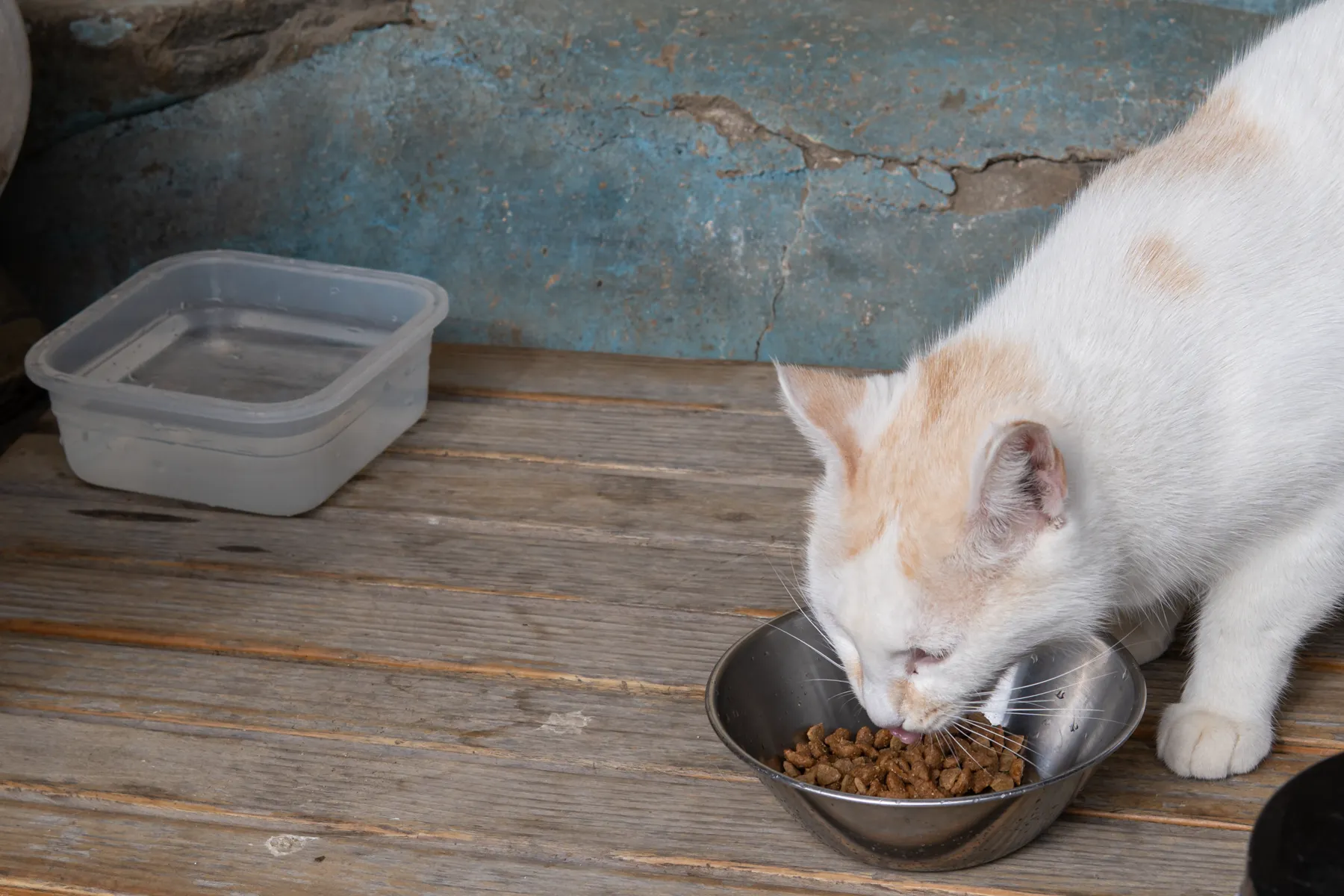
Written down like this, the gap between recommendation and my reality is plain to see. Alley Cat Allies, an American organization that works with street cats, recommends clearing away uneaten food within 30 minutes, because food left out overnight can draw insects and wildlife. That’s the advice of a private American organization, not Korean law or a standard that fits every situation. Korea’s Ministry of Agriculture, Food and Rural Affairs, too, in announcing its revised guidelines for caring for street cats in March 2026, stressed the importance of hygiene, such as keeping the surroundings clean after feeding (press release, in Korean). At my own feeding station, lunch and dinner come close to that 30-minute recommendation; breakfast runs later. The bowls at the neighbor’s house aren’t mine to decide on. I can take responsibility for the front of my own house, but I can’t change how things are done in someone else’s yard to fit my standards.
Can Shared Water Bowls Spread Disease?
At the main feeding station, there is now one water station. I rotate two stainless-steel trays. In the morning, I carry out a tray I washed with detergent indoors the day before, along with warm water, and swap it for the tray outside. At lunch and dinner, I rinse the tray with water from the yard tap, without detergent, and refill it with fresh water. The water gets changed at least three times a day.

If you ask whether a shared water bowl can spread disease, the answer is yes, it can. But the weight of that risk differs from disease to disease. According to the herpesvirus, calicivirus, and panleukopenia guidelines of the European Advisory Board on Cat Diseases (ABCD), feline herpesvirus, a common cause of cat flu, spreads mainly through the nasal discharge, saliva, and eye discharge of sick cats. A contaminated environment generally doesn’t play a large part, though places where cats are densely housed may be an exception. Feline calicivirus also usually spreads through direct contact with discharge, but it can stay infectious on dry surfaces for up to about a month, holds up well against many disinfectants, and can also spread by way of feeding equipment soiled with discharge. Feline panleukopenia virus spreads through feces, by the fecal-oral route. It can stay infectious in the environment for weeks or even months, and contaminated food bowls and water bowls, litter boxes, shoes, and clothing can play an important part in spreading it. It can be especially dangerous for kittens whose antibodies from their mother have waned.
Here is what I understood from my reading. In feline upper respiratory infections, what matters most is direct contact with sick cats, discharge spread at close range, and how densely the cats are gathered, along with the stress that brings. In intestinal infections, the key is fecal contamination. Contaminated water bowls or food bowls can play a part in spreading some pathogens. But, as I said earlier, I couldn’t confirm whether the shared water bowl at our feeding station actually spread infection last summer, or whether it was the main route.
Two things were missing from my routine. First, washing and disinfecting are different. Washing with detergent removes dirt and grease. Herpesvirus is vulnerable to most disinfectants and detergents. But panleukopenia virus holds up well even against many commonly used disinfectants. ABCD explains that proven disinfectants based on sodium hypochlorite (the active ingredient in household bleach) or peracetic acid will kill this virus. Disinfectants work less well when dirt is left behind, so you have to wash first. Dilution and contact time vary by product, so follow the instructions on the label, and rinse and dry disinfected bowls thoroughly before giving them back to the cats. Never mix bleach with acidic cleaners or cleaners containing ammonia; doing so releases toxic gas. I can’t do all this every time, and I’m not saying anyone should. But when a cat looks sick and there are signs of illness, disinfection that takes even panleukopenia into account was needed. I didn’t know that.
Second, I kept only one shared water bowl. Setting out water bowls in several places can reduce the number of cats sharing any one bowl. But how much that actually lowers the risk of infection will depend on how many cats use each bowl and how well the bowls are kept. If the extra bowls aren’t washed on time, all you’ve done is add more places for contamination. Looking after water bowls is a lot of work. Keeping several of them going through a winter when the water freezes will take far more of my resources. So I plan to add them one at a time and gauge how much more there is to look after and how much work it takes.
How My Routine Changes with the Seasons
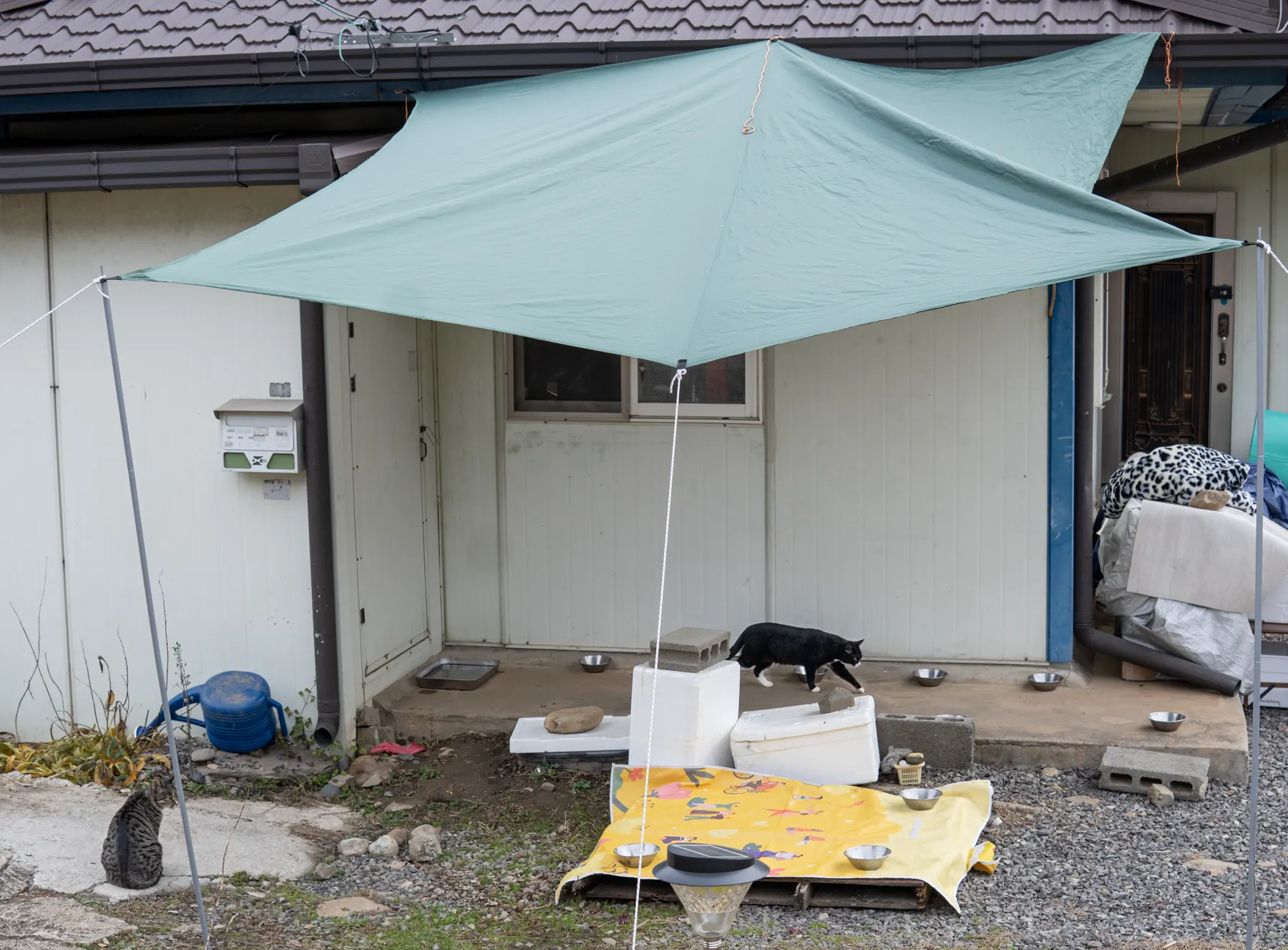
If summer’s problem was the sun, winter’s problems are rain, snow, and cold. When it rains at the main feeding station, the concrete floor and the area around it get wet, and if the rain keeps up, water gets into some of the food bowls. It also makes it harder for me to move around. At first I thought about a small vinyl greenhouse. I still think it’s a good idea, but the cats could tear the vinyl, and above all, the sensitive ones wouldn’t come into a small, enclosed space to eat together. Having no experience setting one up or maintaining it, and worrying that only some of the cats would use it, also held me back. So I changed my mind and decided to try a camping tarp first. A tarp won’t keep out the cold, but it can keep out rain, snow, and dew.
On November 13, 2026, I put up the tarp, attaching it to the eaves. When I checked the next day, rain hadn’t blown into the inner part of the feeding station or onto much of the ground under the tarp nearby. Now, even when it rains, I can put bowls not only under the eaves but also on the bare ground under the tarp in the yard, which lets me space the cats farther apart. That’s after only a few days of watching. I don’t know how it will hold up in strong wind or once snow piles up. I’m also thinking about laying something down on the ground.
Water’s problem is freezing. Since November began, the temperature on clear early mornings has started to drop below freezing. I expect mornings like these to continue for more than three months. Once the yard tap freezes, I won’t be able to wash the bowls outside. So in November I started practicing in advance. I bought one more tray to keep washed indoors, and at feeding time I carry out the water and the clean tray together and swap it for the tray that spent the night outside. I boil 1.2 liters of water in an electric kettle and mix it with cold water from a bucket. That makes warm water that’s pleasant to drink. I thought it would be nice if the cats outside could have a little warm water, even for a moment, in the depths of winter. This is something I actually do every morning now, and it’s also a way of testing the routine before the tap freezes in midwinter. I can’t know exactly how much water each of the outdoor cats drinks. But these days I often see Daon, who lives in my yard, drinking this water before and after meals. To my eyes, she seemed to like it. Once the tap freezes over, I plan to extend this indoor washing and swapping.
At night I can’t change the water. So I’m thinking of buying a heated electric water bowl that won’t freeze, and trying it. I haven’t used one yet, so I don’t know whether it’s really safe and useful, or how it needs to be looked after. I’ll find out as I gain some experience with it.
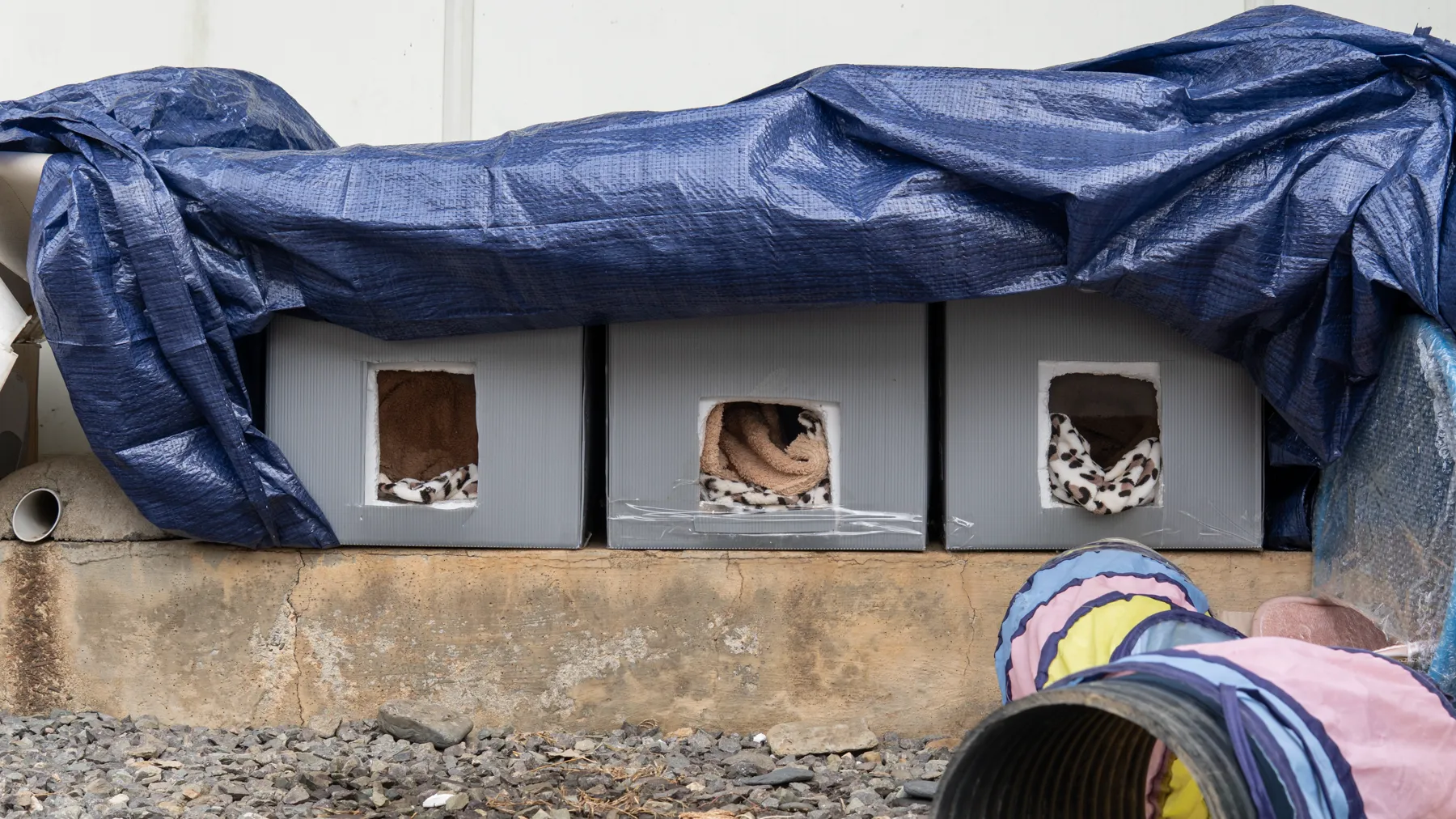
There are still things I haven’t found an answer to. Some of the cats come long before mealtime and sit waiting on the bare ground or the concrete. On mild days that’s fine, but on mornings below freezing it’s different. I’d like to give them somewhere to get out of the cold for a while, but I haven’t come up with a realistic way to do it. Keeping them warmer while they eat is even harder. I built six winter houses for the cats who live in my yard and for newborn kittens, and three of them are at my house. I set the others down, while the mothers were out, in places where newly born kittens had been spotted. I also made two makeshift shelters in the yard for the cats to rest in for a while, and Daon likes one of them enough to sleep there at night too.
Finding a Routine I Can Sustain
I prefer a way of doing things that doesn’t change over one that does. If I haven’t built a system, I get anxious. Paradoxically, though, the best way of doing things, the one that won’t need changing, can only be reached by testing changes. Once a routine settles in and gets more efficient, it passes through the stage of becoming familiar and reaches the point where it runs without my having to think about it. But even the most efficient routine isn’t static, because the circumstances it was built on change on their own. In circumstances that keep changing, there can be no optimal system that never changes.
Feeding times changed in the same way. In summer, the late snack for the cats who live in my yard came at 10:30 p.m., after Hodu’s night walk and after the animals indoors had their own late snack. It took about ten minutes to feed them, and by the time I came back inside, washed the dishes, tidied up, and lay down, it was eleven. It took me another 30 minutes or so to actually fall asleep, and getting up at 5:20 in the morning, it was hard to get even six hours. Now I give the animals indoors their late snack at 9:10, before Hodu’s walk, and the cats outside theirs at around 9:20. The cats outside wait an hour less for their late snack on cold nights, and I can get into bed before 10:30, which has added about 30 minutes of sleep. Getting enough sleep is still a problem I haven’t solved. The blame for that lies entirely with Hodu, my Shiba Inu, who will never relieve herself in the house or anywhere near it. Every eight hours or so, even if the sky is falling, I have to go out with her. Sleeping in is not allowed, and neither is an early night.
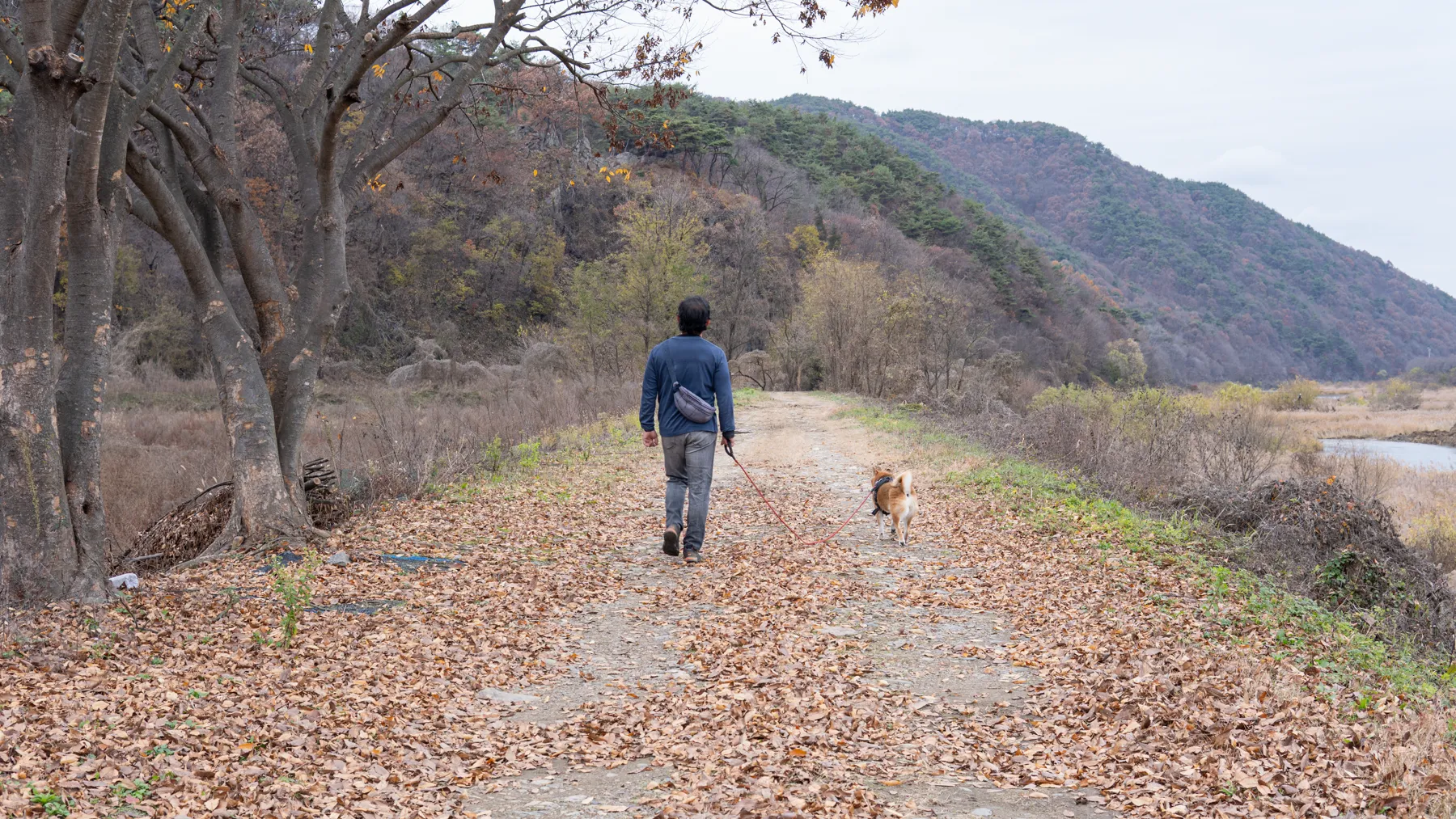
I changed the order in the morning, too. When I get back from Hodu’s walk, the cats outside usually wait by the screen door for more than 30 minutes for their broth breakfast. I used to feed the animals indoors first, but once it gets really cold, that wait will become hard on the cats outside. So, asking the indoor animals to bear with me, I started serving the cats outside first, and their wait got much shorter. The animals in the warm house can wait a little longer.
I haven’t worked it out exactly, but I spend a large part of each day walking Hodu, feeding cats, and, lately, getting ready for winter. There’s also the cost of food and treats, vet bills, and supplies for the animals inside and outside the house. I spend little on myself, so a good share of my resources goes to them. Of all those resources, time matters most. From the move until September, between setting up the house, the vegetable gardening I was trying for the first time, and caring for sick cats, I barely had a moment for anything else in my own life. There’s no farm work now, and next year I’m thinking of planting nothing at all, or only one or two crops that need less tending. These days I also take Kongi, a neighbor’s dog, along on Hodu’s lunchtime walk every day. And since an older neighbor from another house was injured, I’ve been looking after their dog, Bokdaengi, too. On top of all that came the winter preparations for the street cats, but I’ve grown used to this kind of work, and the winter preparations are nearly done.
Still, there simply isn’t enough time. Efficiency and familiarity fill some of the gap, but there is clearly a part they can’t fill. I feel bad that I have almost no time left for my family and friends. On the condition that I keep the country life I want, rather than city life, the time I spend on the animals in my house and the street cats is already close to its limit. If I don’t find a balance between the animals inside and outside the house and my own life, I may end up unable to stay with them for long. But cutting back a large part of what I do to reach a compromise isn’t the way I want to go, at least not yet. My commitment to them must now be measured anew, by how wise and how clear-headed I can be.
Living Alongside Them
Someday I will leave this house. I’m only a tenant here, and I have no plans to buy it. Next year I’ll renew the lease and stay one more year. If after that I hesitate to move and end up staying, the biggest reason will probably be the cats I’ve come to know and the bond I have with them.
If I leave, they will probably just be inconvenienced for a little while. Nothing like the longing I’ll feel will happen to them. Now and then, passing in front of this house, something might faintly come back to them; that may be all that remains for them of the time we spent together. I, on the other hand, will remember them, look at their photos, and miss them. But longing fades with time. So what is it I’m doing now? What does it mean?
I’m truly happy with the life I share with them now. It doesn’t feel like happiness I set out to achieve; it feels like happiness that followed from a relationship between us that came about by chance. When I’m close to them, building a bond, feeling things, talking with them, I’m truly happy. So I don’t really feel that I’m helping them. If anything, I’m the one who benefits. I found happiness in a chance connection with them, and all I want is to go on being happy. Nothing else explains my life here. An addiction to happiness.
For a long time, I lived by enduring the present for the sake of happiness in the future. Whenever I thought about that life, Samuel Beckett’s Waiting for Godot came to mind. The weary picture of enduring today while waiting for something that never comes seemed to overlap with the lives of people in our time who keep putting happiness off, and with my own. When I quit my job and, not long after, moved here, I told myself I would no longer put off happiness. Every day, I’m learning how to enjoy the happiness of the present moment. I’ve spent a long time turning over what happiness is, and I still can’t explain it in certain terms. Even so, living with these animals now, sharing joy and sadness and worry with them, I know that I’m happy. At the very least, I’m happier than I was before.
I worry about Nori’s Mom, her belly enormous with kittens about to be born, and I’m happy when she rubs against me. I’m proud of Daon, the little girl who grows bigger by the day and doesn’t cower even in front of the neighborhood’s top toms. I’m always full of admiration for Jacksooni, who raised her kittens devotedly even though she can’t see out of one eye, and who lost two of the three. Good-natured Ppeonppeoni, the reigning champion of cheek; Nori’s Dad, calm as a spring breeze; Witty’s Dad, serious-faced but gentle and sweet; Pink Yeppeuni’s Mom, with eyes that look rimmed in heavy mascara; kind-hearted Pink Yeppeuni; our Ippeuni, who has quite a temper but is kind to me alone; and Aegiya, the crybaby who has survived alone since babyhood. I’m simply glad that I can connect with them and see them every day.
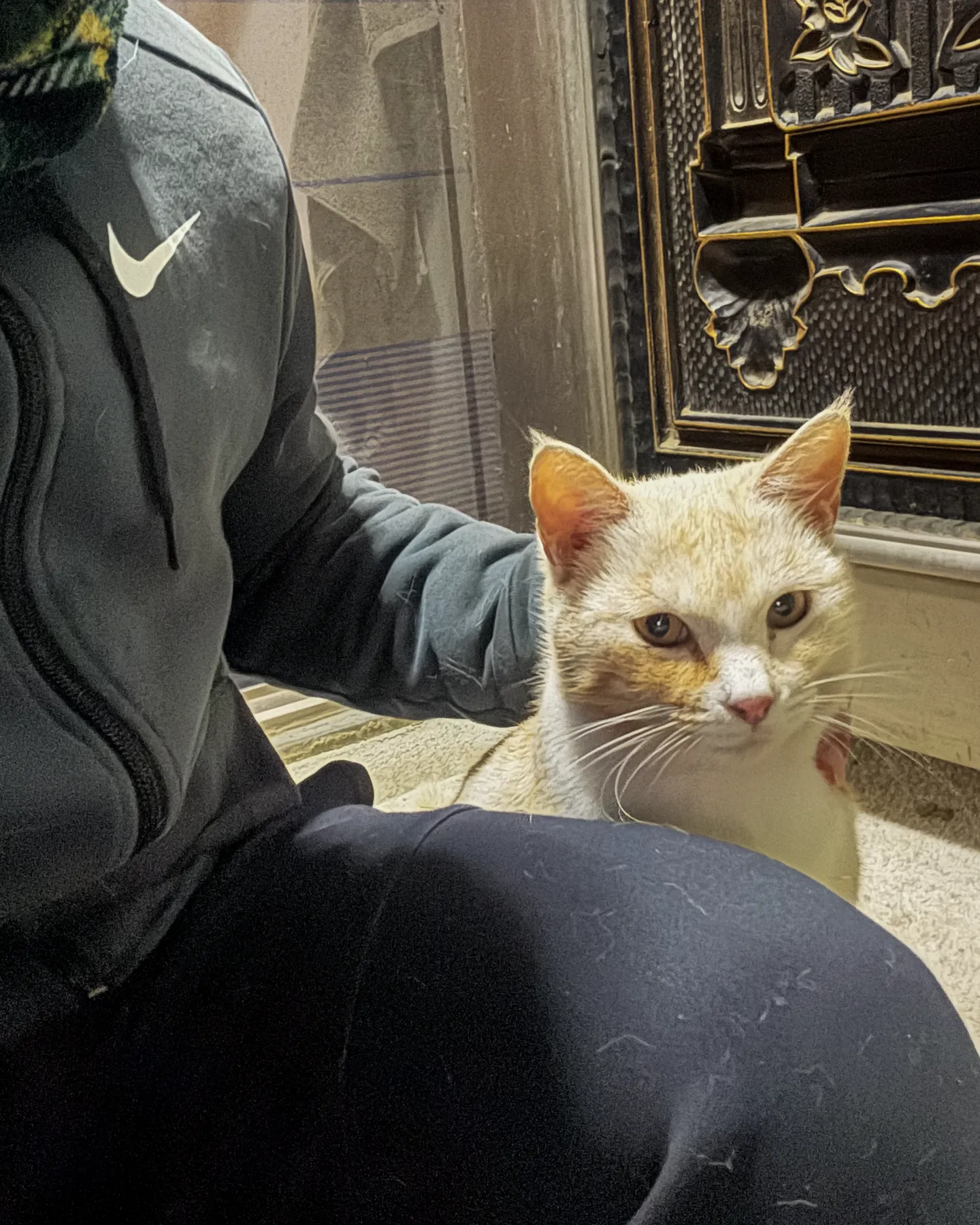
I never made them any promises. And they don’t ask me for help. So what are we? I don’t know. All I know is that we already live alongside one another. And that gives me a truly deep sense of fulfillment. ■